


Stages of change for the component behaviors of advance care planning
- PMID: 21143441
- PMCID: PMC3058883
- DOI: 10.1111/j.1532-5415.2010.03184.x
Stages of change for the component behaviors of advance care planning
Abstract
Objectives: To develop stages-of-change measures for advance care planning (ACP), conceptualized as a group of interrelated but separate behaviors, and to use these measures to characterize older persons' engagement in and factors associated with readiness to participate in ACP.
Design: Observational cohort study.
Setting: Community.
Participants: Persons aged 65 and older recruited from physician offices and a senior center.
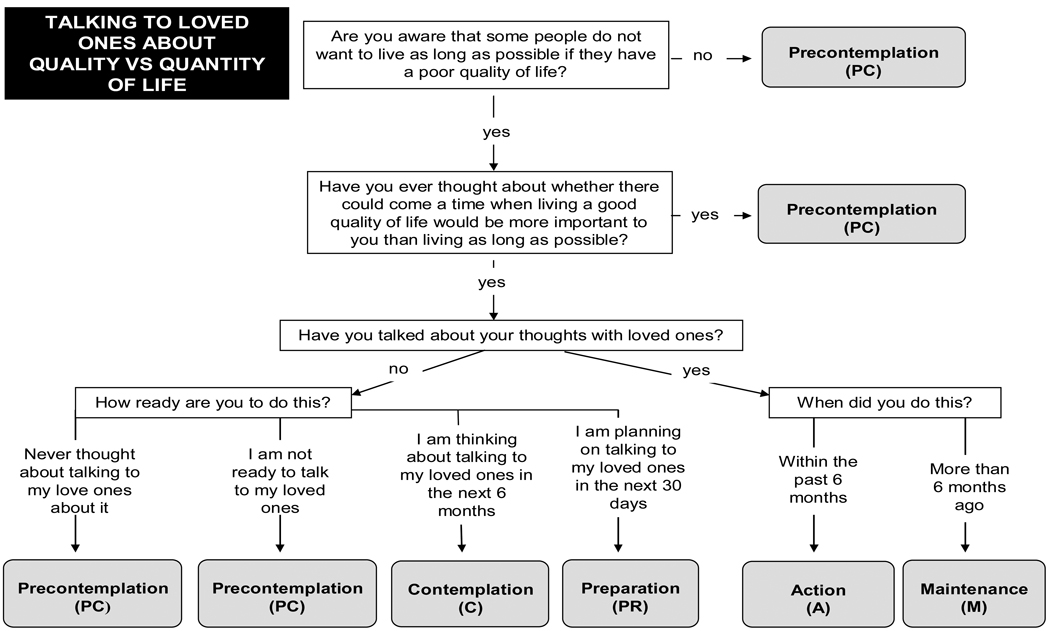
Measurements: Stages of change for six ACP behaviors: completion of a living will and healthcare proxy, communication with loved ones regarding use of life-sustaining treatments and quantity versus quality of life, and communication with physicians about these same issues.
Results: Readiness to participate in ACP varied widely across behaviors. Whereas between approximately 50% and 60% of participants were in the action or maintenance stage for communicating with loved ones about life-sustaining treatment and completing a living will, 40% were in the precontemplation stage for communicating with loved ones about quantity versus quality of life, and 70% and 75% were in the precontemplation stage for communicating with physicians. Participants were frequently in different stages for different behaviors. Few sociodemographic, health, or psychosocial factors were associated with stages of change for completing a living will, but a broader range of factors was associated with stages of change for communication with loved ones about quantity versus quality of life.
Conclusion: Older persons show a range of readiness to engage in different aspects of ACP. Individualized assessment and interventions targeted to stage of behavior change for each component of ACP may be an effective strategy to increase participation in ACP.
© 2010, Copyright the Authors. Journal compilation © 2010, The American Geriatrics Society.
Conflict of interest statement
Figures

References
-
- Fagerlin A, Schneider CE. Enough. The failure of the living will. Hastings Cent Rep. 2004;34:30–42. - PubMed
-
- Lynn J. Why I don't have a living will. Law Med Health Care. 1991;19:101–104. - PubMed
-
- Perkins HS. Controlling death: The false promise of advance directives. Ann Intern Med. 2007;147:51–57. - PubMed
-
- Brett AS. Limitations of listing specific medical interventions in advance directives. JAMA. 1991;266:825–828. - PubMed
-
- Kolarik RC, Arnold RM, Fischer GS, et al. Objectives for advance care planning. J Pall Med. 2002;5:697–704. - PubMed
Publication types
MeSH terms
Grants and funding
LinkOut - more resources
Full Text Sources
Medical
