. 2011 Jan;33(1):175-81.
doi: 10.1111/j.1460-9568.2010.07486.x. Epub 2010 Dec 12.

Associative learning increases adult neurogenesis during a critical period

Affiliations

Associative learning increases adult neurogenesis during a critical period

Megan L Anderson et al. Eur J Neurosci. 2011 Jan.

Abstract

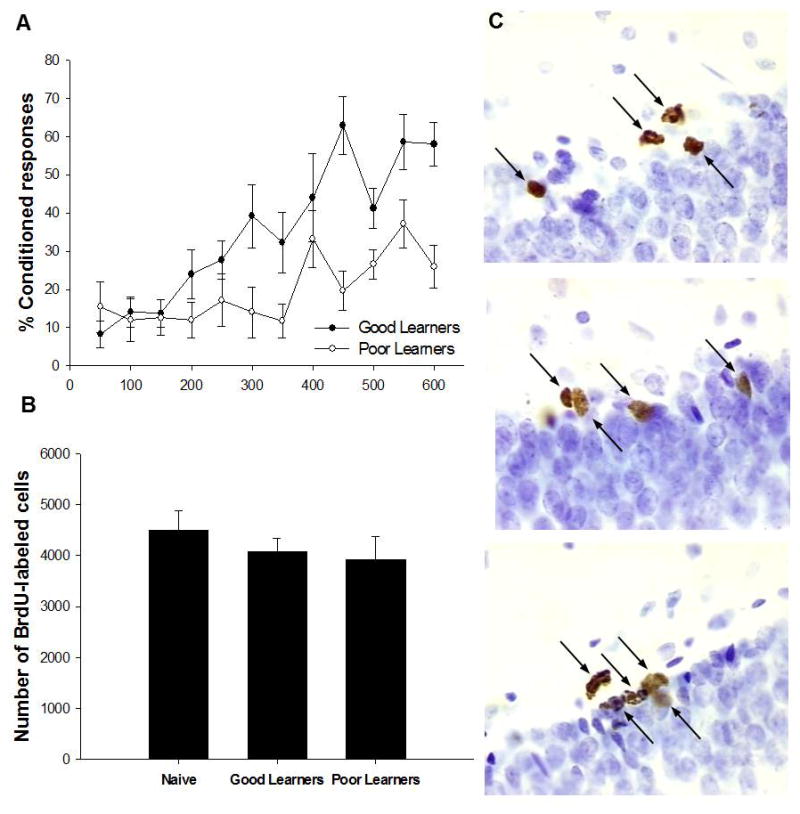
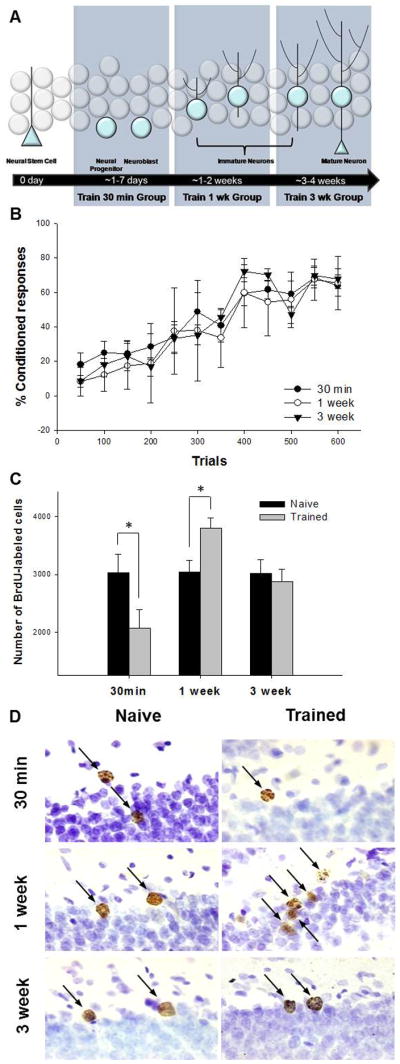
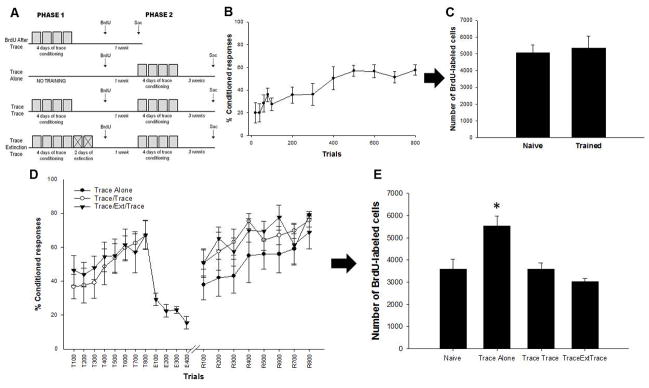
Learning increases the number of immature neurons that survive and mature in the adult hippocampus. One-week-old cells are more likely to survive in response to learning than cells in animals that are exposed to training but do not learn. Because neurogenesis is an ongoing and overlapping process, it is possible that learning differentially affects new cells as a function of their maturity. To address this issue, we examined the effects of associative learning on the survival of cells at different stages of development. Training did not alter the number of cells that were produced during the training experience. Cells that were 1-2 weeks of age at the time of training survived after learning but cells that were younger or older did not. In contrast, cells that were produced during training were less likely to survive than cells in untrained animals. Additionally, the number of cells that were generated after learning in trained animals was not different from the number in untrained animals. Finally, survival was not increased if the memory was expressed when the cells were about 1-week-old. Together, these results indicate that new neurons are rescued from death by initial acquisition, not the expression or reacquisition, of an associative memory and only during a critical period. Overall, these results suggest the presence of a feedback system, which controls how many new neurons become incorporated into the adult brain in response to learning.


Figures

Figure 1
Figure 1. Effects of trace eyeblink conditioning on production of newly generated cells
Acquisition of trace eyeblink conditioned responses for the good and poor learners (A). Total number of BrdU-labeled cells when animals were trained 30min and sacrificed four days after injection compared to naïve animals. There was no change in the number of cells labeled with BrdU during the training experience (B).Photomicrographs at 100x of BrdU-positive cells (arrows) from a naïve animal (top panel), a good learner (middle panel), and a poor learner (bottom panel) from similar areas along the infrapyramidal DG blade in the dorsal hippocampus. Images represent the differences in the number of BrdU-labeled cells in response to training when compared to naïves (C).
Figure 2
Figure 2. Effects of trace eyeblink conditioning on survival of newly generated neurons
A diagram illustrating the stage of development when BrdU-labeled cells were exposed to training. All animals were injected once with BrdU. They were then trained or not 30min, 1 week or 3 weeks later. To assess the effects of learning on cell survival, animals were euthanized four weeks after the BrdU injection (A). Acquisition of the CR in animals trained 30min, 1 week and 3 weeks after BrdU injection (B). Total number of BrdU-labeled cells in the dentate gyrus in animals trained 30 min, 1 week or 3 weeks after injection compared to naïve animals. Trace conditioning increases the number of BrdU-labeled cells when rats are trained 1 week after injection, but decreases the number that survive when they were trained just 30 min after injection (C). Photomicrographs at 100x of BrdU-positive cells (arrows) from each experimental condition. Cells are located along the infrapyramidal blade in the dorsal hippocampus. Images represent the relative differences in the number of BrdU-labeled cells in response to learning when compared to naïve animals. The granularity in some cells depicts the extended time interval between the BrdU injection and sacrifice (D). * indicates p < 0.05.
Figure 3
Figure 3. Acquisition but not memory expression increases the number of surviving cells
A schematic of the experimental design for experiment 2. To assess the effect of learning on the number of cells generated after training, one group of animals were trained and then given a BrdU injection at the time point at which the other groups began phase 2 of training (BrdU After Trace). These animals were euthanized seven days after the BrdU injection. Another group (Trace Alone) animals received no training during phase 1 and were given a BrdU injection seven days before phase 2 trace training. A third group (Trace/Trace) received trace training during phase 1, before the BrdU injection, and were trained with trace conditioning again seven days after the BrdU injection. Another group of animals (Trace/Extinction/Trace) was treated similar to animals in the Trace/Trace condition but received additional extinction trials following phase 1 before the BrdU injection (A). Acquisition of the CR for animals injected with BrdU after trace conditioning (B). The number of BrdU-labeled cells in these animals. Trained and untrained animals have a similar numbers of BrdU-positive cells (C). Acquisition, extinction and reacquisition of the trace memory. Animals in the Trace/Extinction/Trace condition extinguished their responding to the CS but quickly reacquired the CR during retraining. Animals remembered the trace task more than one week after acquisition, regardless of extinction training (D). Animals trained with only a single phase of trace conditioning possessed more BrdU-labeled cells than animals trained again after learning. * indicates p < 0.05.

References

    1. Altman J, Das GD. Autoradiographic and histological evidence of postnatal hippocampal neurogenesis in rats. Journal of Comparative Neurology. 1965;124:319–335. - PubMed
    1. Ambrogini P, Lattanzi D, Ciuffoli S, Agostini D, Bertini L, Stocchi V, Santi S, Cuppini R. Morpho-functional characterization of neuronal cells at different stages of maturation in granule cell later of adult rat dentate gyrus. Brain Research. 2004a;1017:21–31. - PubMed
    1. Ambrogini P, Orsini L, Mancini C, Ferri P, Ciaroni S, Cuppini R. Learning may reduce neurogenesis in adult rat dentate gyrus. Neuroscience Letters. 2004b;359:13–16. - PubMed
    1. Cameron H, Woolley C, McEwen B, Gould E. Differentiation of newly born neurons and glia in the dentate gyrus of the adult rat. Neuroscience. 1993;56:337–344. - PubMed
    1. Cameron HA, McKay RDG. Adult neurogenesis produces a large pool of new granule cells in the dentate gyrus. The Journal of Comparative Neurology. 2001;435:406–417. - PubMed

Publication types