Comparative Study
. 2010 Dec 10:11:153.
doi: 10.1186/1471-2202-11-153.

A comparative study on the efficacy of 10% hypertonic saline and equal volume of 20% mannitol in the treatment of experimentally induced cerebral edema in adult rats

Affiliations
Comparative Study

A comparative study on the efficacy of 10% hypertonic saline and equal volume of 20% mannitol in the treatment of experimentally induced cerebral edema in adult rats

Hong-Ke Zeng et al. BMC Neurosci. .

Abstract

Background: Hypertonic saline and mannitol are commonly used in the treatment of cerebral edema and elevated intracranial pressure (ICP) at present. In this connection, 10% hypertonic saline (HS) alleviates cerebral edema more effectively than the equal volume of 20% mannitol. However, the exact underlying mechanism for this remains obscure. This study aimed to explore the possible mechanism whereby 10% hypertonic saline can ameliorate cerebral edema more effectively than mannitol.

Results: Adult male Sprague-Dawley (SD) rats were subjected to permanent right-sided middle cerebral artery occlusion (MCAO) and treated with a continuous intravenous infusion of 10% HS, 20% mannitol or D-[1-3H(N)]-mannitol. Brain water content (BWC) as analyzed by wet-to-dry ratios in the ischemic hemisphere of SD rats decreased more significantly after 10% HS treatment compared with 20% mannitol. Concentration of serum Na+ and plasma crystal osmotic pressure of the 10% HS group at 2, 6, 12 and 18 h following permanent MCAO increased significantly when compared with 20% mannitol treated group. Moreover, there was negative correlation between the BWC of the ipsilateral ischemic hemisphere and concentration of serum Na+, plasma crystal osmotic pressure and difference value of concentration of serum Na+ and concentration of brain Na+ in ipsilateral ischemic hemisphere in the 10% HS group at the various time points after MCAO. A remarkable finding was the progressive accumulation of mannitol in the ischemic brain tissue.

Conclusions: We conclude that 10% HS is more effective in alleviating cerebral edema than the equal volume of 20% mannitol. This is because 10% HS contributes to establish a higher osmotic gradient across BBB and, furthermore, the progressive accumulation of mannitol in the ischemic brain tissue counteracts its therapeutic efficacy on cerebral edema.


Figures
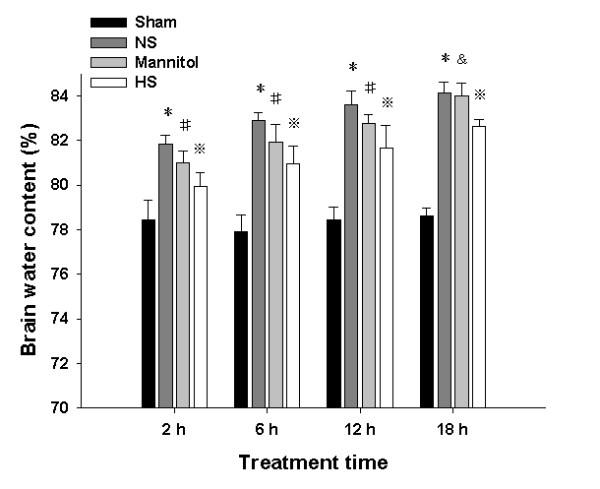
Figure 1
Figure 1
Ipsilateral ischemic hemispheric BWC. BWC(%) in the ipsilateral ischemic hemisphere of the normal saline group, 20% mannitol group and 10% HS group at 2, 6, 12 and 18 h following permanent MCAO and the corresponding sham operated group. Bar graph shows that the percentage of BWC is significantly increased in the ipsilateral ischemic hemisphere of the normal saline group, 20% mannitol group and 10% HS group at various time points when compared with the sham operated group (*#&P < 0.05). The percentage of BWC decreases significantly in the ipsilateral ischemic hemisphere at 2, 6 and 12 h following treatment with 20% mannitol or 10% HS compared with the normal saline group (#P < 0.05, P < 0.05). At 18 h, compared with the normal saline group, the percentage of BWC in the 20% mannitol does not decrease significantly (&P > 0.05). However, the BWC of 10% HS group continues to decrease significantly (P < 0.05). BWC in the ipsilateral ischemic hemispheres of the 10% HS group at 2, 6, 12 and18 h decreases significantly when compared with the 20% mannitol group(P < 0.001).
Figure 2
Figure 2
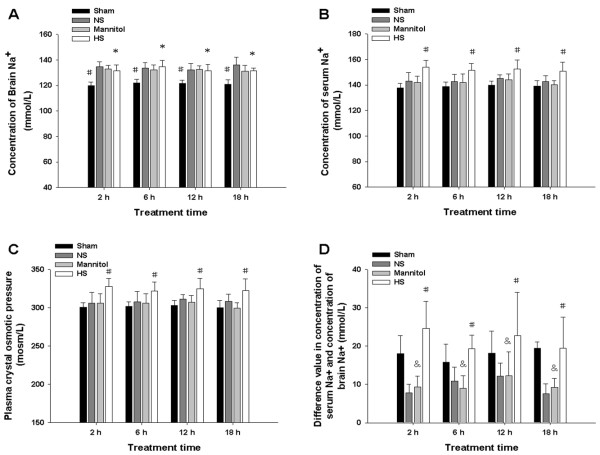
Plasma crystal osmotic pressure, brain Na+ concentration, serum Na+ concentration and difference value of both. Na+ concentration of the ipsilateral ischemic hemispheres (A), serum Na+ concentration (B), plasma crystal osmotic pressure (C) and difference value in concentration of serum Na+ and concentration of brain Na+ in ipsilateral ischemic hemisphere (D) of the normal saline group, the 20% mannitol group and 10% HS group at 2, 6, 12 and18 h following permanent MCAO as well as matching sham operated group
Figure 3
Figure 3
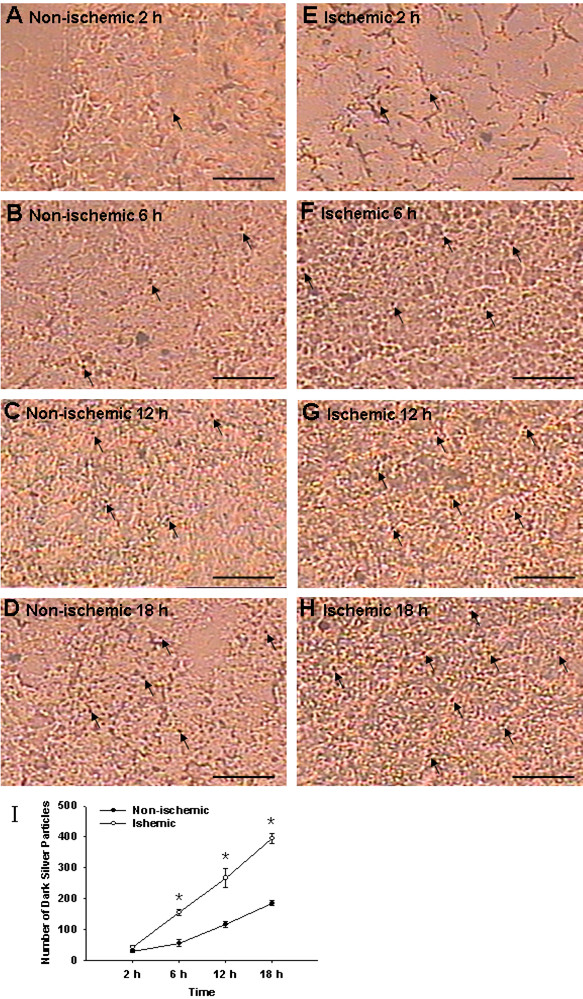
Autoradiography in the peri-infarction brain tissue and the corresponding areas in the non-ischemic tissue. Autoradiography shows the number of black silver particles in the peri-infarction brain tissue. The number of black silver particles increases from 2 to 18 h after administration with D-[1-3H(N)]-mannitol (E, F, G, H) in comparison with the corresponding areas in the non-ischemic tissue (A, B, C, D) being more marked at 12 and 18 h (G, H). The number of dark silver particles also increases in the non-ischemic brain tissue from 2 to 18 h (A, B, C, D), notably at 12 and 18 h (C, D), but the number of particles is evidently less than that in the ischemic brain tissue at corresponding time points. Figure 3I shows a significant increase in the black silver particles in the peri-infarction brain tissue at 6, 12 and 18 h following permanent MCAO. Scale bars: A-H, 20 μm.
Figure 4
Figure 4
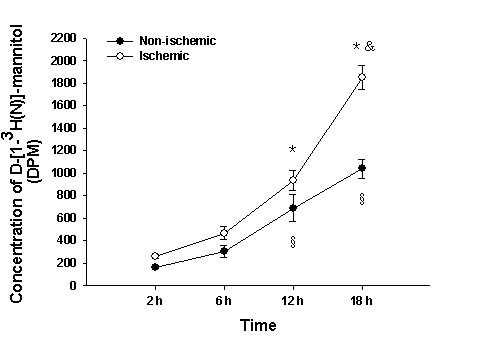
Concentrations of D-[1-3H(N)]-mannitol in the ischemic and non-ischemic brain tissue. Concentrations of D-[1-3H(N)]-mannitol in the ischemic and non-ischemic brain tissue at 6, 12 and 18 h following permanent MCAO. Note the progressive increase in concentration of D-[1-3H(N)]-mannitol in the peri-infarction brain tissue continuously from 2 to 18 h after administration with D-[1-3H(N)]-mannitol as detected by liquid scintillation analyzer.

References

    1. Nag S, Manias JL, Stewart DJ. Pathology and new players in the pathogenesis of brain edema. Acta Neuropathol. 2009;118:197–217. doi: 10.1007/s00401-009-0541-0. - DOI - PubMed
    1. Boulard G, Marguinaud E, Sesay M. Osmotic cerebral oedema: the role of plasma osmolarity and blood brain barrier. Ann Fr Anesth Reanim. 2003;22:215–9. - PubMed
    1. Pérez-Pérez AJ, Pazos B, Sobrado J, Gonzalez L, Gándara A. Acute renal failure following massive mannitol infusion. Am J Nephrol. 2002;22:573–575. - PubMed
    1. van Hengel P, Nikken JJ, de Jong GM, Hesp WL, van Bommel EF. Mannitol-induced acute renal failure. Neth J Med. 1997;50:21–24. doi: 10.1016/S0300-2977(96)00060-5. - DOI - PubMed
    1. Huang SJ, Chang L, Han YY, Lee YC, Tu YK. Efficacy and safety of hypertonic saline solutions in the treatment of severe head injury. Surg Neurol. 2006;65:539–546. doi: 10.1016/j.surneu.2005.11.019. - DOI - PubMed

Publication types

MeSH terms

LinkOut - more resources