. 2011 Apr;105(8):1218-25.
doi: 10.1017/S0007114510004824. Epub 2010 Dec 9.

Epigallocatechin gallate delays the onset of type 1 diabetes in spontaneous non-obese diabetic mice

Affiliations

Epigallocatechin gallate delays the onset of type 1 diabetes in spontaneous non-obese diabetic mice

Zhuo Fu et al. Br J Nutr. 2011 Apr.

Abstract

Type 1 diabetes (T1D) results from the autoimmune-mediated destruction of pancreatic β-cells, leading to deficiency of insulin production. Successful islet transplantation can normalise hyperglycaemia in T1D patients; however, the limited availability of the islets, loss of islet cell mass through apoptosis after islet isolation and potential autoimmune destruction of the transplanted islets prevent the widespread use of this procedure. Therefore, the search for novel and cost-effective agents that can prevent or treat T1D is extremely important to decrease the burden of morbidity from this disease. In the present study, we discovered that ( - )-epigallocatechin gallate (EGCG, 0·05 % in drinking-water), the primary polyphenolic component in green tea, effectively delayed the onset of T1D in non-obese diabetic (NOD) mice. At 32 weeks of age, eight (66·7 %) out of twelve mice in the control group developed diabetes, whereas only three (25 %) out of twelve mice in the EGCG-treated group became diabetic (P < 0·05). Consistently, mice supplemented with EGCG had significantly higher plasma insulin levels and survival rate but lower glycosylated Hb concentrations compared with the control animals. EGCG had no significant effects on food or water intake and body weight in mice, suggesting that the glucose-lowering effect was not due to an alteration in these parameters. While EGCG did not modulate insulitis, it elevated the circulating anti-inflammatory cytokine IL-10 level in NOD mice. These findings demonstrate that EGCG may be a novel, plant-derived compound capable of reducing the risk of T1D.


Figures
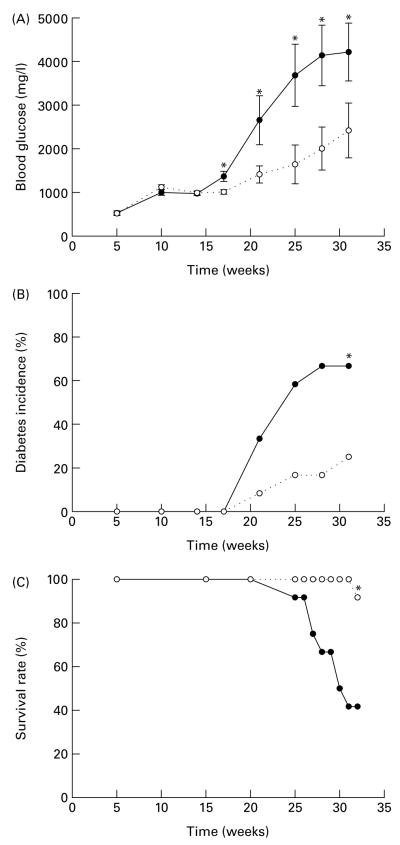
Fig. 1
Fig. 1
Epigallocatechin gallate (EGCG) delays the onset of diabetes in non-obese diabetic (NOD) mice. Female NOD/LtJ mice (5 weeks old) were fed 0·05% of EGCG in drinking-water. Age-matched control mice were given regular water. (A) Non-fasting blood glucose, (B) incidence of diabetes and (C) survival rate were recorded. Values are means, with standard errors represented by vertical bars (n 12). *P<0·05 v. control. formula image, Control; formula image, EGCG.
Fig. 2
Fig. 2
Epigallocatechin gallate (EGCG) improves glucose tolerance and plasma glycosylated Hb (HbA1c) and increases plasma insulin level in non-obese diabetic mice. (A) For the glucose tolerance test, overnight-fasted mice were injected intraperitoneally with a bolus of glucose (2 g/kg body weight), followed by measurements of blood glucose at 0, 5, 15, 30, 60 and 120 min after glucose injection (n 5). (B) Blood levels of HbA1c and (C) plasma insulin concentration were measured at the end of the experiment with respective assay kits (control group, n 9; EGCG-treated group, n 12). Values are means, with standard errors represented by vertical bars. *P<0·05 v. control. formula image, Control; formula image, EGCG.
Fig. 3
Fig. 3
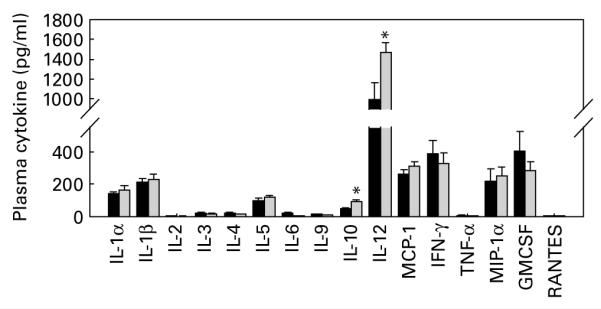
Epigallocatechin gallate (EGCG) treatment increases plasma IL-10 and IL-12 concentrations but does not alter IL-1α, IL-1β, IL-2, IL-3, IL-4, IL-5, IL-6, IL-9, monocyte chemoattractant protein-1 (MCP-1), interferon-g (IFN-γ), TNF-α, macrophage inflammatory protein-1α (MIP-1α), granulocyte macrophage colony-stimulating factor (GMCSF) or RANTES levels. Blood was drawn from fasted mice, and plasma samples were used for measurements of various cytokines, including IL-1α, IL-1β, IL-2, IL-3, IL-4, IL-5, IL-6, IL-9, IL-10, IL-12, MCP-1, IFN-γ, TNF-α, MIP-1α, GMCSF and RANTES (control group, n 9; EGCG-treated group, n 12). *P<0·05 v. control. formula image, Control; formula image, EGCG.
Fig. 4
Fig. 4
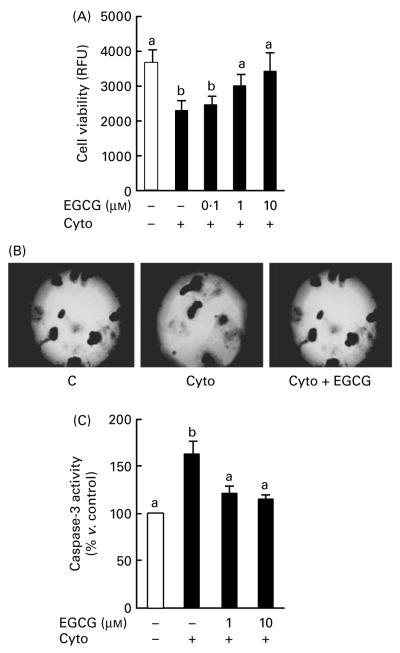
Epigallocatechin gallate (EGCG) promotes human pancreatic β-cell viability. Human islets were pre-incubated in medium with or without various concentrations of EGCG (concentration of 5 μm was used for B) for 12 h, followed by the addition of cytokines (Cyto; IL-1β (5 ng/ml) interferon-γ (10 ng/ml)). (A) Cell viability was determined, and (B) representative images of the control (C) and EGCG-treated islets were shown after 48 h. (C) Cellular caspase-3 activity was measured after 24 h of incubation. Values are means, with standard errors represented by vertical bars (n 4). Means values with unlike letters were significantly different (P<0·05).

References

    1. Danne T, Lange K, Kordonouri O. New developments in the treatment of type 1 diabetes in children. Arch Dis Child. 2007;92:1015–1019. - PMC - PubMed
    1. Zhao Y, Lin B, Darflinger R, et al. Human cord blood stem cell-modulated regulatory T lymphocytes reverse the autoimmune-caused type 1 diabetes in nonobese diabetic (NOD) mice. PLoS One. 2009;4:e4226. - PMC - PubMed
    1. Balentine DA, Wiseman SA, Bouwens LC. The chemistry of tea flavonoids. Crit Rev Food Sci Nutr. 1997;37:693–704. - PubMed
    1. Chow HH, Cai Y, Alberts DS, et al. Phase I pharmacokinetic study of tea polyphenols following single-dose administration of epigallocatechin gallate and polyphenon E. Cancer Epidemiol Biomarkers Prev. 2001;10:53–58. - PubMed
    1. Lee MJ, Maliakal P, Chen L, et al. Pharmacokinetics of tea catechins after ingestion of green tea and (−)-epigallocatechin-3-gallate by humans: formation of different metabolites and individual variability. Cancer Epidemiol Biomarkers Prev. 2002;11:1025–1032. - PubMed

Publication types

MeSH terms