


Receptors, subcellular compartments and the regulation of peripheral B cell responses: the illuminating state of anergy
- PMID: 21144589
- PMCID: PMC3089810
- DOI: 10.1016/j.molimm.2010.10.024
Receptors, subcellular compartments and the regulation of peripheral B cell responses: the illuminating state of anergy
Abstract
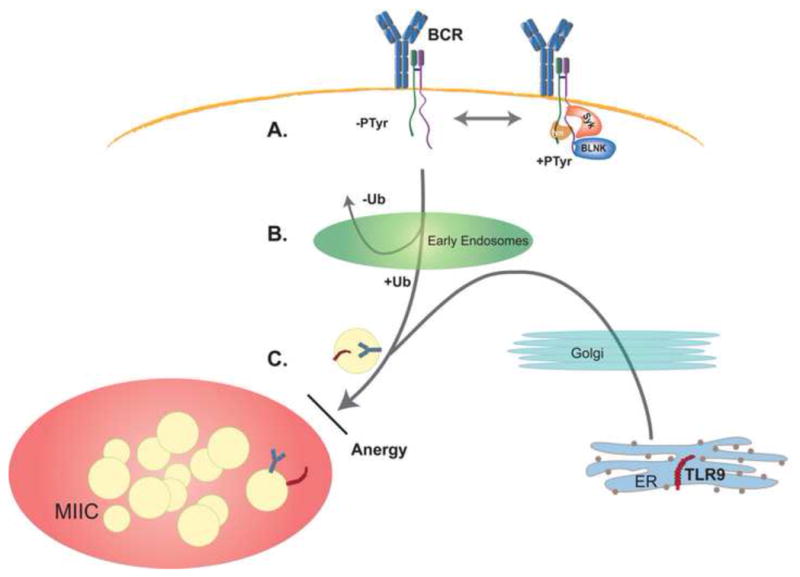
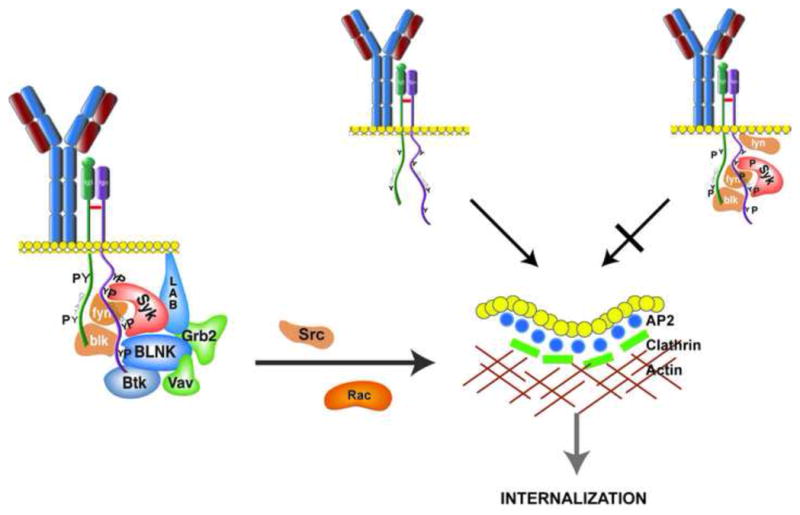
Signals through the B cell antigen receptor (BCR) are necessary but not sufficient for cellular activation. Co-stimulatory signals must be provided through other immune recognition receptor systems, such as MHC class II/CD40 and the toll-like receptor (TLR) 9 that can only productively acquire their ligands in the processive environment of specialized late endosomes (MHC class II containing compartment or MIIC). It has long been appreciated that the BCR, by effectively capturing complex antigens and delivering them to late endosomes, is the link between activation events on the cell surface and those dependent on late endosomes. However, it has become increasingly apparent that the BCR also directs the translocation of MHC class II and TLR9 into the MIIC and that the endocytic flow of these receptors coincides with that of the BCR. This likely ensures close apposition of receptor complexes within the MIIC and the efficient transfer of ligands from the BCR to MHC class II and TLR9. This complex orchestration of receptor endocytic movement is dependent upon the quality of signals elicited through the BCR. Failure to activate specific signaling pathways, such as occurs in anergic B cells, prevents the entry of the BCR and TLR9 into the MIIC and abrogates TLR9 activation. Like anergy, this block in endocytic trafficking is rapidly reversible. These findings indicate that cellular responsiveness can be determined by mechanisms that control the subcellular location of important immune recognition receptors.
Copyright © 2010 Elsevier Ltd. All rights reserved.
Figures
References
-
- Andrews SF, Wilson PC. The anergic B cell. Blood. 2010;115:4976–4978. - PubMed
-
- Batista FD, Harwood NE. The who, how and where of antigen presentation to B cells. Nat Rev Immunol. 2009;9:15–27. - PubMed
-
- Benschop RJ, Aviszus K, Zhang X, Manser T, Cambier JC, Wysocki LJ. Activation and anergy in bone marrow B cells of a novel immunoglobulin transgenic mouse that is both hapten specific and autoreactive. Immunity. 2001;14:33–43. - PubMed
Publication types
MeSH terms
Substances
Grants and funding
LinkOut - more resources
Full Text Sources
Research Materials
