


Review
doi: 10.1016/j.sbi.2010.11.002.
Epub 2010 Dec 6.
The folding of single domain proteins--have we reached a consensus?
Affiliations
- PMID: 21144739
- PMCID: PMC3039110
- DOI: 10.1016/j.sbi.2010.11.002
Item in Clipboard
Review
The folding of single domain proteins--have we reached a consensus?
Curr Opin Struct Biol.
2011 Feb.
Abstract
Rather than stressing the most recent advances in the field, this review highlights the fundamental topics where disagreement remains and where adequate experimental data are lacking. These topics include properties of the denatured state and the role of residual structure, the nature of the fundamental steps and barriers, the extent of pathway heterogeneity and non-native interactions, recent comparisons between theory and experiment, and finally, dynamical properties of the folding reaction.
Copyright © 2010 Elsevier Ltd. All rights reserved.
Figures
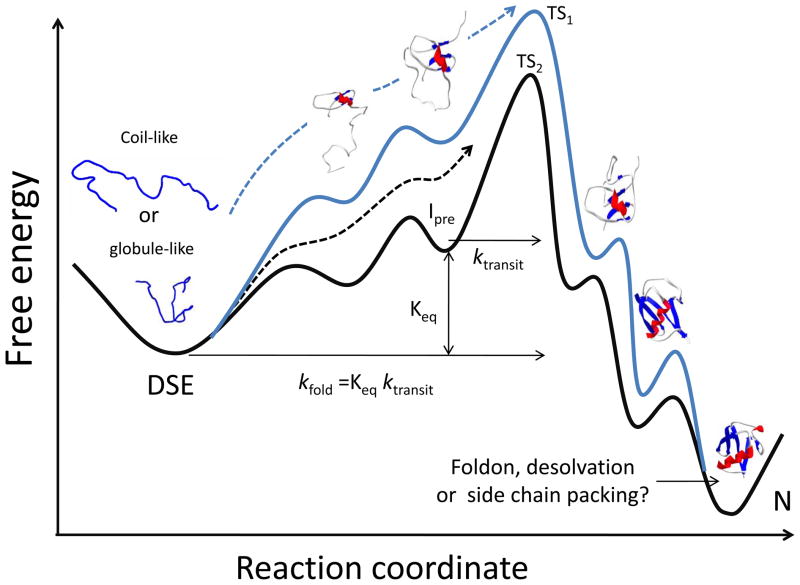
The DSE may be collapsed or expanded and there may be more than one pathway to and from the TS (black and blue traces). Steps between the TS and the native state represent the addition of foldons and are likely to be added in a particular sequence. These behaviors also may apply to the steps leading up to the TS, which are largely hidden from experimental characterization. Different views describe the last folding events as the addition of a foldon, desolvation of the core or the locking of side chains from a dry MG state. In the scheme depicted here, kfold, the observed folding rate, is the product of Keq, the equilibrium constant for Ipre, the highest energy intermediate in fast equilibrium with the DSE, times ktrans, the transit rate going over the barrier at the top.
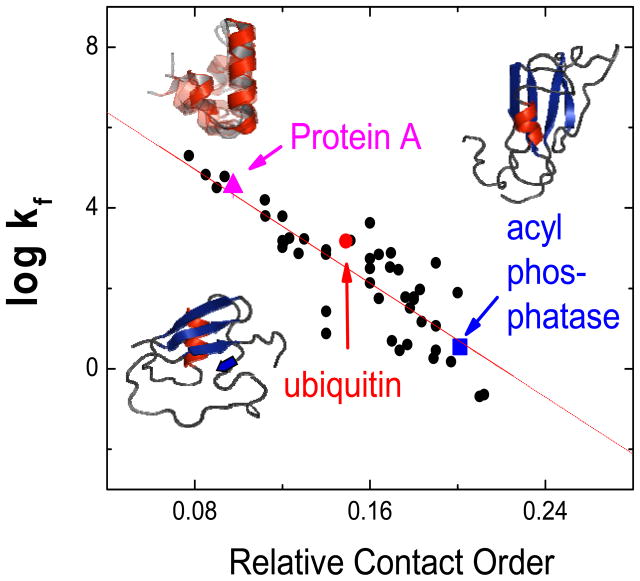
The line indicates the best fit to the data, which may represent proteins which form ~70% of the native topology in the TS. This level is based on the RCO value observed in the three proteins whose representative TS structures were determined using Langevin dynamics simulations constrained by experimental ψ values [62,72,140].
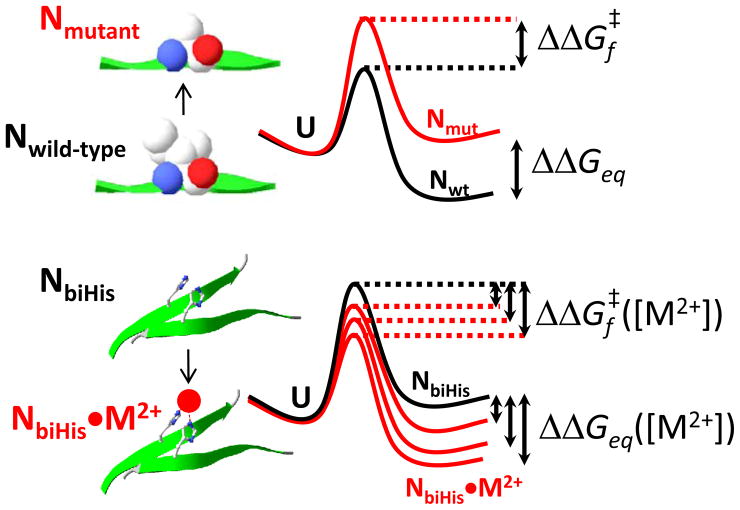
In φ analysis, a side chain is mutated and the change in stability of the TS relative to the native state is quantified as
. In ψ-analysis, a bihistidine (biHis) site is introduced at a location that is stabilized upon binding divalent metal ions (M2+). The stabilization of the TS relative to the native state as a function of [M2+] is
. Whereas a φ value can reflect native and non-native interactions as well as differences in secondary structure propensities of the two amino acids in the TSE, a ψ value reflects the binding of metal to the biHis site which is only possible when the two histidines are in close proximity (e.g. β strand pairing or helix formation, depending on biHis location). Hence, this newer method identifies residue-residue contacts and it is especially powerful in the determination of TS structures and topologies.
References
-
- McCarney ER, Kohn JE, Plaxco KW. Is there or isn’t there? The case for (and against) residual structure in chemically denatured proteins. Crit Rev Biochem Mol Biol. 2005;40:181–189. - PubMed
Publication types
MeSH terms
Substances
Grants and funding
LinkOut - more resources
Full Text Sources
Other Literature Sources
