Review
. 2010 Nov;41 Suppl 2(0 2):S16-23.
doi: 10.1016/S0020-1383(10)70004-8.

Pulmonary pathways and mechanisms regulating transpulmonary shunting into the general circulation: an update

Affiliations
Review

Pulmonary pathways and mechanisms regulating transpulmonary shunting into the general circulation: an update

Andrew T Lovering et al. Injury. 2010 Nov.

Abstract

Embolic insults account for a significant number of neurologic sequelae following many routine surgical procedures. Clearly, these post-intervention embolic events are a serious public health issue as they are potentially life altering. However, the pathway these emboli utilize to bypass the pulmonary microcirculatory sieve in patients without an intracardiac shunt such as an atrial septal defect or patent foramen ovale, remains unclear. In the absence of intracardiac routes and large diameter pulmonary arteriovenous malformations, inducible large diameter intrapulmonary arteriovenous anastomoses in otherwise healthy adult humans may prove to be the best explanation. Our group and others have demonstrated that inducible large diameter intrapulmonary arteriovenous anastomoses are closed at rest but can open during hyperdynamic conditions such as exercise in more than 90% of healthy humans. Furthermore, the patency of these intrapulmonary anastomoses can be modulated through the fraction of inspired oxygen and by body positioning. Of particular clinical interest, there appears to be a strong association between arterial hypoxemia and neurologic insults, suggesting a breach in the filtering ability of the pulmonary microvasculature under these conditions. In this review, we present evidence demonstrating the existence of inducible intrapulmonary arteriovenous anastomoses in healthy humans that are modulated by exercise, oxygen tension and body positioning. Additionally, we identify several clinical conditions associated with both arterial hypoxemia and an increased risk for embolic insults. Finally, we suggest some precautionary measures that should be taken during interventions to keep intrapulmonary arteriovenous anastomoses closed in order to prevent or reduce the incidence of paradoxical embolism.


Figures

Fig. 1
Fig. 1
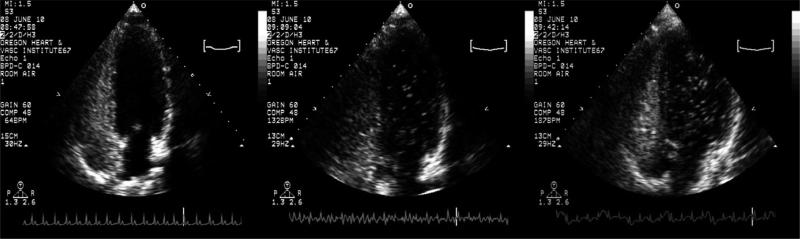
Transpulmonary passage of saline contrast microbubbles with exercise. Representative saline contrast echocardiograms from a single subject pre-exercise, and during exercise at 50% and 90% of VO2max while breathing room air. Shunt scores were 0, 2, 3 for pre-exercise, 50% and 90% of VO2max respectively.
Fig. 2
Fig. 2
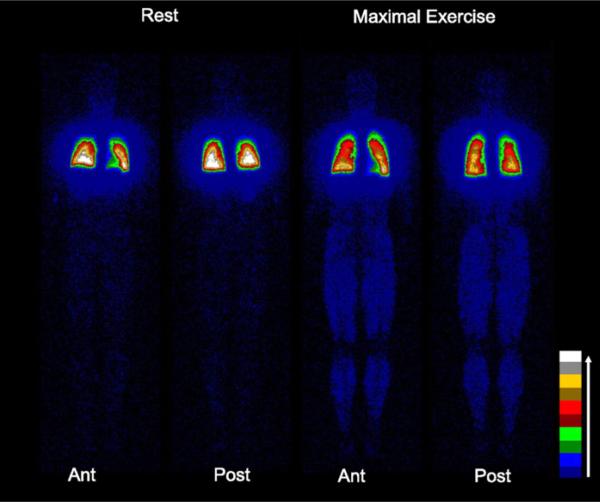
Transpulmonary passage of macroaggregates of albumin with exercise. Anterior (Ant) and posterior (Post) planar whole body images obtained following injections with technetium-99m macroaggregates of albumin at rest and during maximal treadmill exercise. The increased number of counts in the exercising muscles (legs) indicates intrapulmonary shunting of technetium-99m macroaggregates of albumin that have become trapped in systemic capillaries. The percent shunt in this individual at rest was 0.7%, which increased to 3.0% at maximal exercise. Color bar represents increasing count intensities with lighter colors. (From Lovering AT, Haverkamp HC, Romer LM, et al. Transpulmonary passage of 99mTc macroaggregates albumin in healthy humans at rest and during maximal exercise. J Appl Physiol 2009;106:1986–92; with permission.)
Fig. 3
Fig. 3
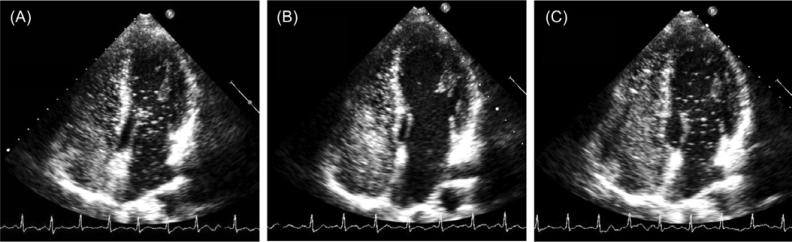
Prevention of transpulmonary passage of saline contrast bubbles with exercise in hyperoxia. Saline contrast echocardiograms from a 36-year-old male subject during exercise at 180 W in normoxia and hyperoxia. (A) echocardiogram during exercise for 1 min at 180 W in normoxia. Note saline contrast bubbles in the left heart indicating arteriovenous shunting. Bubble score = 3. (B) Echocardiogram during exercise for 120 s at 180 W in hyperoxia (100% O2). Note absence of saline contrast bubbles in the left heart indicating no arteriovenous shunting. Bubble score = 0. (C) Echocardiogram upon returning to exercise for 60 s at 180 W in normoxia. Note appearance of saline contrast bubbles in the left heart recommenced indicating arteriovenous shunting. Bubble score = 3. (From Lovering AT, Stickland MK, Amann M, Murphy JC, O'Brien MJ, Hokanson JS, Eldridge MW. Hyperoxia prevents exercise-induced intrapulmonary arteriovenous shunt in healthy humans. J Physiol. 2008 Sep 15;586(Pt 18):4559–65; with permission.)
Fig. 4
Fig. 4
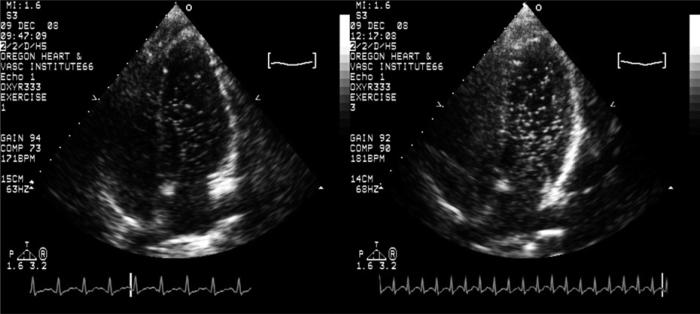
Increased transpulmonary passage of saline contrast microbubbles with exercise in hypoxia. Representative saline contrast echocardiograms from a single subject during exercise in normoxia and hypoxia FIO2 = 0.14 at 75% of VO2max. Shunt score of 3 in normoxia and 4 during hypoxia. From Laurie SS, Yang X, Elliott JE, et al. Hypoxia-induced intrapulmonary arteriovenous shunting at rest in healthy humans. J Appl Physiol 2010;109(4):1072–9. © Am Physiol Soc, used with permission.
Fig. 5
Fig. 5
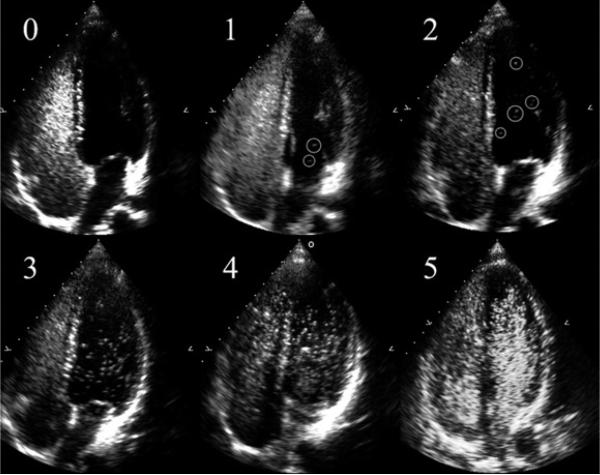
Transpulmonary passage of saline contrast microbubbles at rest in hypoxia. Representative echocardiograms of bubble scores 0–4 in a single subject at rest breathing (0) room air, (1) FIO2 = 0.16, (2) FIO2 = 0.14, (3) FIO2 = 0.12, (4) FIO2 = 0.10, and a second subject (5) with a bubble score of 5 breathing FIO2 = 0.10. Scores 1 and 2 have bubbles circled for clarity. From Laurie SS, Yang X, Elliott JE, et al. Hypoxia-induced intrapulmonary arteriovenous shunting at rest in healthy humans. J Appl Physiol 2010;109(4):1072–9. © Am Physiol Soc, used with permission.
Fig. 6
Fig. 6
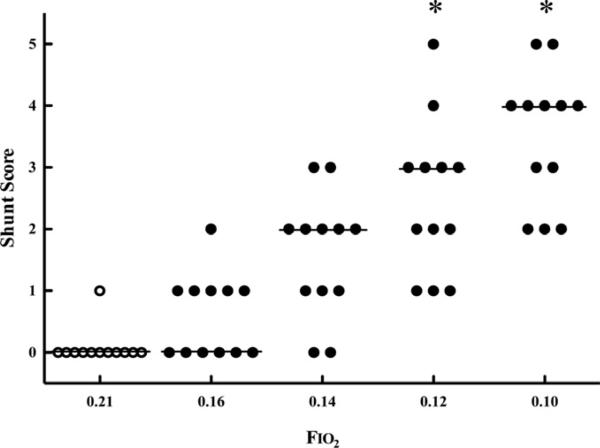
Bubble scores at rest in hypoxia. Individual subject bubble scores at rest in the left ventricle breathing FIO2 = 0.21 and after 30 min breathing FIO2 = 0.16, 0.14, 012, and 0.10. Horizontal lines indicate mode, *p < 0.01 vs. FIO2 = 0.21 (Friedman's test, Dunn's post-test). From Laurie SS, Yang X, Elliott JE, et al. Hypoxia-induced intrapulmonary arteriovenous shunting at rest in healthy humans. J Appl Physiol 2010;109(4):1072–9. © Am Physiol Soc, used with permission.
Fig. 7
Fig. 7
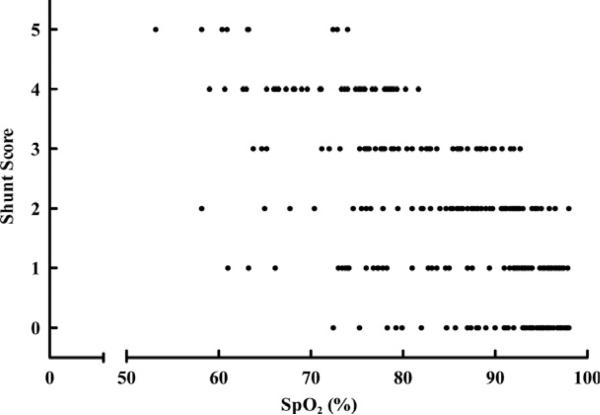
Bubble scores at rest in hypoxia as a function of arterial oxygen saturation. Bubble scores of the left ventricle at rest vs. corresponding SpO2 (n = 300). From Laurie SS, Yang X, Elliott JE, et al. Hypoxia-induced intrapulmonary arteriovenous shunting at rest in healthy humans. J Appl Physiol 2010;109(4):1072–9. © Am Physiol Soc, used with permission.

References

    1. Basnyat B, Wu T, Gertsch JH. Neurological conditions at altitude that fall outside the usual definition of altitude sickness. High Alt Med Biol. 2004;5:171–9. - PubMed
    1. Burkard ME, Van Liew HD. Simulation of exchanges of multiple gases in bubbles in the body. Respir Physiol. 1994;95:131–45. - PubMed
    1. Butler BD, Hills BA. The lung as a filter for microbubbles. J Appl Physiol. 1979;47:537–43. - PubMed
    1. Cheney FW, Pavlin J, Ferens J, Allen D. Effect of pulmonary microembolism on arteriovenous shunt flow. J ThoracCardiovascSurg. 1978;76:473–78. - PubMed
    1. Danesh J, Collins R, Appleby P, Peto R. Association of fibrinogen, C-reactive protein, albumin, or leukocyte count with coronary heart disease: meta-analyses of prospective studies. JAMA. 1998;279:1477–82. - PubMed

Publication types