


doi: 10.1016/j.cell.2010.11.031.
Lipid trafficking sans vesicles: where, why, how?
Affiliations
- PMID: 21145454
- PMCID: PMC3004474
- DOI: 10.1016/j.cell.2010.11.031
Item in Clipboard
Lipid trafficking sans vesicles: where, why, how?
Cell.
.
Abstract
Eukaryotic cells possess a remarkable diversity of lipids, which distribute among cellular membranes by well-characterized vesicle trafficking pathways. However, transport of lipids by alternate, or "nonvesicular," routes is also critical for lipid synthesis, metabolism, and proper membrane partitioning. In the past few years, considerable progress has been made in characterizing the mechanisms of nonvesicular lipid transport and how it may go awry in particular diseases, but many fundamental questions remain for this rising field.
Copyright © 2010 Elsevier Inc. All rights reserved.
Figures
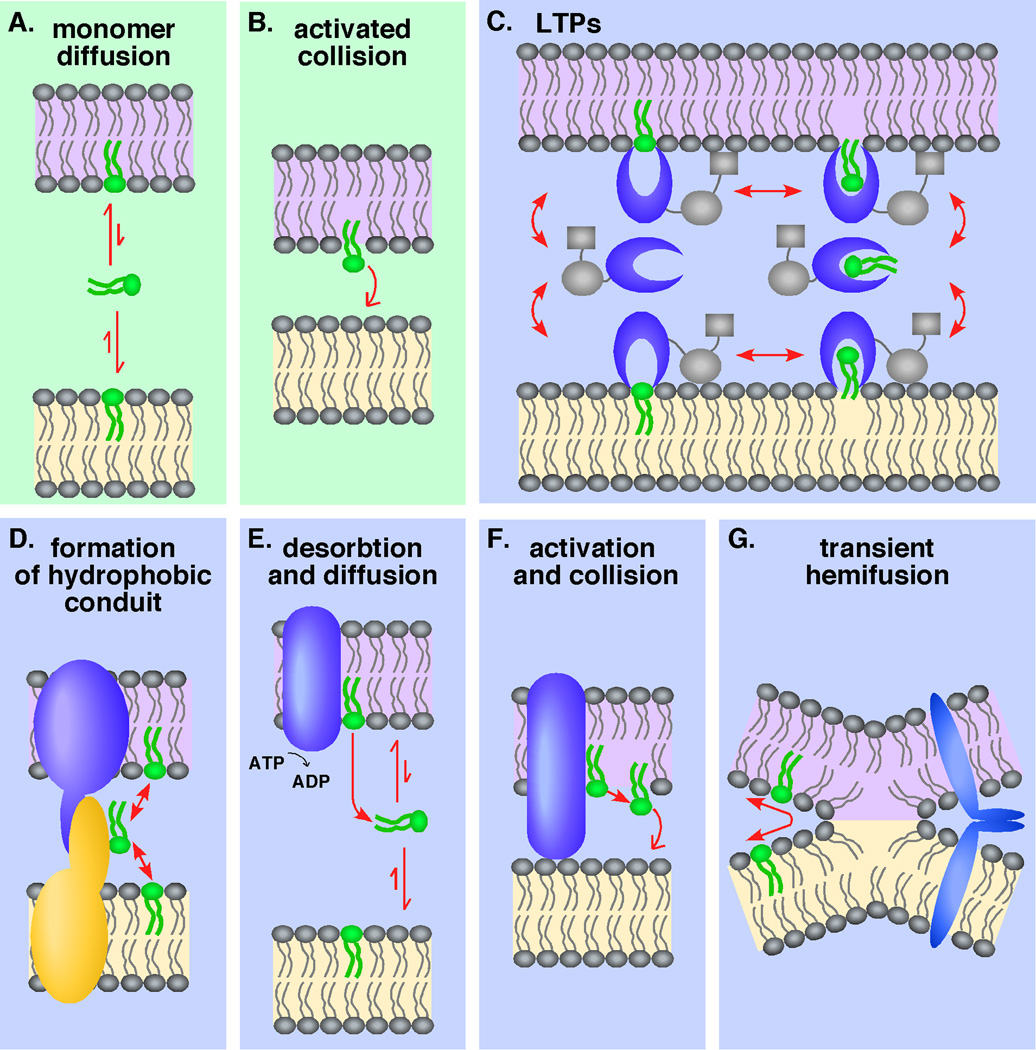
Lipids can spontaneously exchange between two membranes without the assistance of proteins; (A) monomers can diffuse through the aqueous phase or (B) during the collision of two membrane collision after the lipid is “activated.” (C) Lipid transport proteins (LTPs) can also exchange lipids between membranes and organelles. LTPs have a lipid-binding domain (blue) and, many times, targeting domains (purple) that may direct lipid transfer to particular membranes by binding to lipids or proteins. Lipids may exchange at membrane contact sites where two membranes come together in close proximity. Protein complexes may facilitate this process (D) by forming a tunnel that allows lipids diffuse between the membranes, (E) by promoting lipid desorption from one membrane, (F) by activating lipids prior to membrane collision, or (G) by promoting transient membrane hemifusion.
References
-
- Benning C. Mechanisms of lipid transport involved in organelle biogenesis in plant cells. Annu Rev Cell Dev Biol. 2009;25:71–91. - PubMed
-
- Cheruku SR, Xu Z, Dutia R, Lobel P, Storch J. Mechanism of cholesterol transfer from the Niemann-Pick type C2 protein to model membranes supports a role in lysosomal cholesterol transport. J Biol Chem. 2006;281:31594–31604. - PubMed
-
- Choi JY, Riekhof WR, Wu WI, Voelker DR. Macromolecular assemblies regulate nonvesicular phosphatidylserine traffic in yeast. Biochem Soc Trans. 2006;34:404–408. - PubMed
-
- D'Angelo G, Polishchuk E, Di Tullio G, Santoro M, Di Campli A, Godi A, West G, Bielawski J, Chuang CC, van der Spoel AC, Platt FM, Hannun YA, Polishchuk R, Mattjus P, De Matteis MA. Glycosphingolipid synthesis requires FAPP2 transfer of glucosylceramide. Nature. 2007;449:62–67. - PubMed
Publication types
MeSH terms
Substances
Grants and funding
LinkOut - more resources
Full Text Sources
Miscellaneous
