


Suppressed monocyte gene expression profile in men versus women with PTSD
- PMID: 21145962
- PMCID: PMC3039086
- DOI: 10.1016/j.bbi.2010.12.001
Suppressed monocyte gene expression profile in men versus women with PTSD
Abstract
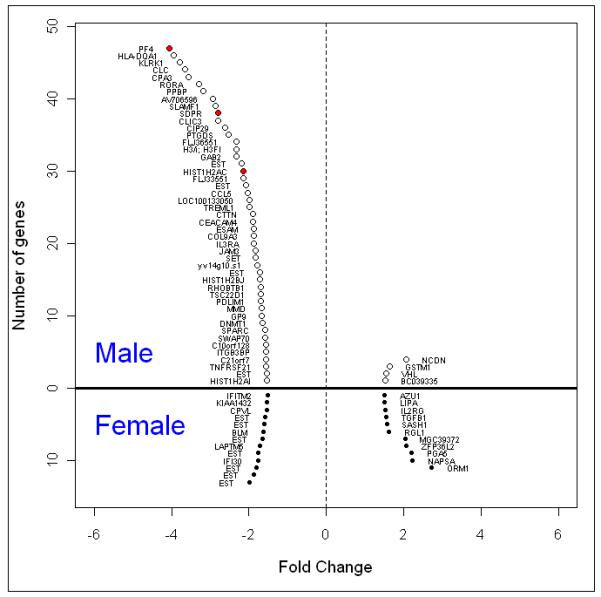
There have been several attempts to use gene microarrays from peripheral blood mononuclear cells to identify new biological pathways or targets for therapy in Posttraumatic Stress Disorder (PTSD). The few studies conducted to date have yielded an unclear pattern of findings, perhaps reflecting the use of heterogeneous samples of circulating immune cells for analysis. We used gene microarrays on a homogeneous sample of circulating monocytes to test the hypothesis that chronic PTSD would be associated with elevated inflammatory activity and to identify new pathways dysregulated in the disorder. Forty-nine men (24 PTSD+ and 25 age-matched trauma-exposed PTSD- controls) and 18 women (10 PTSD+ and 8 age-matched PTSD- controls) were recruited. Gene expression microarray analysis was performed on CD14+ monocytes, immune cells that initiate and respond to inflammatory signaling. Male subjects with PTSD had an overall pattern of under-expression of genes on monocytes (47 under-expressed versus 4 over-expressed genes). A rigorous correction for multiple comparisons and verification with qPCR showed that of only 3 genes that were differentially expressed, all were under-expressed. There was no transcriptional evidence of chronic inflammation in male PTSD+ subjects. In contrast, preliminary data from our pilot female PTSD+ subjects showed a relatively balanced pattern of increased and decreased expression of genes and an increase in activity of pathways related to immune activation. The results indicate differential patterns of monocyte gene expression in PTSD, and the preliminary data from our female pilot subjects are suggestive of gender dimorphism in biologic pathways activated in PTSD. Changes in immune cell gene expression may contribute to medical morbidity in PTSD.
Copyright © 2010 Elsevier Inc. All rights reserved.
Figures
References
-
- Altemus M, Cloitre M, Dhabhar FS. Enhanced cellular immune response in women with PTSD related to childhood abuse. Am J Psychiatry. 2003;160:1705–1707. - PubMed
-
- Benjamini Y, Hochberg Y. Controlling the false discovery rate - A practical and powerful approach to multiple testing. Journal of the Royal Statistical Society Series B-Methodological. 1995;57:289–300.
-
- Binder EB, Bradley RG, Liu W, Epstein MP, Deveau TC, Mercer KB, Tang Y, Gillespie CF, Heim CM, Nemeroff CB, Schwartz AC, Cubells JF, Ressler KJ. Association of FKBP5 Polymorphisms and Childhood Abuse With Risk of Posttraumatic Stress disorder Symptoms in Adults. Journal of the American Medical Association. 2008;299:1291–1305. - PMC - PubMed
-
- Blake DD, Weathers FW, Nagy LM, Kaloupek DG, Gusman FD, Charney DS, Keane TM. The development of a clinician-administered PTSD scale. Journal of Traumatic Stress. 1995;8:75–90. - PubMed
-
- Burger D, Dayer JM. Cytokines, acute-phase proteins, and hormones: IL-1 and TNF-alpha production in contact-mediated activation of monocytes by T lymphocytes. Ann N Y Acad Sci. 2002;966:464–473. - PubMed
Publication types
MeSH terms
Grants and funding
LinkOut - more resources
Full Text Sources
Medical
Research Materials
