


Drug response profiles to experimental pain are opioid and pain modality specific
- PMID: 21146469
- PMCID: PMC3052955
- DOI: 10.1016/j.jpain.2010.07.011
Drug response profiles to experimental pain are opioid and pain modality specific
Abstract
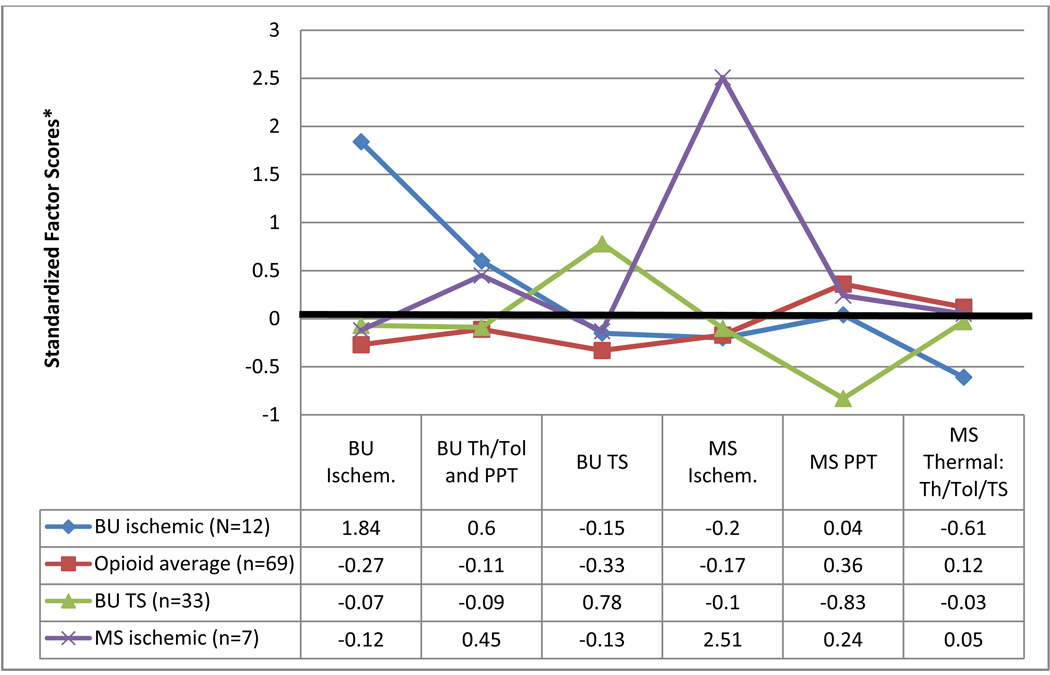
Given our limited ability to predict analgesic efficacy, further research is needed to understand factors influencing analgesic response patterns. The aim of this study was to better understand the relationship between morphine and butorphanol analgesic efficacy tested against multiple pain modalities within the same individuals. Participants included healthy men (n = 72) and women (n = 67) who underwent thermal, pressure, and ischemic experimental pain testing before and after the double-blind administration of morphine and butorphanol during separate testing sessions. Factor analysis revealed 6 factors with analgesic effects grouped primarily by pain modality and specific to either morphine or butorphanol. Hierarchical cluster analysis of individual factor scores led to 4 distinct drug response profiles. Three groups displayed exceptional analgesic efficacy produced by 1 type of opioid on 1 pain stimulus modality, whereas the fourth drug response profile was characterized by average analgesic efficacy across all pain modalities for both opioids. These findings suggest that opioids with varying efficacy at the μ and κ receptors produce independent effects on unique pain mechanisms and that individual responsiveness for some is dependent on pain mechanism and opioid type, although a subset of the population is moderately responsive to opioids regardless of efficacy of receptor binding or predominant pain mechanism being activated.
Perspective: This investigation provides a foundation for understanding patterns of opioid efficacy in varying types of pain. Our findings suggest that opioid response patterns are more complex than originally thought with about half of individuals exhibiting opioid and pain modality specific analgesic response profiles.
Copyright © 2011 American Pain Society. Published by Elsevier Inc. All rights reserved.
Figures
References
-
- Arendt-Nielsen L, Yarnitsky D. Experimental and clinical applications of quantitative sensory testing applied to skin, muscles and viscera. J Pain. 2009;10:556–572. - PubMed
-
- Belknap JK, Noordewier B, Lame M. Genetic dissociaiton of multiple morphine effects among C57BL/6J, DBA/2J and C3H–HEJ inbred mouse strains. Physiol Behav. 1989;46:69–74. - PubMed
-
- Bellgowan PSF, Helmstetter FJ. The role of mu and kappa opioid receptors within the periaqueductal gray in the expression of conditional hypoalgesia. Brain Res. 1998;791:83–89. - PubMed
-
- Chesler EJ, Ritchie J, Kokayeff A, Lariviere WR, Wilson SG, Mogil JS. Genotype-dependence of gabapentin and pregabalin sensitivity: the pharmacogenetic mediation of analgesia is specific to the type of pain being inhibited. Pain. 2003;106:325–335. - PubMed
-
- Coghill RC, Gracely RH. Validation of combined numerical-analog descriptor scales for rating pain intensity and pain unpleasantness. Proc Am Pain Soc. 1996;15:86.
Publication types
MeSH terms
Substances
Grants and funding
LinkOut - more resources
Full Text Sources
Medical
Research Materials
