. 2011 Feb 11;406(1):44-58.
doi: 10.1016/j.jmb.2010.12.001. Epub 2010 Dec 10.

Elevated copper remodels hepatic RNA processing machinery in the mouse model of Wilson's disease

Affiliations

Elevated copper remodels hepatic RNA processing machinery in the mouse model of Wilson's disease

Jason L Burkhead et al. J Mol Biol. .

Abstract

Copper is essential to mammalian physiology, and its homeostasis is tightly regulated. In humans, genetic defects in copper excretion result in copper overload and Wilson's disease (WD). Previous studies on the mouse model for WD (Atp7b(-)(/-)) revealed copper accumulation in hepatic nuclei and specific changes in mRNA profile prior to the onset of pathology. To find a molecular link between nuclear copper elevation and changes in hepatic transcriptome, we utilized quantitative ionomic and proteomic approaches. X-ray fluorescence and inductively coupled plasma mass spectrometry analysis indicate that copper in the Atp7b(-/-) nucleus, while highly elevated, does not markedly alter nuclear ion content. Widespread protein oxidation is also not observed, although the glutathione reductase SelH is upregulated, likely to maintain redox balance. We further demonstrate that accumulating copper affects the abundance and/or modification of a distinct subset of nuclear proteins. These proteins populate pathways that are most significantly associated with RNA processing. An alteration in splicing pattern was observed for hnRNP A2/B1, itself the RNA shuttling factor and spliceosome component. Analysis of hnRNP A2/B1 mRNA and protein revealed an increased retention of exon 2 and a selective 2-fold upregulation of a corresponding protein splice variant. Mass spectrometry measurements suggest that the nucleocytoplasmic distribution of RNA binding proteins, including hnRNP A2/B1, is altered in the Atp7b(-/-) liver. We conclude that remodeling of the RNA processing machinery is an important component of cell response to elevated copper that may guide pathology development in the early stages of WD.


Figures

1
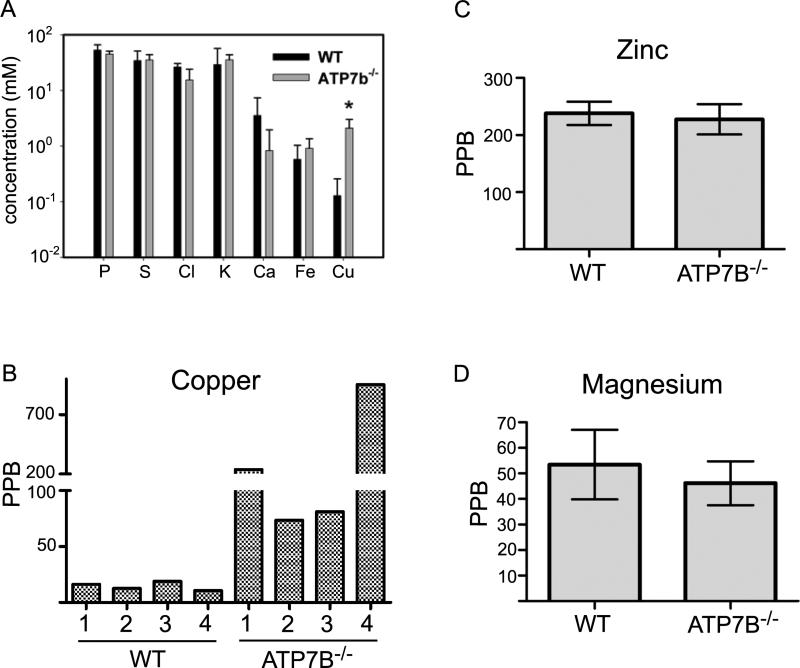
1. Ion composition of Atp7b-/- nuclei is not significantly affected by elevated copper
(A) Elemental concentration in the wild type and Atp7b-/- nuclei in situ was determined by SXRF following rapid freezing of liver tissue and sectioning. Statistically significant change is indicated by a star (Two independent biological replicates were used for each control and Atp7b-/- samples, with 4 and 3 scans per sample, respectively. The SD values were determined using the sample mean average for all scans). (B) Copper concentration in purified wild type and Atp7b-/- hepatic cell nuclei, as measured by ICP-MS; values for individual animals are shown. (C,D) The ICP-MS results for zinc and magnesium in purified wild type and Atp7b-/- cell nuclei. Two independent experiments (with the same results) were done using 4 animals of each genotype (4 controls and 4 Atp7b-/-) per experiment.
2
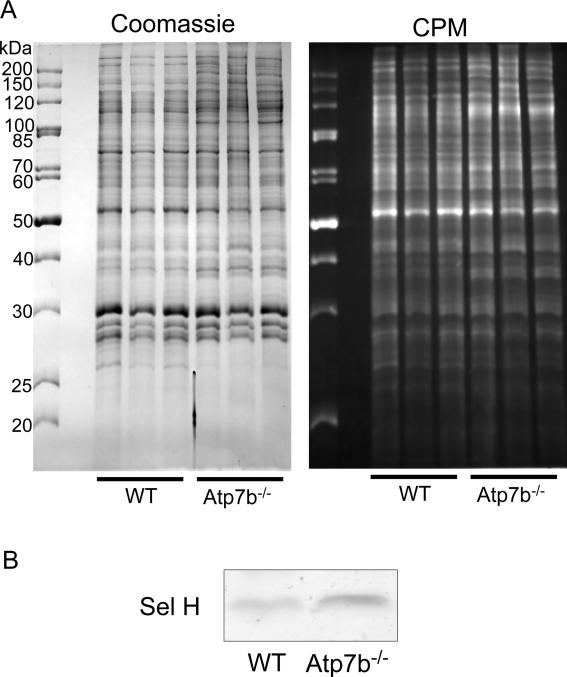
2. Copper does not induce a widespread oxidation of cysteines in Atp7b-/- nuclei
Nuclear protein extracts were labeled with the Cys directed fluorescein coumarin maleimide CPM, separated by standard Laemmli gel and then stained by Coomassie. (A) Left: Comparison of protein patterns in control and Atp7b-/- nuclei by Coomassie staining, Right: CPM fluorescent image of the same gel. (B) Immunodetection of Sel H in purified nuclei from the wild type and Atp7b-/- livers. Three of each control and Atp7b-/- livers were used for the experiment.
3
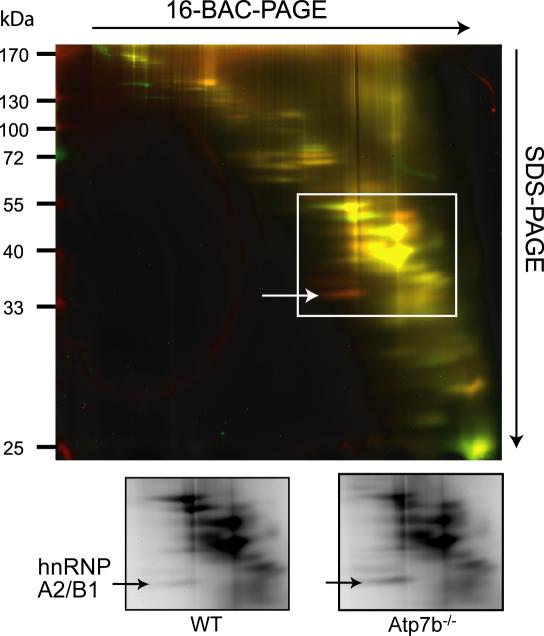
3. The RNA binding protein hnRNP A2/B1 is significantly changed in Atp7b-/- nuclei
Top: 16-BAC/SDS-PAGE 2D gel separation of proteins from Cy3-labeled extract of wild type (green) and Cy5-labeled Atp7b -/- (red) nuclei. (B) Grayscale image of the gel with differentially abundant spot indicated. The protein in the spot was extracted, digested and identified by mass-spectrometry as hnRNP A2/B1. Two independent experiments were performed with the same result, the results of one of them is shown.
4
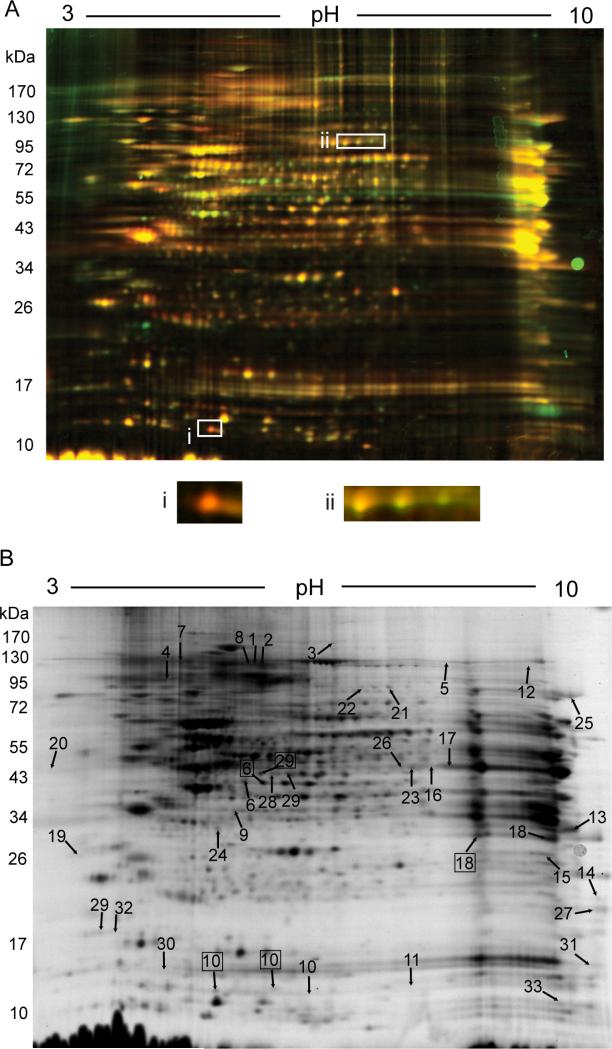
4. Remodeling of nuclear proteome in response to copper elevation
(A) Representative DIGE gel comparing the wild type (Cy3, green) and Atp7b -/- (Cy5, red) samples: box (i) illustrates apparent change in protein abundance, box (ii) - change in modification. (B) Grayscale image of the representative DIGE gel with differentially changed spots indicated by arrows. Numbers identify spots changed in abundance. Boxed numbers indicate the same protein as the one indicated by number but without change in abundance. The presence of the same protein in two spots suggests changes in posttranslational modification. (6 independent biological replicates of each genotype/per gel was used in analytical experiments; 4 independent biological replicates of each genotype per gel was used for the large-scale experiment. Fold-difference and t-test were employed to identify all changed spots)
5
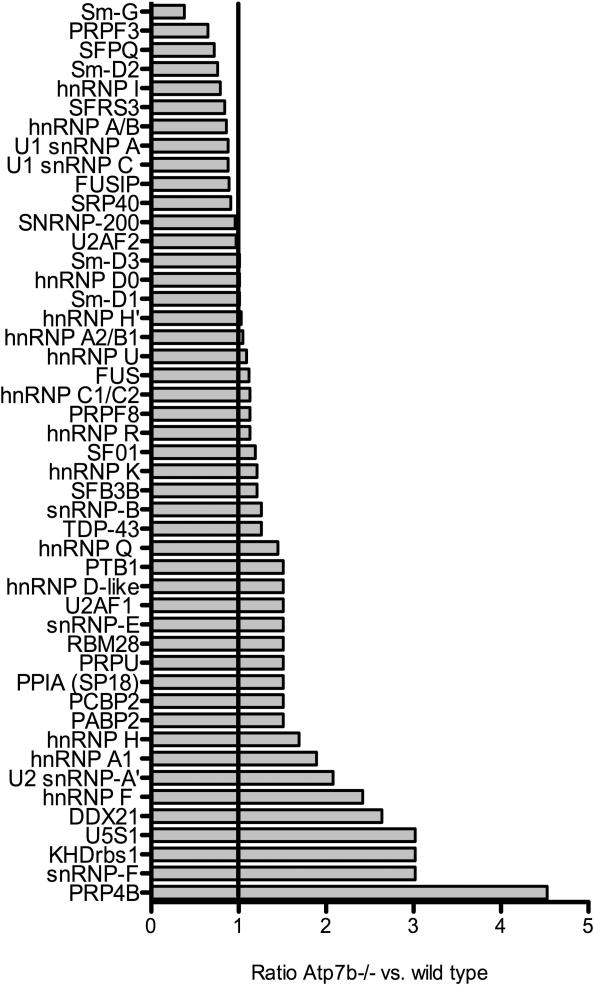
5. Relative abundance of RNA binding proteins in the Atp7b-/- nuclei compared to wild type
Fold change of the RNA binding proteins in Atp7b-/- sample compared to wild type is indicated. Abundance was determined by spectral counting.
6
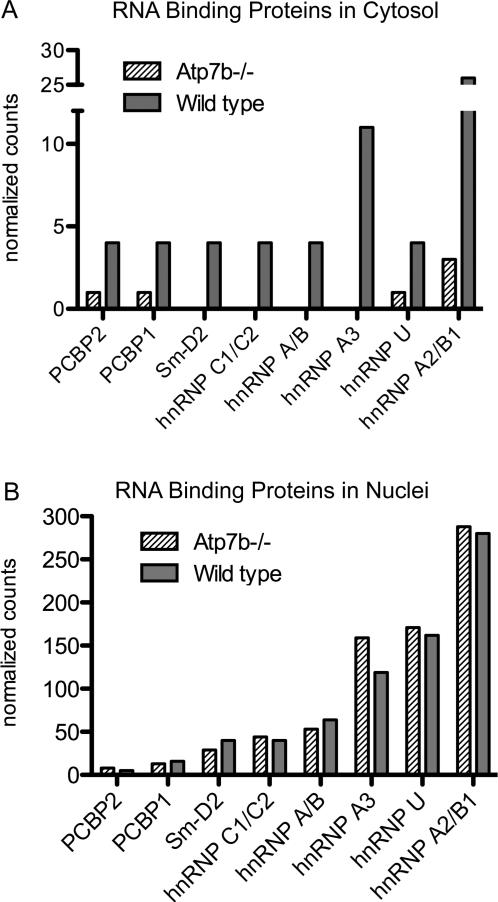
6. Nucleo-cytoplasmic distribution of RNA binding proteins in Atp7b-/- and wild type samples
Normalized MS/MS spectral counts illustrate (A) the decreased amount of several RNA binding proteins in Atp7b-/- cytosol and (B) reciprocal increase of hnRNP A3, hnRNPU, and hnRNP A2/B1 in Atp7b-/- nuclei
7
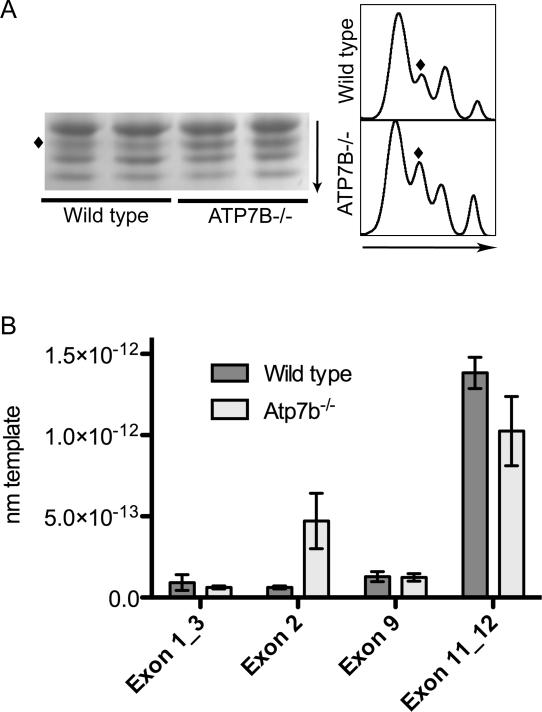
7. Increased retention of exon 2 is associated with the up-regulation of a single splice variant of hnRNPA2/B1
(A) Left: SDS-PAGE and immunodetection of hnRNP A2/B1 variants (one of 6 independent experiments is shown). Right: Signal intensity as measured by densitometry. Arrows indicate direction of migration in electrophoresis. The diamond symbol (◆) indicates the upregulated variant. (B) The hnRNP exon abundance was determined by quantitative PCR and normalized to GAPDH. Mean values (generated using 3 of each independent control and Atp7b-/- samples) and standard deviation are shown.

References

    1. Buiakova OI, Xu J, Lutsenko S, Zeitlin S, Das K, Das S, Ross BM, Mekios C, Scheinberg IH, Gilliam TC. Null mutation of the murine ATP7B (Wilson disease) gene results in intracellular copper accumulation and late-onset hepatic nodular transformation. Hum. Mol. Genet. 1999;8:1665–1671. - PubMed
    1. Huster D, Finegold MJ, Morgan CT, Burkhead JL, Nixon R, Vanderwerf SM, Gilliam CT, Lutsenko S. Consequences of copper accumulation in the livers of the Atp7b-/- (Wilson disease gene) knockout mice. Am. J. Pathol. 2006;168:423–434. - PMC - PubMed
    1. Harris ZL, Gitlin JD. Genetic and molecular basis for copper toxicity. Am J Clin Nutr. 1996;63:836S–841S. - PubMed
    1. Waggoner DJ, Bartnikas TB, Gitlin JD. The role of copper in neurodegenerative disease. Neurobiol Dis. 1999;6:221–230. - PubMed
    1. Carmichael PL, Hewer A, Osborne MR, Strain AJ, Phillips DH. Detection of bulky DNA lesions in the liver of patients with Wilson's disease and primary haemochromatosis. Mutat Res. 1995;326:235–243. - PubMed

Publication types

MeSH terms