


Drinking and stress: an examination of sex and stressor differences using IVR-based daily data
- PMID: 21146940
- PMCID: PMC3090709
- DOI: 10.1016/j.drugalcdep.2010.10.022
Drinking and stress: an examination of sex and stressor differences using IVR-based daily data
Abstract
Background: Research on the relation of stress to alcohol consumption is inconsistent regarding the direction of effects, and this association has been shown to vary by sex and type of stress. We sought to build upon the stress-drinking literature by examining the direction of the stress-drinking association over time as well as sex and stressor differences using daily data.
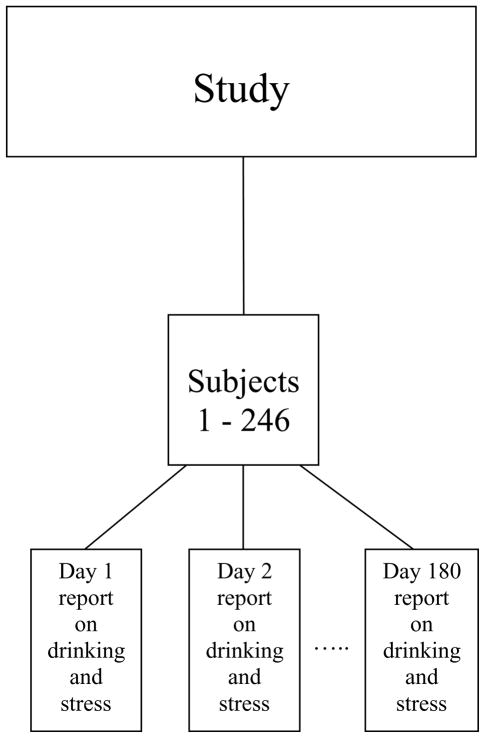
Method: 246 heavy drinking adults (67% men) aged 21-82 reported daily stress levels and alcohol consumption over 180 days using Interactive Voice Response (IVR). Baseline daily hassles were examined as an alternative measure of stress. Generalized estimating equations (GEEs) were conducted to test the stress-drinking association accounting for alcohol dependency at baseline and sex and stressor type as moderators.
Results: IVR daily stress predicted increased alcohol consumption the following day, whereas baseline level of daily hassles did not. Examining the opposite direction of effects, IVR ratings of daily alcohol consumption predicted decreased next-day stress. Stress predicted higher alcohol consumption the next day for men but there was no significant association for women. For both sexes, drinking predicted decreased stress the next day, but this effect was stronger for women.
Conclusions: This study generally supported the drinking to cope and self-medication hypotheses, with findings that increased stress led to increased drinking. The time-varying relation between stress and alcohol appears to be sex- and measure-specific, however. Therefore, interventions targeted at stress management found to be effective for one sex should not be presumed to be applicable to the other.
Copyright © 2010 Elsevier Ireland Ltd. All rights reserved.
Conflict of interest statement
Figures
References
-
- Abrams K, Kushner MG. The moderating effects of tension-reduction alcohol outcome expectancies on placebo responding in individuals with social phobia. Addict Behav. 2004;29:1221–1224. - PubMed
-
- Andersson C, Gordh Soderpalm AHV, Bergllund M. Use of real-time interactive voice response in a study of stress and alcohol consumption. Alcoholism Clin Exp Res. 2007;31:1908–1912. - PubMed
-
- Armeli S, Carney MA, Tennen H, Affleck G, O’Neil T. Stress and alcohol use: A daily process examination of the stressor-vulnerability model. J Pers Soc Psychol. 2000;78:979–994. - PubMed
-
- Armeli S, Dehart T, Tennen H, Todd M, Affleck G. Daily interpersonal stress and the stressor-vulnerability model of alcohol use. J Soc Clin Psychol. 2007;26:896–921.
-
- Armeli S, Tennen H, Todd M, Carney MA, Mohr C, Affleck G, Hromi A. A daily process examination of the stress-response dampening effects of alcohol consumption. Psychol Addict Behav. 2003;17:266–276. - PubMed
Publication types
MeSH terms
Substances
Grants and funding
LinkOut - more resources
Full Text Sources
Medical
