


Randomized trial of adjuvant zoledronic acid in postmenopausal women with high-risk breast cancer
- PMID: 21147691
- PMCID: PMC3091169
- DOI: 10.3816/CBC.2010.n.062
Randomized trial of adjuvant zoledronic acid in postmenopausal women with high-risk breast cancer
Abstract
Purpose: We present the results of a randomized multicenter clinical trial of adjuvant zoledronic acid (ZA) in postmenopausal women with high-risk breast cancer. The primary objective was change in bone mineral density (BMD) at the lumbar spine and femoral neck at 1 year. Secondary objectives included change in calcaneal BMD, disease-free survival (DFS), overall survival (OS), and toxicity.
Patients and methods: Postmenopausal women with stage II/III breast cancer diagnosed up to 5 years previous were eligible and randomized to either observation or ZA 4 mg intravenous every 3 months. Bone mineral density testing was performed at 0, 6, and 12 months.
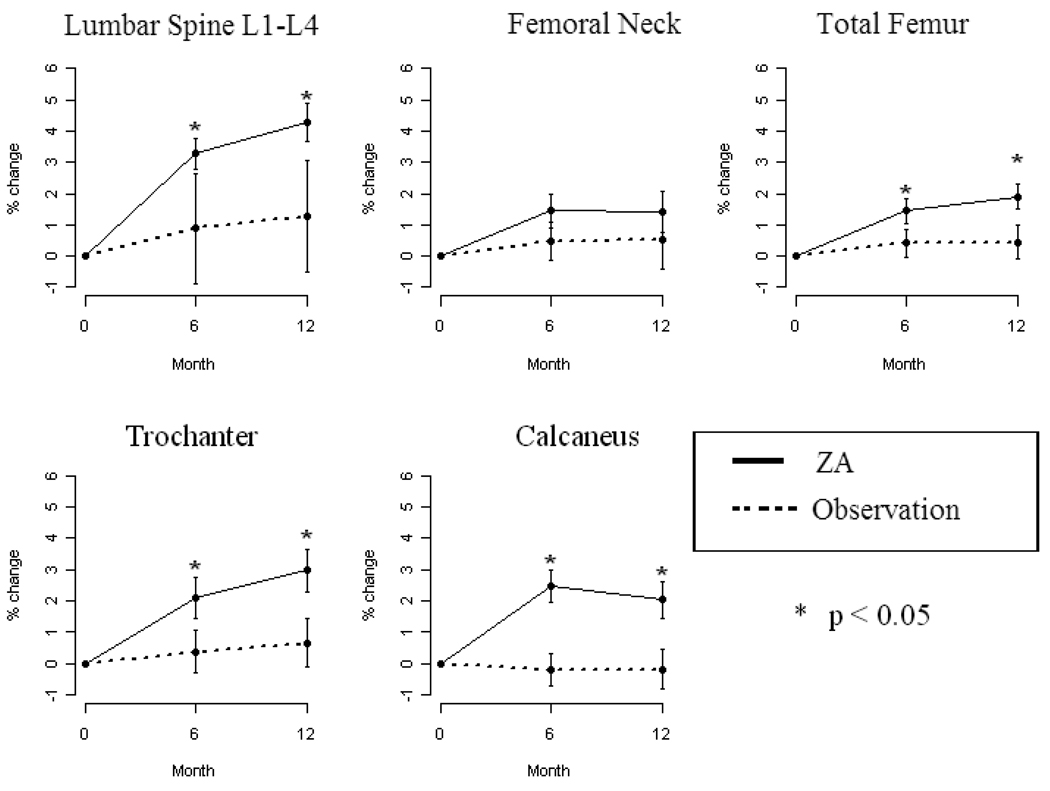
Results: Sixty-eight women were enrolled (36 ZA and 32 observation). The population was a median of 2 years from diagnosis and the majority received tamoxifen during the study. There was a significant difference in the mean change from baseline to 1 year follow-up for lumbar spine (increased by 4.28% ± 0.62%; P = .01), total femur (increased by 1.9% ± 0.4%; P = .03), trochanter (increased by 2.97% ± 0.69%; P = .03), and calcaneal BMD (increased by 2% ± 0.57%; P = .01) in favor of the ZA arm. No significant difference in the mean change for the femoral neck was seen. No significant differences in DFS or OS were observed.
Conclusion: Zoledronic acid significantly improved the BMD at multiple skeletal sites in postmenopausal women largely on tamoxifen. No new safety signals were noted. There were insufficient events to comment on DFS or OS.
Figures
References
-
- Keen RW. Burden of osteoporosis and fractures. Curr Osteoporos Rep. 2003;1:66–70. - PubMed
-
- Parkin DM, Bray F, Ferlay J, Pisani P. Global cancer statistics, 2002. CA Cancer J Clin. 2005;55:74–108. - PubMed
-
- Green JR, Muller K, Jaeggi KA. Preclinical pharmacology of CGP 42'446, a new, potent, heterocyclic bisphosphonate compound. J Bone Miner Res. 1994;9:745–751. - PubMed
-
- Ottewell PD, Lefley DV, Coleman RE, Holen I. Evaluation of the molecular mechanisms for the sequence-dependent, synergistic anti-tumour effects of doxorubicin and zoledronic acid in breast cancer. 31st Annual San Antonio Breast Cancer Symposium; 2008. Abstr 2151.
-
- Diel IJ, Solomayer EF, Costa SD, et al. et al. Reduction in new metastases in breast cancer with adjuvant clodronate treatment. N Engl J Med. 1998;339:357–363. - PubMed
Publication types
MeSH terms
Substances
Grants and funding
LinkOut - more resources
Full Text Sources
Medical
