. 2010 Dec 8;30(49):16573-84.
doi: 10.1523/JNEUROSCI.3305-10.2010.

Visual receptive field properties of neurons in the superficial superior colliculus of the mouse

Affiliations

Visual receptive field properties of neurons in the superficial superior colliculus of the mouse

Lupeng Wang et al. J Neurosci. .

Abstract

The mouse is a promising model in the study of visual system function and development because of available genetic tools. However, a quantitative analysis of visual receptive field properties had not been performed in the mouse superior colliculus (SC) despite its importance in mouse vision and its usefulness in developmental studies. We have made single-unit extracellular recordings from superficial layers of the SC in urethane-anesthetized C57BL/6 mice. We first map receptive fields with flashing spot stimuli and show that most SC neurons have spatially overlapped ON and OFF subfields. With drifting sinusoidal gratings, we then determine the tuning properties of individual SC neurons, including selectivity for stimulus direction and orientation, spatial frequency tuning, temporal frequency tuning, response linearity, and size preference. A wide range of receptive field sizes and selectivity are observed across the population and in various subtypes of SC neurons identified morphologically. In particular, orientation-selective responses are discovered in the mouse SC, and they are not affected by cortical lesion or long-term visual deprivation. However, ON/OFF characteristics and spatial frequency tuning of SC neurons are influenced by cortical inputs and require visual experience during development. Together, our results provide essential information for future investigations on the functional development of the superior colliculus.


Figures

Figure 1.
Figure 1.
Responses of SC neurons to flashing spots. A, Spike rasters (middle panel) and peristimulus time histograms (PSTHs) (bottom panel) of a SC neuron in response to a 5° bright square flashed on and off (top panel) within its receptive field. Calibration: 30 spikes/s (y-axis), 0.2 s (x-axis). B, The PSTHs of the neuron to spots flashed at different locations on the video monitor, showing both ON and OFF responses in most locations where spikes were evoked. C, Distribution of cells with ON only (white; n = 7 of 115), OFF only (black; n = 4 of 115), and ON–OFF responses (gray; n = 104 of 115). D, Distribution of ON/OFF peak response ratio (mean, 0.11 ± 0.03; median, 0.11; n = 115). E, Distribution of correlation coefficient of ON/OFF responses (mean, 0.69 ± 0.02; median, 0.78; n = 114).
Figure 2.
Figure 2.
Overlapped ON and OFF subfields in the receptive field of SC neurons. A, B, ON (A) and OFF (B) responses of a SC neuron (same as in Fig. 1B) to flashing spots. The color scales represent response magnitude (spikes/second), with red for ON and green for OFF. The yellow solid line on each panel is two-dimensional Gaussian fit of the response, and the dashed line is the fit of the opposite polarity, illustrating the large overlap of ON and OFF responses (OI = 0.87). C, Examples of SC receptive fields, with ON (red) and OFF (green) subfields and their OI shown above. D, Distribution of OI (median, 0.71; mean, 0.68 ± 0.02; n = 73). E, Correlation between OI and ON/OFF response correlation coefficient (r2 = 0.55; p < 0.001; n = 73). F, G, Distribution of the area of ON (F) and OFF (G) subfield. Note that the x-axes in both figures are cut off at 210 deg2 to better illustrate the distributions (ON area, 107.5 ± 14.9 deg2 with median of 70.4 deg2; n = 85; OFF area, 111.5 ± 12.5 deg2 with median of 83.4 deg2; n = 92). H, The distribution of ON/OFF area ratio (mean, −0.08 ± 0.04; median, −0.12; n = 73).
Figure 3.
Figure 3.
SC responses evoked by drifting gratings. A, Sinusoidal gratings (top panel) drifted perpendicular to their orientations along different directions (bottom panel). B, PSTHs of an example neuron in response to the drifting gratings. Each column includes PSTHs along 12 directions at one spatial frequency. C, Polar plot of the direction tuning curve of the neuron demonstrates its high orientation selectivity. D, Spatial frequency tuning curve of the same cell at its preferred direction. E, Tuning curve of a direction-selective cell.
Figure 4.
Figure 4.
Population analysis of grating-evoked responses. A, Polar plot of DSI (radii from origin) and preferred directions (angles). The outer circle represents DSI value of 1, the middle one of 0.5, and the inner one of 0.33. B, Distribution of DSI (mean, 0.39 ± 0.03; median, 0.28; n = 125). Note that a substantial fraction of neurons had DSI near 1. C, Distribution of highly direction-selective cells (DSI ≥ 0.5) in groups of different OSI values. D–F, Distributions of tuning width (mean, 40.9° ± 1.3°; median, 42.8°; n = 108) (D), preferred spatial frequency (n = 125) (E), and temporal frequency (n = 64) (F). G, The F1/F0 ratio of SC neurons shows a bimodal distribution, with most (n = 93 of 125) <1. H, Correlation between F1/F0 ratio and OI of individual cells (r2 = 0.17; p < 0.01; n = 41; black dots). Note that cells that only responded to ON or OFF were added to the plot (“x” symbols), with their OI assigned to 0.
Figure 5.
Figure 5.
The preference of SC neurons for stimulus size. A, PSTHs of an example neuron in response to flashing circles of different sizes, with their radii listed in each panel. B, Tuning curves of both ON (solid line) and OFF (dashed line) responses of the neuron shown in A. C, Distribution of the preferred sizes in response to flashing ON and OFF (n = 43). D, Distribution of the preferred sizes to drifting gratings (n = 49). E, Ratio of the response evoked by the largest grating to that evoked by the preferred size is plotted against receptive field size for individual neurons (r2 = 0.56; p < 0.001; n = 30). F, Difference in preferred direction in response to optimally sized and full-field gratings is plotted against the DSI at the preferred size (n = 49). G, Similar tuning widths in response to gratings at the preferred size and at full screen (r2 = 0.35; p < 0.01; n = 24).
Figure 6.
Figure 6.
Cortical influence on SC response properties. A, A coronal section showing the extent of cortical lesion. B, Box plots of OSI in V1 (n = 120), normal SC (SC w/ Ctx, n = 125) and SC without cortical projections (SC w/o Ctx, n = 112). The ends of the plots represent 5th and 95th percentiles (same below unless otherwise noted). V1 cells are more orientation-selective than in SC (p < 0.001), and removing cortex has no effect on SC selectivity (p = 0.49). C, Tuning width of the three groups (V1, n = 92; SC w/ Ctx, n = 108; SC w/o Ctx, n = 90). D, DSI of the three groups (V1, n = 120; SC w/ Ctx, n = 125; SC w/o Ctx, n = 112). E, Distribution of direction-selective cells (DSI ≥ 0.5), orientation-selective cells (OSI ≥ 0.5 and DSI < 0.5), and others (OSI < 0.5 and DSI < 0.5) in the SC with and without cortex. F, Distribution of the preferred spatial frequency (V1, n = 98; SC w/ Ctx, n = 125; SC w/o Ctx, n = 112). G, Box plots of F1/F0 ratio (V1, n = 120; SC w/ Ctx, n = 125; SC w/o Ctx, n = 112). H, Distribution of cells with ON only (white; n = 11 of 107), OFF only (black; n = 4 of 107), and ON–OFF responses (gray; n = 92 of 107) in the absence of cortical input. I, Cumulative distribution of correlation coefficient in the two conditions (SC w/ Ctx, n = 114; SC w/o Ctx, n = 92; p < 0.001). J, Cumulative distribution of OI (SC w/ Ctx, n = 73; SC w/o Ctx, n = 40; p < 0.05). K, Removing cortex does not change ON, OFF subfield areas of SC neurons. The ends of the box plots represent 10th and 90th percentiles. L, Evoked and spontaneous firing rate of SC neurons in the presence and absence of cortical input. *p < 0.05, **p < 0.01, and ***p < 0.001.
Figure 7.
Figure 7.
SC responses in the absence of visual experience during development. A, Distribution of cells with ON only (white; n = 14 of 71), OFF only (black; n = 2 of 71), and ON–OFF responses (gray; n = 55 of 71) in the SC after dark rearing from birth to the day of recording (approximately postnatal day 60). B, Dark rearing does not change ON, OFF subfield size (p = 0.95 for ON; p = 0.57 for OFF, t test). The ends of the box plots represent 10th and 90th percentiles. C, Cumulative distribution of overlap index in NR (n = 73) and DR (n = 29) cells. No significant difference is found (p = 0.81). D, Distribution of the preferred spatial frequency in the SC of NR (n = 125) and DR (n = 78) mice. The distribution is shifted to higher spatial frequency in DR (p < 0.001, χ2 test). E, F, Cumulative distribution of OSI (E) and DSI (F) in the two conditions. No significant difference is seen for either OSI (p = 0.15) or DSI (p = 0.44).
Figure 8.
Figure 8.
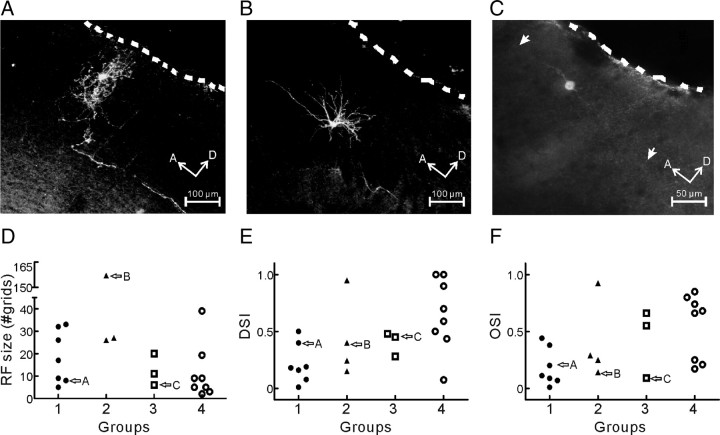
Response heterogeneity in the mouse SC. A, Confocal image of a putative narrow field vertical cell, whose soma was located ∼100 μm below the SC surface (dashed line). A, Anterior; D, dorsal. B, Confocal image of a putative wide field vertical cell, whose soma was ∼300 μm below the SC surface (dashed line). Note that the dendritic arbors were probably truncated in these images because of sectioning. C, A horizontal cell with horizontally elongated dendrites (arrows). The SC surface is indicated by dashed lines. D, Scatter plots of receptive field sizes of different cell groups. The size was determined by counting the number of 5 × 5° grid points where flashing spots evoked responses. The example cells shown in A–C are labeled with arrows. The group numbers correspond to those in supplemental Table 1 (available at www.jneurosci.org as supplemental material). Note that only three of the four group 2 cells responded. E, F, Distribution of DSI (E) and OSI (F) of different groups. All values were obtained after cortical lesion.

References

    1. Andermann ML, Kerlin AM, Reid RC. Chronic cellular imaging of mouse visual cortex during operant behavior and passive viewing. Front Cell Neurosci. 2010;4:3. - PMC - PubMed
    1. Balkema GW, Jr, Pinto LH. Electrophysiology of retinal ganglion cells in the mouse: a study of a normally pigmented mouse and a congenic hypopigmentation mutant, pearl. J Neurophysiol. 1982;48:968–980. - PubMed
    1. Bereshpolova Y, Stoelzel CR, Gusev AG, Bezdudnaya T, Swadlow HA. The impact of a corticotectal impulse on the awake superior colliculus. J Neurosci. 2006;26:2250–2259. - PMC - PubMed
    1. Binns KE, Salt TE. Post eye-opening maturation of visual receptive field diameters in the superior colliculus of normal- and dark-reared rats. Brain Res Dev Brain Res. 1997a;99:263–266. - PubMed
    1. Binns KE, Salt TE. Different roles for GABAA and GABAB receptors in visual processing in the rat superior colliculus. J Physiol. 1997b;504:629–639. - PMC - PubMed

Publication types

MeSH terms