


Similar efficacy and tolerability of double-dose chloroquine and artemether-lumefantrine for treatment of Plasmodium falciparum infection in Guinea-Bissau: a randomized trial
- PMID: 21148503
- PMCID: PMC3086436
- DOI: 10.1093/infdis/jiq001
Similar efficacy and tolerability of double-dose chloroquine and artemether-lumefantrine for treatment of Plasmodium falciparum infection in Guinea-Bissau: a randomized trial
Abstract
Background: In 2008, Guinea-Bissau introduced artemether-lumefantrine for treatment of uncomplicated malaria. Previously, 3 times the standard dose of chloroquine, that was probably efficacious against Plasmodium falciparum with the resistance-associated chloroquine-resistance transporter (pfcrt) 76T allele, was routinely used. The present study compared the efficacy and tolerability of a double standard dose of chloroquine with the efficacy and tolerability of artemether-lumefantrine.
Methods: In a randomized open-label clinical trial, artemether-lumefantrine or chloroquine (50 mg/kg) were given as 6 divided doses over 3 days to children aged 6 months--15 years who had uncomplicated P. falciparum monoinfection. Drug concentrations were measured on day 7. P. falciparum multidrug resistance gene N86Y and pfcrt K76T alleles were identified.
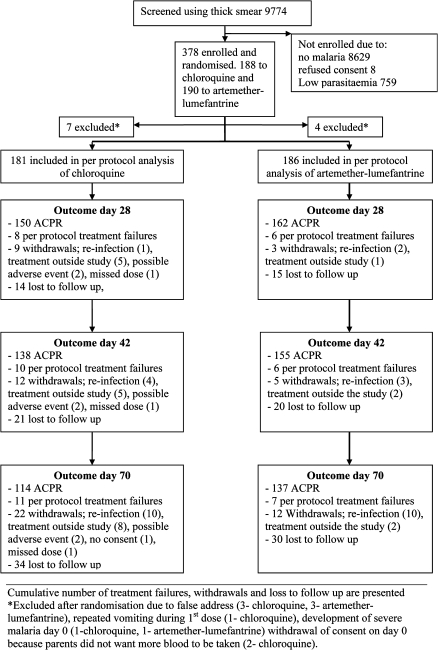
Results: The polymerase chain reaction-adjusted day 28 and 42 treatment efficacies were 162 (97%) of 168 and 155 (97%) of 161, respectively, for artemether-lumefantrine and 150 (95%) of 158 and 138 (94%) of 148, respectively, for chloroquine. When parasites with resistance-associated pfcrt 76T were treated, the day 28 efficacy of chloroquine was 87%. No severe drug-related adverse events were detected. Symptom resolution was similar with both treatments.
Conclusions: Both treatments achieved the World Health Organization-recommended efficacy for antimalarials that will be adopted as policy. High-dose chloroquine treatment regimes should be further evaluated with the aim of assessing chloroquine as a potential partner drug to artemisinin derivatives. Clinical trials registration. NCT00426439.
Figures
Comment in
-
Is chloroquine making a comeback?J Infect Dis. 2011 Jan 1;203(1):11-2. doi: 10.1093/infdis/jiq002. J Infect Dis. 2011. PMID: 21148490 Free PMC article. No abstract available.
References
-
- Wongsrichanalai C, Pickard AL, Wernsdorfer WH, Meshnick SR. Epidemiology of drug-resistant malaria. Lancet Infect Dis. 2002;2:209–18. - PubMed
-
- WHO. World malaria report. World Health Organization; 2009.
-
- Noedl H, Se Y, Schaecher K, Smith BL, Socheat D, Fukuda MM. Evidence of artemisinin-resistant malaria in western Cambodia. N Engl J Med. 2008;359:2619–20. - PubMed
Publication types
MeSH terms
Substances
Associated data
LinkOut - more resources
Full Text Sources
Medical
