. 2011 Feb;10(2):226-36.
doi: 10.1128/EC.00209-10. Epub 2010 Dec 10.

Recombination can cause telomere elongations as well as truncations deep within telomeres in wild-type Kluyveromyces lactis cells

Affiliations

Recombination can cause telomere elongations as well as truncations deep within telomeres in wild-type Kluyveromyces lactis cells

Laura H Bechard et al. Eukaryot Cell. 2011 Feb.

Abstract

In this study, we examined the role of recombination at the telomeres of the yeast Kluyveromyces lactis. We demonstrated that an abnormally long and mutationally tagged telomere was subject to high rates of telomere rapid deletion (TRD) that preferentially truncated the telomere to near-wild-type size. Unlike the case in Saccharomyces cerevisiae, however, there was not a great increase in TRD in meiosis. About half of mitotic TRD events were associated with deep turnover of telomeric repeats, suggesting that telomeres were often cleaved to well below normal length prior to being reextended by telomerase. Despite its high rate of TRD, the long telomere showed no increase in the rate of subtelomeric gene conversion, a highly sensitive test of telomere dysfunction. We also showed that the long telomere was subject to appreciable rates of becoming elongated substantially further through a recombinational mechanism that added additional tagged repeats. Finally, we showed that the deep turnover that occurs within normal-length telomeres was diminished in the absence of RAD52. Taken together, our results suggest that homologous recombination is a significant process acting on both abnormally long and normally sized telomeres in K. lactis.


Figures
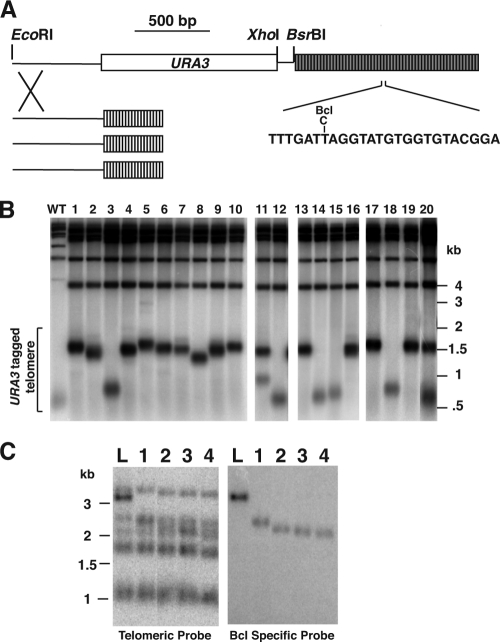
Fig. 1.
Fig. 1.
Frequent deletions occur at a long telomere in K. lactis. (A) Diagram of the single long Bcl telomere introduced into K. lactis cells (shown to scale). This telomere contains a URA3 selectable marker gene (white box) inserted into the subtelomeric sequence. The unique XhoI site allows the Bcl telomere to be separated from other telomeres in gels. A native BsrBI site 3 bp internal to the telomere is present in 10 of the 12 wild-type telomeres in the cell. The long telomere is made up completely of Bcl repeats containing a single base pair change that makes a BclI restriction site (gray blocks). After transformation into K. lactis cells with wild-type telomeric repeats (white blocks), the long Bcl telomere recombines via subtelomeric homology and replaces a single native telomere. (B) Southern blot hybridized to a telomeric probe, showing an XhoI digest of genomic DNAs from subclones of cells containing the long Bcl telomere. The wild-type (WT) control is an equivalent telomeric fragment containing a subtelomeric URA3 gene, but of wild-type length and composed of wild-type telomeric repeats. After introduction into K. lactis cells, the XhoI fragment containing the long Bcl telomere measures ∼1.5 kb and contains ∼55 telomeric repeats, indicating that it is ∼3 times longer than a wild-type telomere. The position of the introduced telomere is indicated by the bracket. (C) Southern blot showing an EcoRI digest of telomeres hybridized to the Klac1-25 probe (which hybridizes to both wild-type and Bcl telomeric repeats) and a probe specific for Bcl repeats. Four clones that had undergone TRD are shown (lanes 1 to 4) as well as a clone with the original long telomere (lane L). Markers are shown in kilobases in both panels B and C.
Fig. 2.
Fig. 2.
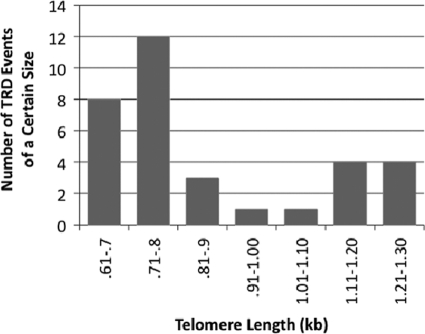
Summary of telomere lengths after TRD. The bar graph shows the length distribution of 33 of the TRD events observed. The telomere length was measured as the size of the XhoI Bcl telomeric fragment after TRD, and the vertical axis shows the number of samples which were shortened to within a given size range.
Fig. 3.
Fig. 3.
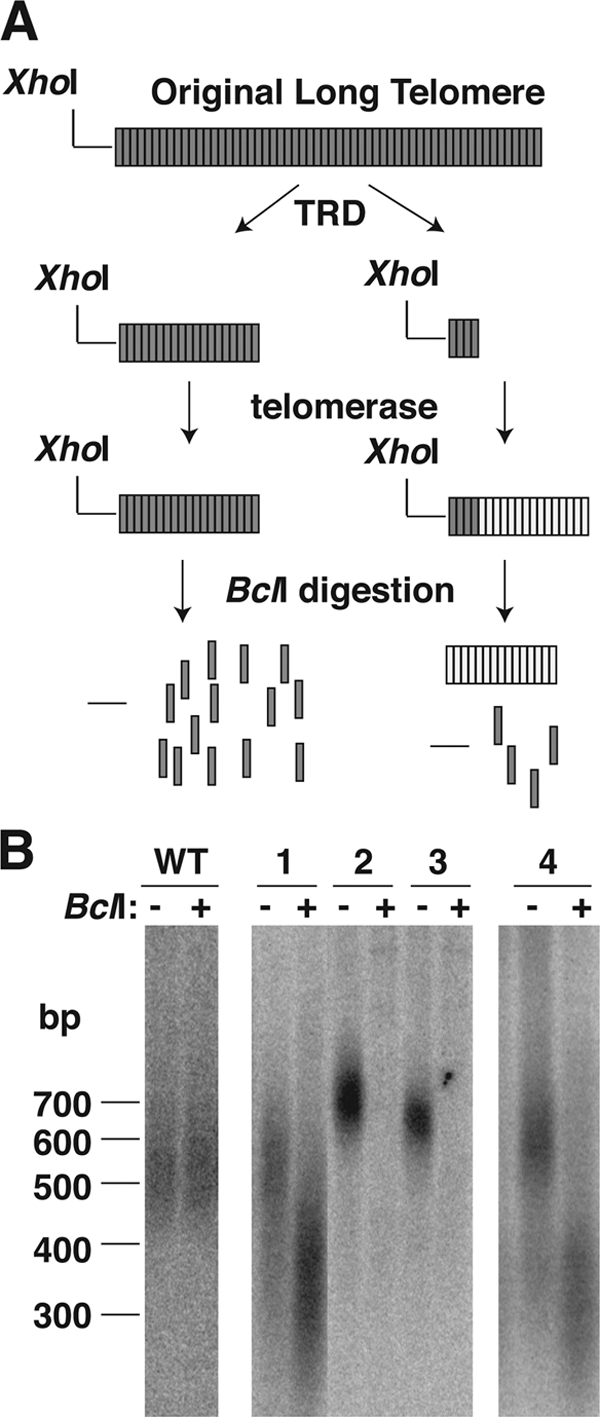
TRD events can result in turnover deep into the shortened telomere. (A) Two possible outcomes for the long Bcl telomere after undergoing TRD. In the first, on the left, the long telomere is shortened to wild-type size, and all of the remaining repeats are Bcl repeats. After cleavage with BclI, the telomeric repeats are cleaved into individual repeats, and a small subtelomeric segment is liberated. In the outcome on the right, the long telomere is shortened to well below wild-type size and then reextended by the wild-type telomerase. After cleavage with BclI, a block of wild-type repeats will be left over, the Bcl repeats will be cleaved into individual repeats, and a small subtelomeric fragment will again be liberated. (B) Southern blots of 2% agarose gels hybridized to the Klac1-25 telomeric probe (which hybridizes to both wild-type and Bcl repeats), showing XhoI and XhoI-plus-BclI digests of four subclones that underwent TRD. The WT control described in the legend to Fig. 1 is shown on the left.
Fig. 4.
Fig. 4.
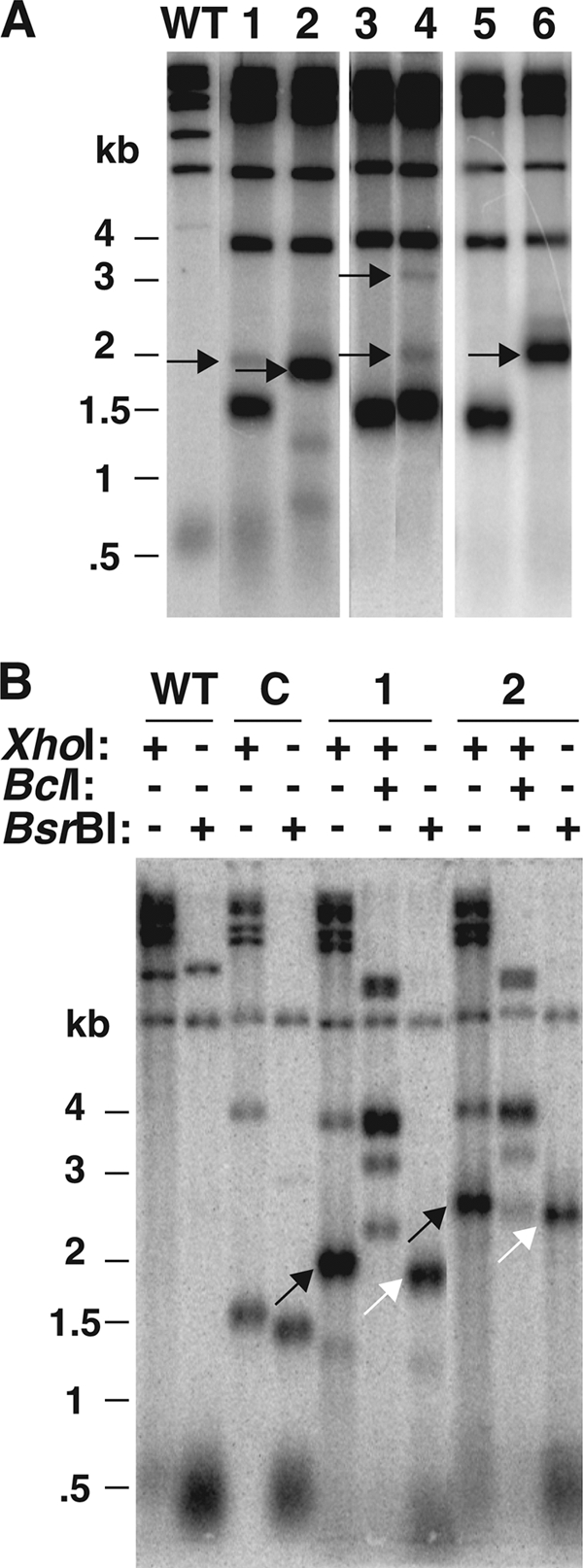
Further elongation of the long Bcl telomere can occur, and these elongations are made up of Bcl repeats. (A) Southern blot showing an XhoI digest of several long Bcl telomeres that have undergone elongation events. A wild-type control, as described in the legend to Fig. 1, is shown on the left. Black arrows show the positions of elongated telomeres in the sample. (B) Southern blot showing cleavage of DNAs from two subclones that had undergone elongation events with XhoI, XhoI plus BclI, and BsrBI, as indicated. A wild-type control is shown on the left, and “C” represents a control long telomere that has not undergone TRD or elongation. Positions of elongated telomeres in samples 1 and 2 are shown with slanted black arrows, and positions of the elongated telomeres in samples 1 and 2 after cleavage with BsrBI are shown with white arrows. Note that subclones 1 and 2 are not the same subclones as those shown in panel A. Markers for both panels are shown in kilobases.
Fig. 5.
Fig. 5.
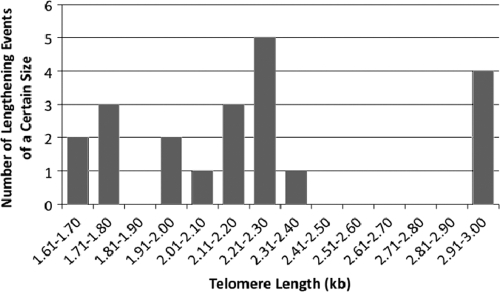
Summary of lengths of Bcl telomeres after further elongation. The bar graph shows the length distribution of 21 elongation events, including those detected as all of the Bcl telomeres in the samples examined or as a subset of the total. The telomere length was measured as the size of the XhoI Bcl telomeric fragment after elongation, and the vertical axis shows the number of samples which were lengthened to within a given size range.
Fig. 6.
Fig. 6.
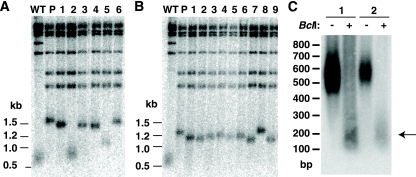
rad52Δ cells undergo TRD that often has appreciable turnover associated with it. (A) Southern blot showing XhoI digest of two TRD events in a rad52Δ strain containing the long Bcl telomere. Lane WT, URA3-tagged telomere that is wild type in length and sequence; lane P, precursor URA3-tagged long Bcl telomere from immediately prior to isolation of the subclones in the other lanes. The long Bcl telomere in the precursor was slightly longer than the same telomere in the subclones because of gradual sequence attrition in the latter from undergoing more cell divisions. (B) Southern blot showing XhoI digest of an apparent slight elongation event in a rad52Δ strain. Lanes marked WT and P indicate wild-type and precursor Bcl telomeres, as described for panel A. (C) Southern blot of a 1.5% agarose gel showing XhoI and XhoI-plus-BclI digests of two subclones that had undergone TRD to near-wild-type size in a rad52Δ strain. The position of the leftover wild-type block of repeats is shown with an arrow. Markers in panels A and B are shown in kilobases, and markers in panel C are shown in base pairs.
Fig. 7.
Fig. 7.
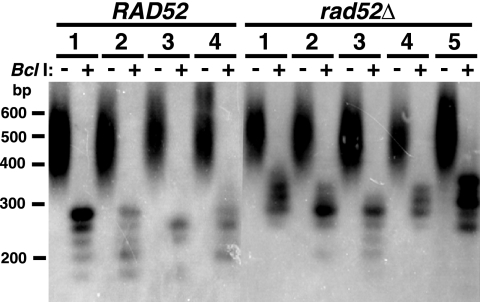
RAD52 contributes to turnover at K. lactis telomeres. The Southern blot, hybridized to a telomeric probe, shows BsrBI and BsrBI-plus-BclI digests of DNAs from five independent clones of rad52Δ TER1-7C(Bcl) cells and four independent clones of RAD52 TER1-7C(Bcl) cells. All clones were grown for ∼400 cell divisions prior to analysis. Positions of DNA size markers are indicated.
Fig. 8.
Fig. 8.
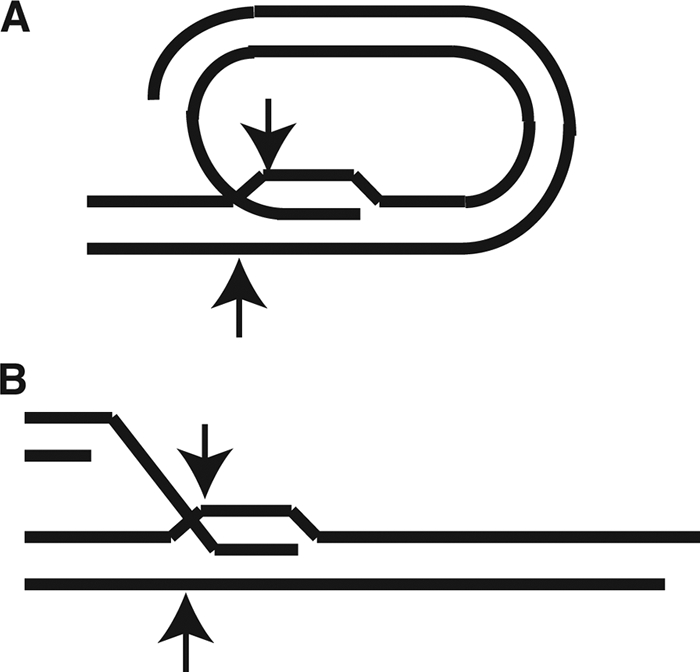
Two potential mechanisms of TRD. (A) Model showing intramolecular strand invasion of a telomeric end into its own telomeric repeats, forming a t-loop. (B) Model showing strand invasion of a wild-type telomere into an abnormally long telomere. Nucleolytic cleavage positions that might produce a TRD event are shown with arrows in each model.

References

    1. Bailey S. M., Brenneman M. A., Goodwin E. H. 2004. Frequent recombination in telomeric DNA may extend the proliferative life of telomerase-negative cells. Nucleic Acids Res. 32:3743–3751 - PMC - PubMed
    1. Bechard L. H., et al. 2009. Mutant telomeric repeats in yeast can disrupt the negative regulation of recombination-mediated telomere maintenance and create an alternative lengthening of telomeres-like phenotype. Mol. Cell. Biol. 29:626–639 - PMC - PubMed
    1. Bryan T. M., Englezou A., Gupta J., Bacchetti S., Reddel R. R. 1995. Telomere elongation in immortal human cells without detectable telomerase activity. EMBO J. 14:4240–4248 - PMC - PubMed
    1. Bucholc M., Park Y., Lustig A. J. 2001. Intrachromatid excision of telomeric DNA as a mechanism for telomere size control in Saccharomyces cerevisiae. Mol. Cell. Biol. 21:6559–6573 - PMC - PubMed
    1. Carter S. D., Iyer S., Xu J., McEachern M. J., Astrom S. U. 2007. The role of nonhomologous end-joining components in telomere metabolism in Kluyveromyces lactis. Genetics 175:1035–1045 - PMC - PubMed

Publication types

Substances