Perceptual learning, aging, and improved visual performance in early stages of visual processing
- PMID: 21149304
- PMCID: PMC3136086
- DOI: 10.1167/10.13.4
Perceptual learning, aging, and improved visual performance in early stages of visual processing
Abstract
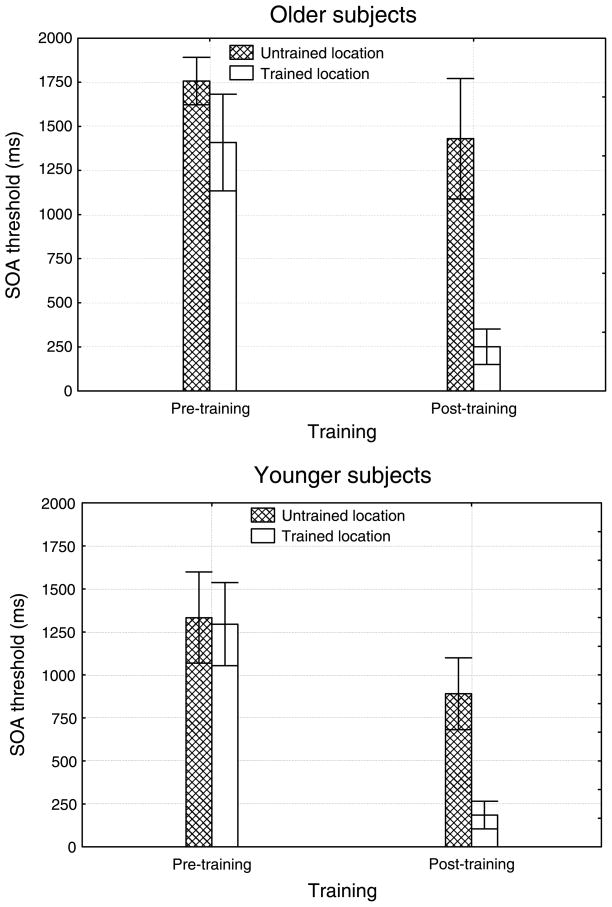
In the present study, we examined whether perceptual learning methods can be used to improve performance of older individuals. Subjects performed a texture discrimination task in the peripheral visual field and a letter discrimination task in central vision. The SOA threshold was derived by presenting a mask following the stimuli. Older subjects (age greater than 65 years) were either trained for 2 days using near threshold stimuli (experimental group) or were trained with the task with supra-threshold stimuli (older control group). The experimental group showed significant improvement in the task as a result of training whereas the older control group showed no significant improvement. The improved performance post-training equaled that of a younger control group and was maintained for at least 3 months. The results of two additional experiments indicate that the improved performance was not due to changes in divided attention, that the effect of perceptual learning was location specific, and that the pattern of learning was similar to that of younger subjects. These results indicate that perceptual learning with near threshold training can be used to improve visual performance among older individuals, that the improvements are not the result of practice with the visual task, and that the improvements do not transfer to non-trained locations.
Figures


References
-
- Ahissar M, Hochstein S. Task difficulty and the specificity of perceptual learning. Nature. 1997;387:401–406. - PubMed
-
- Andersen GJ, Atchley P. Age-related differences in the detection of three-dimensional surfaces from optic flow. Psychology and Aging. 1995;10:650–658. - PubMed
-
- Andersen GJ, Cisneros J, Atchley P, Saidpour A. Speed, size, and edge-rate information for the detection of collision events. Journal of Experimental Psychology: Human Perception and Performance. 1999;25:256–269. - PubMed
-
- Andersen GJ, Enriquez A. Aging and the detection of observer and moving object collisions. Psychology and Aging. 2006;21:74–85. - PubMed
-
- Atchley P, Andersen GJ. The effects of age, retinal eccentricity, and speed on the detection of optic flow components. Psychology and Aging. 1998;13:297–308. - PubMed
Publication types
MeSH terms
Grants and funding
LinkOut - more resources
Full Text Sources
Medical