


Review
doi: 10.1074/jbc.R110.179325.
Epub 2010 Dec 13.
Cellular processing of the glucocorticoid receptor gene and protein: new mechanisms for generating tissue-specific actions of glucocorticoids
Affiliations
- PMID: 21149445
- PMCID: PMC3030321
- DOI: 10.1074/jbc.R110.179325
Item in Clipboard
Review
Cellular processing of the glucocorticoid receptor gene and protein: new mechanisms for generating tissue-specific actions of glucocorticoids
J Biol Chem.
.
Abstract
Glucocorticoids regulate numerous physiological processes and are mainstays in the treatment of inflammation, autoimmune disease, and cancer. The traditional view that glucocorticoids act through a single glucocorticoid receptor (GR) protein has changed in recent years with the discovery of a large cohort of receptor subtypes arising from alternative processing of the GR gene. These isoforms differ in their expression, gene regulatory, and functional profiles. Post-translational modification of these proteins further expands GR diversity. Here, we discuss the origin and molecular properties of the GR isoforms and their contribution to the sensitivity and specificity of the glucocorticoid response.
Figures
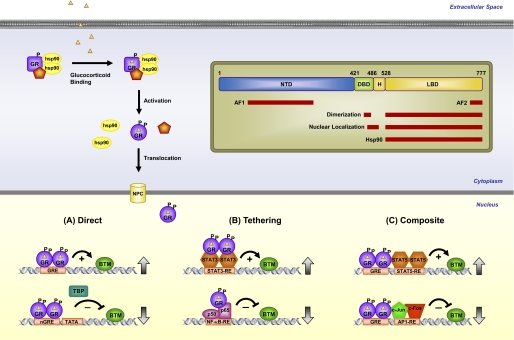
GR signaling pathway. Upon binding glucocorticoids, cytoplasmic GR undergoes a change in conformation (activation), becomes hyperphosphorylated (P), dissociates from accessory proteins, and translocates into the nucleus, where it regulates gene expression. GR enhances or represses transcription of target genes by direct GRE binding (A), by tethering itself to other transcription factors apart from DNA binding (B), or in a composite manner by both direct GRE binding and interactions with transcription factors bound to neighboring sites (C). Inset, GR is composed of an NTD, a DBD, a hinge region (H), and an LBD. Regions involved in transcriptional activation (AF1 and AF2), dimerization, nuclear localization, and chaperone hsp90 binding are indicated. Position numbers are for the human GR. NPC, nuclear pore complex; BTM, basal transcription machinery; TBP, TATA-binding protein; nGRE, negative GRE; RE, response element.
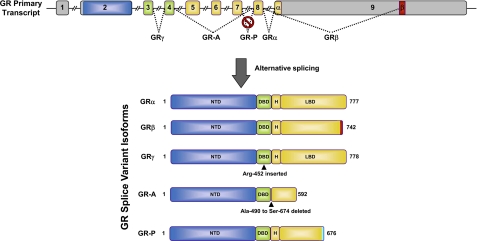
GR isoforms generated by alternative splicing. The human GR primary transcript is composed of nine exons, with exon 2 encoding most of the NTD, exons 3 and 4 encoding the DBD, and exons 5–9 encoding the hinge region (H) and LBD. The classic GRα protein results from splicing of exon 8 to the beginning of exon 9. GRβ is produced from an alternative splice acceptor site that links the end of exon 8 to downstream sequences in exon 9, encoding a variant with a unique 15-amino acid C terminus (positions 728–742). GRγ is generated by an alternative splice donor site in the intronic sequence separating exons 3 and 4, resulting in a protein with an arginine insertion (Arg-452) between the two zinc fingers of the DBD. GR-A is produced from alternative splicing that joins exon 4 to exon 8, deleting the proximal 185 amino acids of the LBD (Ala-490–Ser-674) encoded by exons 5–7. GR-P is formed by a failure to splice exon 7 to exon 8. The retained intronic sequence introduces a stop codon, resulting in a truncated receptor mutant missing the distal half of the LBD.
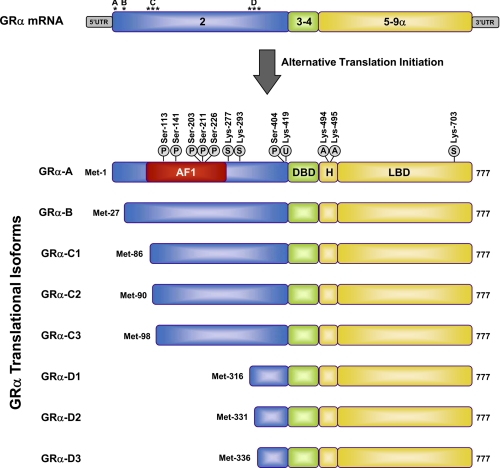
GRα isoforms generated by alternative translation initiation and sites of post-translational modification. Initiation of translation from eight different AUG start codons in a single GRα mRNA generates receptor isoforms with progressively shorter NTDs. Approximate locations of the AUG start codons in the exon 2 sequences of the GRα mRNA are designated by asterisks. The initiator methionines, AF1 region (amino acids 77–262), and sites of post-translational modifications (phosphorylation (P), sumoylation (S), ubiquitination (U), and acetylation (A)) are indicated for the human GRα isoforms. H, hinge region.
References
-
- Barnes P. J. (1998) Clin. Sci. 94, 557–572 - PubMed
-
- Sapolsky R. M., Romero L. M., Munck A. U. (2000) Endocr. Rev. 21, 55–89 - PubMed
-
- Rhen T., Cidlowski J. A. (2005) N. Engl. J. Med. 353, 1711–1723 - PubMed
-
- Chrousos G. P., Kino T. (2005) Sci. STKE 2005, pe48. - PubMed
-
- Kino T., De Martino M. U., Charmandari E., Mirani M., Chrousos G. P. (2003) J. Steroid Biochem. Mol. Biol. 85, 457–467 - PubMed
Publication types
MeSH terms
Substances
Grants and funding
LinkOut - more resources
Full Text Sources
Molecular Biology Databases
