Randomized Controlled Trial
. 2010 Dec;128(12):1528-32.
doi: 10.1001/archophthalmol.2010.292.

Longitudinal and cross-sectional analyses of visual field progression in participants of the Ocular Hypertension Treatment Study

Affiliations
Randomized Controlled Trial

Longitudinal and cross-sectional analyses of visual field progression in participants of the Ocular Hypertension Treatment Study

Paul H Artes et al. Arch Ophthalmol. 2010 Dec.

Abstract

Objective: To assess agreement between longitudinal and cross-sectional analyses for determining visual field progression in data from the Ocular Hypertension Treatment Study.

Methods: Visual field data from 3088 eyes of 1570 participants (median follow-up, 7 years) were analyzed. Longitudinal analyses were performed using change probability with total and pattern deviation, and cross-sectional analyses were performed using the glaucoma hemifield test, corrected pattern standard deviation, and mean deviation. The rates of mean deviation and general height change were compared to estimate the degree of diffuse loss in emerging glaucoma.

Results: Agreement on progression in longitudinal and cross-sectional analyses ranged from 50% to 61% and remained nearly constant across a wide range of criteria. In contrast, agreement on absence of progression ranged from 97.0% to 99.7%, being highest for the stricter criteria. Analyses of pattern deviation were more conservative than analyses of total deviation, with a 3 to 5 times lesser incidence of progression. Most participants developing field loss had both diffuse and focal changes.

Conclusions: Despite considerable overall agreement, 40% to 50% of eyes identified as having progressed with either longitudinal or cross-sectional analyses were identified with only one of the analyses. Because diffuse change is part of early glaucomatous damage, pattern deviation analyses may underestimate progression in patients with ocular hypertension.


Figures
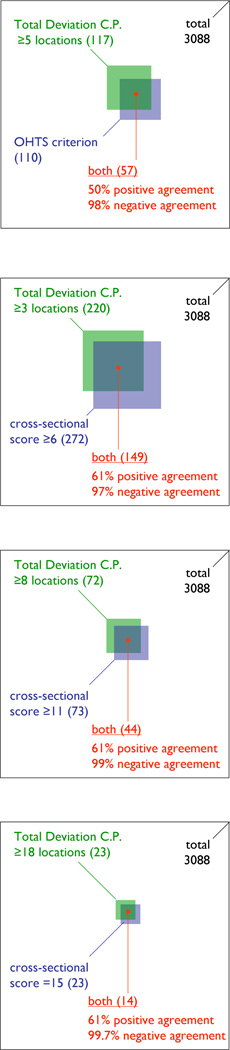
Figure 1
Figure 1
a) Agreement between longitudinal (total deviation change probability [C.P.], green square) and cross-sectional analyses (OHTS criterion, blue square) of visual field progression. The area of each square, and their overlap, is proportional to the number of eyes classified as having progressed with each method (in brackets).The total deviation criterion (5 locations) has been selected to provide the best possible match to the incidence of change with the OHTS criterion. The large square (black) is proportional to the total number of eyes (3088): b) Agreement between longitudinal (total deviation, green square) and cross-sectional (blue square) analyses of visual field progression with liberal criteria approximately matched for incidence of progression c) Agreement between longitudinal (total deviation, green square) and cross-sectional (blue square) analyses of visual field progression with moderate criteria approximately matched for incidence of progression. d) Agreement between longitudinal (total deviation, green square) and cross-sectional (blue square) analyses of visual field progression with conservative criteria approximately matched for incidence of progression.
Figure 2
Figure 2
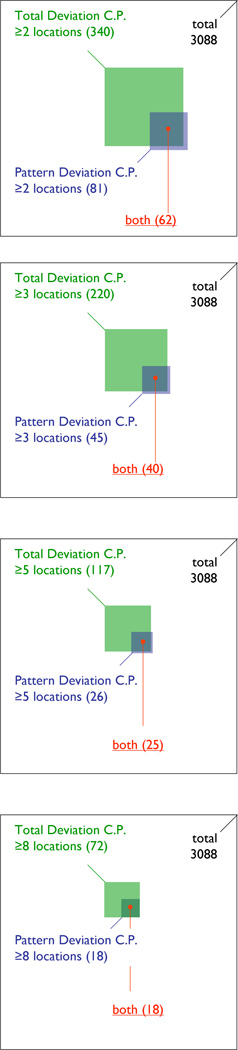
Agreement between total deviation (green squares) and pattern deviation (blue squares) change probability (C.P.) analyses of visual field progression. The area of each square, and the overlap, is proportional to the number of eyes classified as having progressed with each method (in brackets). The large square (black) symbolizes the total number of eyes (3088). a) Results with criteria of ≥2 locations with significant change in 3 consecutive tests b) Results with criteria of ≥3 locations with significant change in 3 consecutive tests c) Results with criteria of ≥5 locations with significant change in 3 consecutive tests d) Results with criteria of ≥8 locations with significant change in 3 consecutive tests.
Figure 3
Figure 3
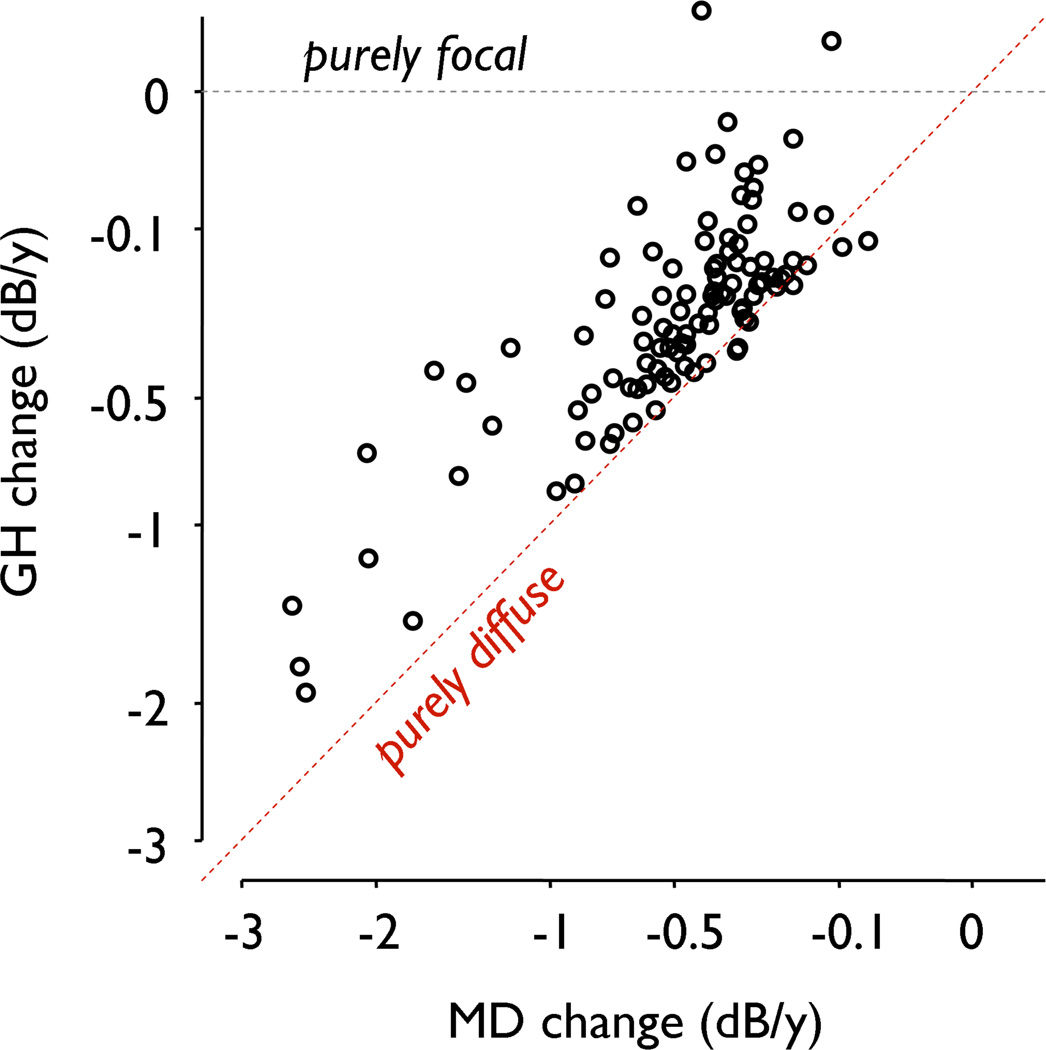
Changes in visual field General Height (GH) and Mean Deviation (MD) in eyes that developed glaucoma. Changes were established as the slope (by linear regression) of GH and MD (dB) with follow-up time (y). Eyes with purely focal change would show a change in MD but not in GH (dashed horizontal line), while eyes with purely diffuse change would show approximately equal slopes with both indices (dashed diagonal line). Most eyes showed focal as well as diffuse changes. For clarity, points are shown only if either MD or GH slope had a p-value <0.1 (n=108), omitting 63 with confirmed glaucomatous endpoints but no statistical trend in either GH nor MD. Axes are on a square-root scale to emphasize mid-range values.

References

    1. Kass MA, Heuer DK, Higginbotham EJ, et al. The Ocular Hypertension Treatment Study: a randomized trial determines that topical ocular hypotensive medication delays or prevents the onset of primary open-angle glaucoma. Arch Ophthalmol. 2002 Jun;120(6):701–713. discussion 829-730. - PubMed
    1. Palmberg P. Answers from the ocular hypertension treatment study. Arch Ophthalmol. 2002 Jun;120(6):829–830. - PubMed
    1. Gordon MO, Kass MA. The Ocular Hypertension Treatment Study: design and baseline description of the participants. Arch Ophthalmol. 1999 May;117(5):573–583. - PubMed
    1. Asman P, Heijl A. Glaucoma Hemifield Test. Automated visual field evaluation. Archives of Ophthalmology. 1992;110(6):812–819. - PubMed
    1. Johnson CA, Keltner JL, Cello KE, et al. Baseline visual field characteristics in the ocular hypertension treatment study. Ophthalmology. 2002 Mar;109(3):432–437. - PubMed

Publication types