Review
. 2010 Dec 15;9(24):4824-35.
doi: 10.4161/cc.9.24.14322. Epub 2010 Dec 15.

Alternative activation of tumor-associated macrophages by IL-4: priming for protumoral functions

Affiliations
Review

Alternative activation of tumor-associated macrophages by IL-4: priming for protumoral functions

Hao-Wei Wang et al. Cell Cycle. .

Abstract

Although macrophages were originally recognized as major immune effector cells, it is now appreciated that they also play many important roles in the maintenance of tissue homeostasis, and are involved in a variety of pathological conditions including cancer. Several studies have demonstrated the contributions of tumor-associated macrophages (TAMs) to tumor initiation, progression, and metastasis. However, the detailed mechanisms underlying how TAMs differ molecularly from their normal counterparts and how the conversion to TAMs occurs have only just begun to be understood. TAMs have been proposed to exhibit phenotypes of 'alternatively activated' macrophages, though there has been limited evidence directly linking the phenotypes of TAMs to the alternative activation of macrophages. This review will focus on IL-4, the prototypic cytokine that induces the alternative activation of macrophages, and review current knowledge regarding the contributions of IL-4 to the phenotypes of TAMs and its effects on tumorigenesis.


Figures
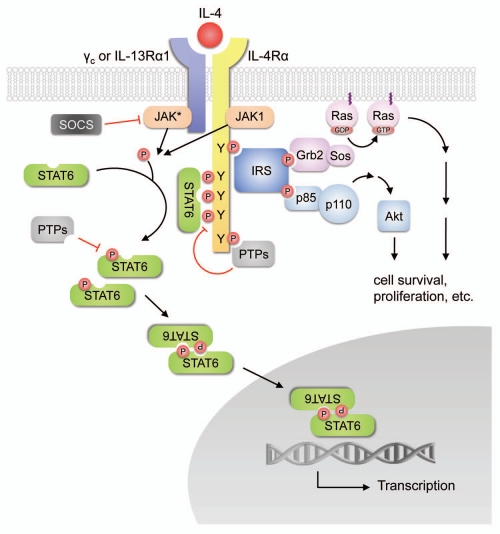
Figure 1
Figure 1
Signaling pathways downstream of IL-4 receptors. IL-4 receptors can signal through the Janus kinase/signal transducer and activator of transcription (JAK/STAT) cascades, or through insulin receptor substrate (IRS)-mediated activation of the phosphatidylinositol 3-kinase (PI3K)-Akt and Ras-MAPK pathways.
Figure 2
Figure 2
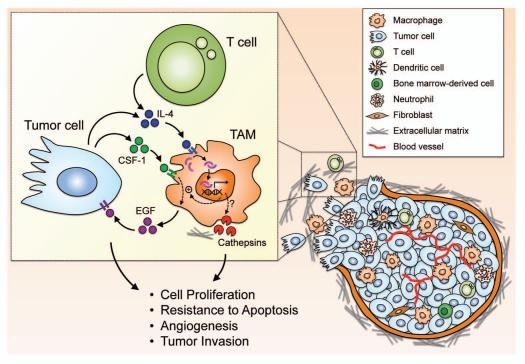
IL-4 as a major activator of TAM phenotypes in the tumor microenvironment. The tumor microenvironment is comprised of a variety of different cell types and matrix components, and complex cellular interactions are likely involved in the acquisition of tumor-promoting phenotypes by tumor-associated macrophages (TAMs). IL-4 supplied by either T cells or tumor cells can act on TAMs to augment the EGF/CSF-1 paracrine loop between TAMs and tumor cells, and also upregulates cathepsin enzyme activity in TAMs, although the detailed molecular mechanisms remain to be elucidated. These effects of IL-4 collectively prime TAMs with the capability to promote tumor growth and progression through different mechanisms.,,
Figure 3
Figure 3
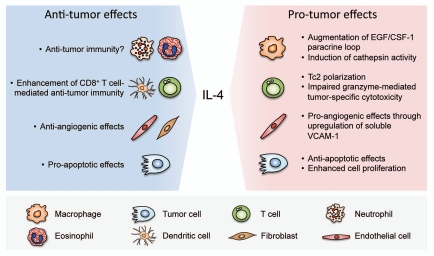
Opposing effects of IL-4 on tumorigenesis through its impact on different cell types in the tumor microenvironment. IL-4 can exert tumorpromoting functions by enhancing the EGF/CSF-1 paracrine loop between TAMs and tumor cells, and through induction of cathepsin enzyme activity in TAMs. It also impedes T cell-mediated immunity against tumor cells through polarization of CD8+ T cells to type 2 cytotoxic T cells (Tc2), or via impairment of granzyme-mediated tumor-specific cytotoxicity of CD8+ T cells. IL-4 has also been shown to induce angiogenesis by stimulating the production of soluble VCAM-1 from endothelial cells. Additionally, IL-4 protects tumor cells from apoptosis through upregulation of anti-apoptotic proteins, and enhances cell proliferation through activation of MAPK signaling pathways. On the other hand, IL-4 also exhibits anti-tumor effects through different mechanisms including recruitment and activation of innate immune cells, such as neutrophils, eosinophils and dendritic cells. CD8+ T cells have been found to mediate the anti-tumor activities of IL-4. In some types of cancers, IL-4 can induce apoptosis of tumor cells. IL-4 has also been reported to inhibit angiogenesis directly through its effects on endothelial cells or indirectly through effects on tumor stromal fibroblasts.

References

    1. van Furth R, Cohn ZA, Hirsch JG, Humphrey JH, Spector WG, Langevoort HL. The mononuclear phagocyte system: a new classification of macrophages, monocytes and their precursor cells. Bull World Health Organ. 1972;46:845–852. - PMC - PubMed
    1. Auffray C, Sieweke MH, Geissmann F. Blood monocytes: development, heterogeneity and relationship with dendritic cells. Annu Rev Immunol. 2009;27:669–692. - PubMed
    1. Geissmann F, Jung S, Littman DR. Blood monocytes consist of two principal subsets with distinct migratory properties. Immunity. 2003;19:71–82. - PubMed
    1. Gordon S, Taylor PR. Monocyte and macrophage heterogeneity. Nat Rev Immunol. 2005;5:953–964. - PubMed
    1. Ziegler-Heitbrock L, Ancuta P, Crowe S, Dalod M, Grau V, Hart DN, et al. Nomenclature of monocytes and dendritic cells in blood. Blood. 2010;116:74–80. - PubMed

Publication types

LinkOut - more resources