. 2010 Nov 22:4:217.
doi: 10.3389/fnhum.2010.00217. eCollection 2010.

Age differences in the neural representation of working memory revealed by multi-voxel pattern analysis

Affiliations

Age differences in the neural representation of working memory revealed by multi-voxel pattern analysis

Joshua Carp et al. Front Hum Neurosci. .

Abstract

Working memory function declines across the lifespan. Computational models of aging attribute such memory impairments to reduced distinctiveness between neural representations of different mental states in old age, a phenomenon termed dedifferentiation. These models predict that neural distinctiveness should be reduced uniformly across experimental conditions in older adults. In contrast, the Compensation-Related Utilization of Neural Circuits Hypothesis (CRUNCH) model predicts that the distinctiveness of neural representations should be increased in older adults (relative to young adults) at low levels of task demand but reduced at high levels of demand. The present study used multi-voxel pattern analysis to measure the effects of age and task demands on the distinctiveness of the neural representations of verbal and visuospatial working memory. Neural distinctiveness was estimated separately for memory encoding, maintenance, and retrieval, and for low, medium, and high memory loads. Results from sensory cortex during encoding and retrieval were consistent with the dedifferentiation hypothesis: distinctiveness of visual cortical representations during these phases was uniformly reduced in older adults, irrespective of memory load. However, maintenance-related responses in prefrontal and parietal regions yielded a strikingly different pattern of results. At low loads, older adults showed higher distinctiveness than younger adults; at high loads, this pattern reversed, such that distinctiveness was higher in young adults. This interaction between age group and memory load is at odds with the dedifferentiation hypothesis but consistent with CRUNCH. In sum, our results provide partial support for both dedifferentiation- and compensation-based models; we argue that comprehensive theories of cognitive aging must incorporate aspects of both models to fully explain complex patterns of age-related neuro-cognitive change.

Keywords: aging; compensation; dedifferentiation; fMRI; multi-voxel pattern analysis; working memory.


Figures
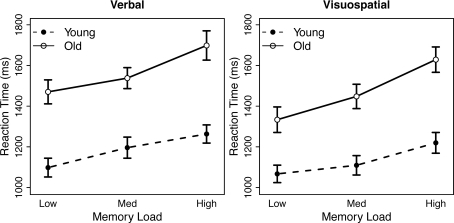
Figure 1
Figure 1
Effects of age group and memory load on reaction time. Left panel: data from the verbal working memory task. Right panel: data from the visuospatial working memory task.
Figure 2
Figure 2
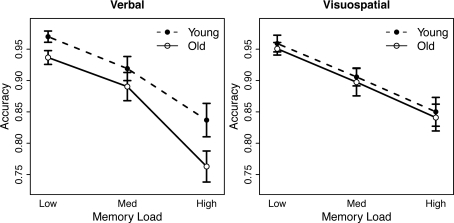
Effects of age group and memory load on response accuracy. Left panel: data from the verbal working memory task. Right panel: data from the visuospatial working memory task.
Figure 3
Figure 3
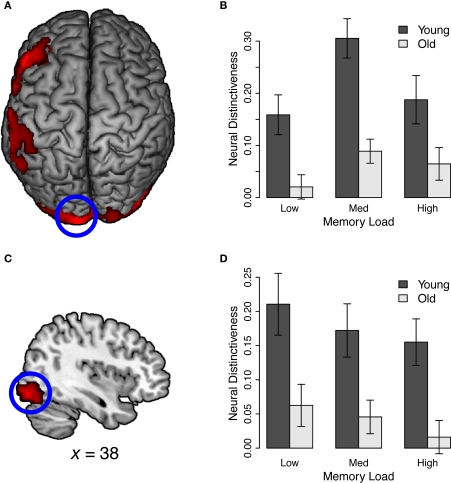
Main effect of age group during working memory encoding. See also Table 1, Main effect of age. (A) Older adults showed decreased distinctiveness between verbal and visuospatial WM tasks in prefrontal, parietal, and sensory cortex. Left striate cortex is highlighted. (B) Neural distinctiveness scores from left striate cortex. (C) Older adults also showed decreased neural distinctiveness in right inferior occipital gyrus (x = 38). (D) Neural distinctiveness scores from right inferior occipital gyrus.
Figure 4
Figure 4
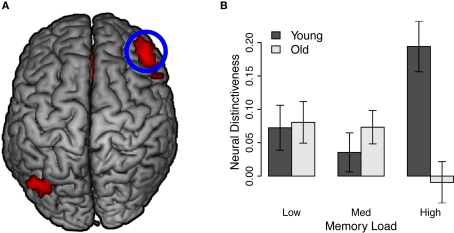
Age group by load interaction during working memory encoding. See also Table 1, Age by load interaction. (A) Neural distinctiveness increased with load in younger adults but decreased with load in older adults in right middle frontal gyrus, anterior cingulate cortex, and left middle temporal gyrus. Middle frontal gyrus is highlighted. (B) Neural distinctiveness scores from right middle frontal gyrus.
Figure 5
Figure 5
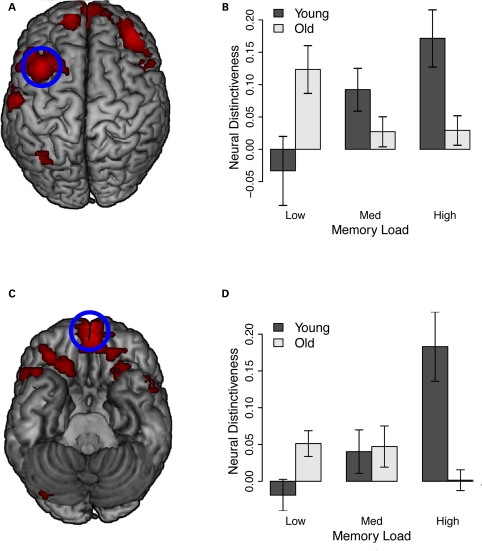
Age group by load interaction during working memory maintenance. See also Table 2, Age by load interaction. (A) Neural distinctiveness increased with load in younger adults but decreased with load in older adults across several prefrontal and parietal clusters. Left superior frontal gyrus is highlighted. (B) Neural distinctiveness scores from left superior frontal gyrus. Further descriptions of these results are given in Table 2. (C) Age by load interactions along the ventral surface of the brain. Orbitofrontal cortex is highlighted. (D) Neural distinctiveness scores from orbitofrontal cortex.

References

    1. Baltes P. B., Lindenberger U. (1997). Emergence of a powerful connection between sensory and cognitive functions across the adult life span: a new window to the study of cognitive aging? Psychol. Aging 12, 12–21 10.1037/0882-7974.12.1.12 - DOI - PubMed
    1. Bellis T. J., Nicol T., Kraus N. (2000). Aging affects hemispheric asymmetry in the neural representation of speech sounds. J. Neurosci. 20, 791–797 - PMC - PubMed
    1. Cabeza R. (2002). Hemispheric asymmetry reduction in older adults: the HAROLD model. Psychol. Aging 17, 85–100 10.1037/0882-7974.17.1.85 - DOI - PubMed
    1. Cabeza R., Anderson N., Locantore J., McIntosh A. (2002). Aging gracefully: compensatory brain activity in high-performing older adults. Neuroimage 17, 1394–1402 10.1006/nimg.2002.1280 - DOI - PubMed
    1. Cappell K., Gmeindl L., Reuter-Lorenz P. (2010). Age differences in prefontal recruitment during verbal working memory maintenance depend on memory load. Cortex 46, 462–473 10.1016/j.cortex.2009.11.009 - DOI - PMC - PubMed

LinkOut - more resources