


Emotion word comprehension from 4 to 16 years old: a developmental survey
- PMID: 21151378
- PMCID: PMC2996255
- DOI: 10.3389/fnevo.2010.00109
Emotion word comprehension from 4 to 16 years old: a developmental survey
Abstract
Background: Whilst previous studies have examined comprehension of the emotional lexicon at different ages in typically developing children, no survey has been conducted looking at this across different ages from childhood to adolescence.
Purpose: To report how the emotion lexicon grows with age.
Method: Comprehension of 336 emotion words was tested in n = 377 children and adolescents, aged 4-16 years old, divided into 6 age-bands. Parents or teachers of children under 12, or adolescents themselves, were asked to indicate which words they knew the meaning of.
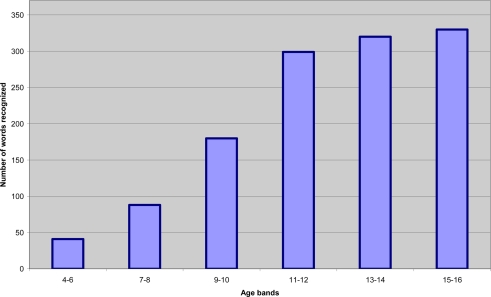
Results: Between 4 and 11 years old, the size of the emotional lexicon doubled every 2 years, but between 12 and 16 years old, developmental rate of growth of the emotional lexicon leveled off. This survey also allows emotion words to be ordered in terms of difficulty.
Conclusions: Studies using emotion terms in English need to be developmentally sensitive, since during childhood there is considerable change. The absence of change after adolescence may be an artifact of the words included in this study. This normative developmental data-set for emotion vocabulary comprehension may be useful when testing for delays in this ability, as might arise for environmental or neurodevelopmental reasons.
Keywords: autism; development; emotions.
Figures
References
-
- Baron-Cohen S., Wheelwright S., Spong A., Scahill V. L., Lawson J. (2001). Are intuitive physics and intuitive psychology independent? A test with children with Asperger Syndrome. J. Dev. Learn. Disord. 5, 47–78
-
- Bretherton I., Beeghly M. (1982). Talking about internal states: The acquisition of an explicit theory of mind. Dev. Psychol. 18, 906–921 10.1037/0012-1649.18.6.906 - DOI
-
- Baron-Cohen S., Hill J., Golan O., Wheelwright S. (2003). Electronic emotions: encyclopaedic. Autism Dig. 5, 14–19
-
- Denham S.A. (1998). Emotional Development in Young Children. New York, London: Guilford Press
-
- Ekman P., Friesen W. (1969). The repertoire of non-verbal behavior: categories, origins, usage, and coding. Semiotica 1, 49–98
LinkOut - more resources
Full Text Sources
