Review
. 2010;10(3):1871-89.
doi: 10.3390/s100301871.

Raman spectroscopy and related techniques in biomedicine

Affiliations
Review

Raman spectroscopy and related techniques in biomedicine

Andrew Downes et al. Sensors (Basel). 2010.

Abstract

In this review we describe label-free optical spectroscopy techniques which are able to non-invasively measure the (bio)chemistry in biological systems. Raman spectroscopy uses visible or near-infrared light to measure a spectrum of vibrational bonds in seconds. Coherent anti-Stokes Raman (CARS) microscopy and stimulated Raman loss (SRL) microscopy are orders of magnitude more efficient than Raman spectroscopy, and are able to acquire high quality chemically-specific images in seconds. We discuss the benefits and limitations of all techniques, with particular emphasis on applications in biomedicine--both in vivo (using fiber endoscopes) and in vitro (in optical microscopes).

Keywords: CARS microscopy; Raman imaging; Raman spectroscopy.


Figures
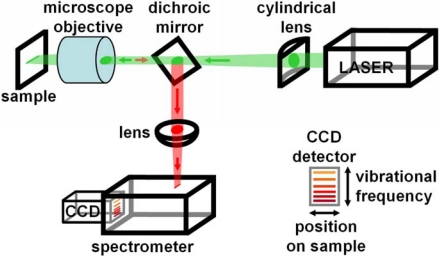
Figure 1.
Figure 1.
Schematic of Raman spectrometer. The displayed set-up focuses the illuminating laser (coloured green) down to a line on the sample (slit scanning mode), which can be replaced by a spot by removing the cylindrical lens. When a spot is illuminated at the sample, the Raman-shifted light (colored red) is filtered out from the laser light by a dichroic mirror, and dispersed along a vertical line on the two dimensional CCD detector. In slit-scanning mode, many spectra are acquired simultaneously: each position along the line on the sample produces a spectrum along the CCD detector.
Figure 2.
Figure 2.
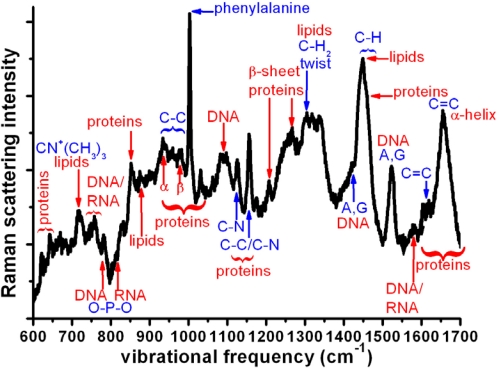
Unprocessed Raman spectrum of live MCF-7 breast cancer cells. 300 seconds acquisition time, 785 nm illumination, approximately 100 mW illumination power.
Figure 3.
Figure 3.
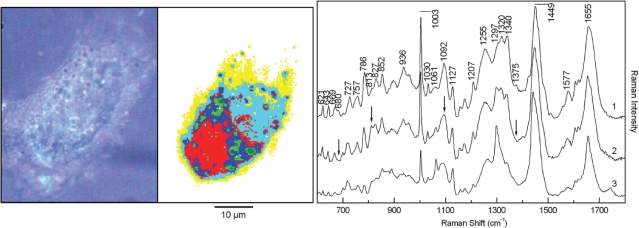
Photomicrograph of formalin-fixed lung fibroblast cell in buffer (left), Raman image after segmentation by cluster analysis (middle), Raman spectra (right) representing the nucleus (trace 1: red cluster), the cytoplasm (trace 2: cyan cluster) and lipid vesicles (trace 3: green cluster). © The Royal Society of Chemistry.
Figure 4.
Figure 4.
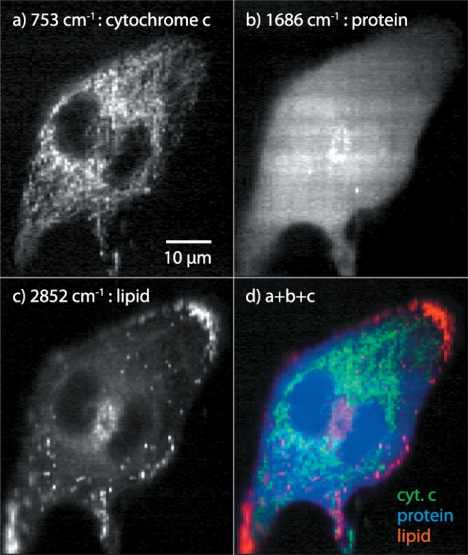
Raman scattering images of unstained, unlabelled living HeLa cells reconstructed using the distribution of Raman signals at (a) 753 cm−1, (b) 1,686 cm−1, and (c) 2,852 cm−1, showing the distribution of cytochrome c, protein beta sheet, and lipid molecules, respectively. Image (d) was constructed by merging images (a) through (c) with color channels. The sample was irradiated with a light intensity of 3.3 mW/μm2 at the focal plane in 78 lines of exposure. The exposure time of each line was 5 s, and the images consist of 78 × 281 pixels. © Society of Photo-Optical Instrumentation Engineers.
Figure 5.
Figure 5.
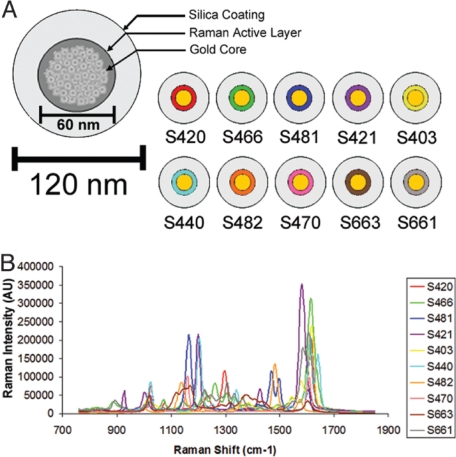
Schematic representation of a SERS Raman nanoparticle and graph depicting unique Raman spectra associated with each of the 10 SERS nanoparticles used for in vivo multiplexed imaging. (A) Schematic of a SERS Raman nanoparticle consisting of a 60-nm gold core with a unique Raman active layer adsorbed onto the gold surface and coated with glass totaling 120 nm in diameter. The trade name of each SERS nanoparticle is depicted to the right, where a color has been assigned to the Raman active layer of each SERS nanoparticle. (B) Graph depicting Raman spectra of all 10 SERS nanoparticles; each spectrum has been assigned a color corresponding to its unique Raman active layer as shown in (A). © The National Academy of Sciences.
Figure 6.
Figure 6.
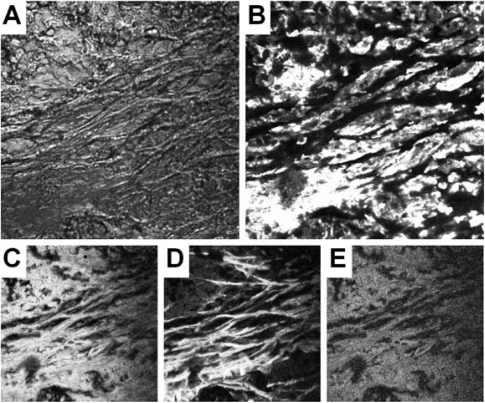
Complementary epi-detected confocal images from the same 212 μm square region of a 20 μm thick sample of cancerous breast tissue. (a) Differential interference contrast (DIC), (b) CARS tuned to 1,662 cm−1, (c) two-photon fluorescence (2PEF), (d) second harmonic generation (SHG), (e) sum frequency generation (SFG). Images (b) and (e) were acquired simultaneously, with 11 mW of 1,064.4 nm and 16 mW of 904.4 nm (measured at the sample), all other images were acquired sequentially with illumination only at 904.4 nm. All pixel dwell times were 61 μs (except ‘a’: 1.7 μs), and all images were 512 × 512 pixels. The scan unit dichroic mirror was at 870 nm, the dichroic mirror in the filter block (Photomultiplier detector unit) was at 670 nm. Further short pass filters were applied before ‘b’ (800 nm) and ‘c’, ‘d’, ‘e’ (660 nm). Band pass filters were at 800 nm (width 30 nm) in ‘b’, 535 nm (width 30 nm) in ‘c’, 460 nm (width 50 nm) in ‘d’, 480 nm (width 30 nm) in ‘e’. © John Wiley & Sons, Ltd.
Figure 7.
Figure 7.
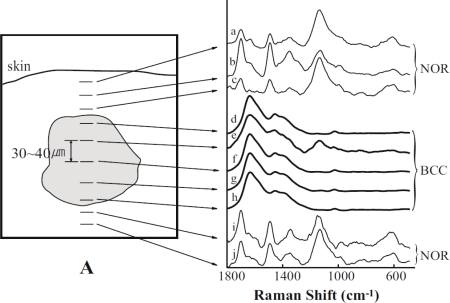
Confocal Raman profiles of skin tissue with an interval of 30–40 μm. © Springer-Verlag.
Figure 8.
Figure 8.
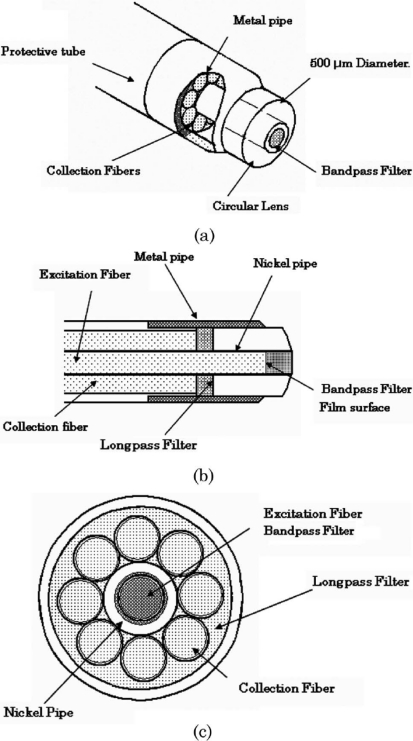
(a) Structure of distal end of a micro Raman probe (MRP). (b) Longitudinal cross section of distal end of a MRP. (c) Transverse cross section at fiber-filter interface. © 2009 Optical Society of America.
Figure 9.
Figure 9.
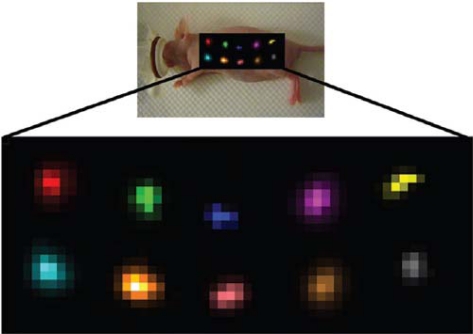
Evaluation of multiplexing 10 different SERS nanoparticles in vivo. Raman map of 10 different SERS particles injected subcutaneously. in a nude mouse. Arbitrary colors have been assigned to each unique SERS nanoparticle batch injected. Panels below depict separate channels associated with each of the injected SERS nanoparticles. Grayscale bar to the right depicts the Raman intensity, where white represents the maximum intensity and black represents no intensity. The postprocessing software was able to successfully separate all 10 SERS nanoparticles into their respective channels with minimal crosstalk. © The National Academy of Sciences.
Figure 10.
Figure 10.
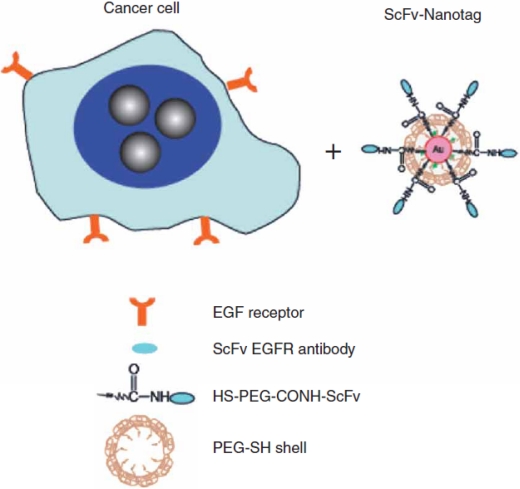
Cancer cell targeting and spectroscopic detection by using antibody-conjugated SERS nanoparticles. Preparation of targeted SERS nanoparticles by using a mixture of SH-PEG (thinly—polyethylene glycol) and a hetero-functional PEG (SH-PEG-COOH). Covalent conjugation of an EGFR-antibody (epidermal growth factor receptor) fragment occurs at the exposed terminal of the hetero-functional PEG. © 2010 Nature Publishing Group.
Figure 11.
Figure 11.
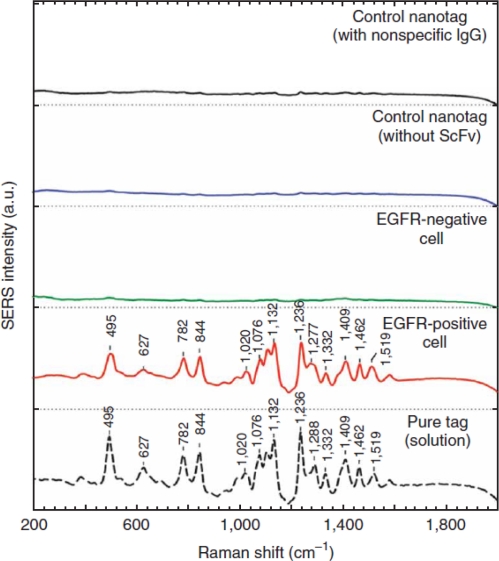
SERS spectra obtained from EGFR-positive cancer cells (Tu686) and from EGFR-negative cancer cells (human non-small cell lung carcinoma NCI-H520), together with control data and the standard tag spectrum. All spectra were taken in cell suspension with 785-nm laser excitation and were corrected by subtracting the spectra of nametag-stained cells by the spectra of unprocessed cells. The Raman reporter molecule is diethylthiatricarbocyanine (DTTC), and its distinct spectral signatures are indicated by wavenumbers (cm−1). © 2010 Nature Publishing Group.
Figure 12.
Figure 12.
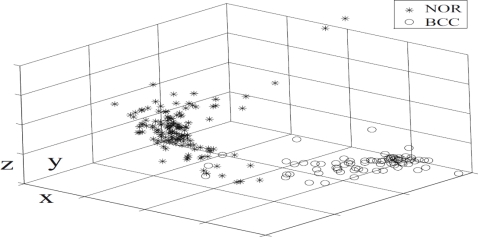
Distribution of the first three components of PCA transformed spectra (of biopsy samples from 10 patients) © Springer-Verlag.

References

    1. Yang W., Xiao X., Tan J., Cai Q. In situ evaluation of breast cancer cell growth with 3D ATR-FTIR spectroscopy. Vib. Spectros. 2009;49:64–67.
    1. Tobin M., Chesters M., Chalmers J., Rutten F., Fisher S., Symonds I., Hitchcock A., Allibone R., Dias-Gunasekara S. Infrared microscopy of epithelial cancer cells in whole tissues and in tissue culture, using synchrotron radiation. Faraday Discus. 2004;126:27–39. - PubMed
    1. De Gelder J., De Gussem K., Vandenabeele P., Moens L. Reference database of Raman spectra of biological molecules. J. Raman Spectrosc. 2007;38:1133–1147.
    1. Liu Y., Sonek G., Berns M., Tromberg B. Physiological monitoring of optically trapped cells: assessing the effects of confinement by 1064-nm laser tweezers using microfluorometry. Biophys. J. 1996;71:2158–2167. - PMC - PubMed
    1. Puppels G., Olminkhof J., Segers-Nolten G., Otto C., de Mul F., Greve J. Laser irradiation and Raman spectroscopy of single living cells and chromosomes: sample degradation occurs with 514.5 nm but not with 660 nm laser light. Exp. Cell. Res. 1991;95:361–367. - PubMed

Publication types

LinkOut - more resources