


doi: 10.1371/journal.pone.0014161.
Does perceptual learning suffer from retrograde interference?
Affiliations
- PMID: 21151868
- PMCID: PMC2998421
- DOI: 10.1371/journal.pone.0014161
Item in Clipboard
Does perceptual learning suffer from retrograde interference?
PLoS One.
.
Abstract
In motor learning, training a task B can disrupt improvements of performance of a previously learned task A, indicating that learning needs consolidation. An influential study suggested that this is the case also for visual perceptual learning. Using the same paradigm, we failed to reproduce these results. Further experiments with bisection stimuli also showed no retrograde disruption from task B on task A. Hence, for the tasks tested here, perceptual learning does not suffer from retrograde interference.
Conflict of interest statement
Figures

A) Task A: in each trial, participants indicated in which of two intervals a left offset dot Vernier was presented. In the other interval, an aligned dot Vernier was presented. b) Task B: in each trial, participants indicated in which of two intervals a right offset dot Vernier was presented. In the other interval, an aligned dot Vernier was presented. C) Training procedures. In the A-only group, seven participants trained 400 trials with task A on each of five days. In the AB group, seven participants trained for five days, first 400 trials with task A and immediately after 400 trials with task B. D) Results. For the A-only group, discrimination performance on task A improved from day one (red dashed line) to day five (red solid line). For the AB group, discrimination performance on task A improved in a similar fashion from day one (black dashed line) to day five (black solid line). There was no obvious difference in the improvements between the two groups. E) For the AB group, performance on task B improved from day one (dashed line) to day five (solid line). The x-axis shows the five different Verniers offsets (means ± SEM).
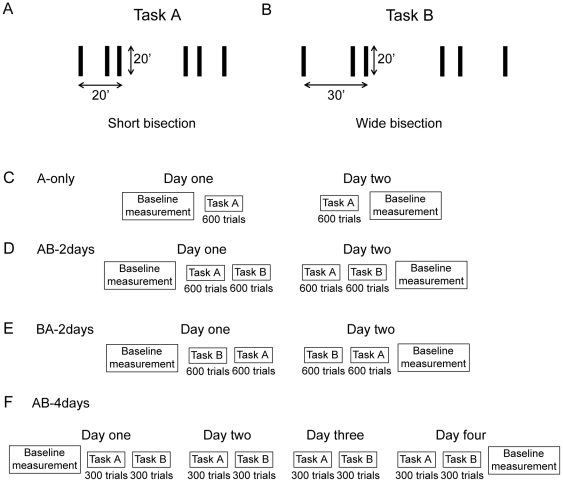
A) In task A, participants indicated whether the center line in a short bisection stimulus (20′ distance between the two outer lines) was offset to the left or to the right. B) In task B, participants indicated whether the center line in a wide bisection stimulus (30′ distance between the two outer lines) was offset to the left or to the right. C) Procedure for the A-only group. Baseline performance was measured on day one and two for task A for both horizontal and vertical orientations. On each of two days, participants trained 600 trials with task A, vertical orientation only. D) Procedure for the AB-2days group. Baseline performance was measured on day one and two for task A and task B for both horizontal and vertical orientations. On each of two days, participants first trained 600 trials with task A, directly followed by 600 trials with task B. Training was with the vertical orientation only. E) Procedure for the BA-2days group. Procedure was exactly the same as for the AB-2days group, except that the order of tasks was reversed, i.e. on each day, first task B, then task A, was trained. F) Procedure for the AB-4days group. Baseline performance was measured on day one and four for task A and task B for both horizontal and vertical orientations. On each of four days, participants first trained 300 trials with task A, directly followed by 300 trials with task B. During training, only vertically oriented stimuli were presented.

In figures A–C, individual data are plotted as small dots while group averages are displayed as big dots (means ± SEM). Dots positioned below the diagonal black lines indicate improvement of performance. Performance for task A in the control group (A-only) is shown as black dots in all figures. * Performance improved in the A-only condition. A) Performance improved in the AB-2days condition. B) Performance improved in the BA-2days condition. C) Performance improved in the AB-4days condition. Performance for task A improved similarly in all four conditions. D) Transfer of learning was determined by calculating the ratios between post- and pre-training baseline thresholds for the untrained horizontal orientations of task A and B.. A ratio less than 1.0 indicates improvement of performance, i.e. transfer of learning. Two-tailed, one sample t-tests were used to test transfer of learning. Improvement of performance did not transfer to any untrained horizontal stimuli [A-only; task A: t(8) = −0.62, p>.55; AB-2days; task A: t(6) = −0.49, p>.65; task B: t(6) = −0.33, p>.76; BA-2days; task A: t(6) = 1.25, p>.26; task B: t(6) = −0.22, p>.83; AB-4days; task A: t(5) = −0.69, p>.52; task B: t(5) = 0.82, p>.45].
References
-
- Karni A, Sagi D. The time course of learning a visual skill. Nature. 1993;365:250–252. - PubMed
-
- Karni A, Tanne D, Rubenstein BS, Askenasy JJM, Sagi D. Dependence on rem sleep of overnight improvement of a perceptual skill. Science. 1994;265:679–682. - PubMed
-
- Matarazzo L, Franko E, Maquet P, Vogels R. Offline processing of memories induced by perceptual visual learning during subsequent wakefulness and sleep: A behavioral study. Journal of Vision. 2008;8:1–9. - PubMed
-
- Mednick SC, Nakayama K, Cantero JL, Atienza M, Levin AA, et al. The restorative effect of naps on perceptual deterioration. Nature Neuroscience. 2002;5:677–681. - PubMed
Publication types
MeSH terms
LinkOut - more resources
Full Text Sources
