. 2010 Dec 3;5(12):e15099.
doi: 10.1371/journal.pone.0015099.

Anti-inflammatory effects of resveratrol, curcumin and simvastatin in acute small intestinal inflammation

Affiliations

Anti-inflammatory effects of resveratrol, curcumin and simvastatin in acute small intestinal inflammation

Stefan Bereswill et al. PLoS One. .

Abstract

Background: The health beneficial effects of Resveratrol, Curcumin and Simvastatin have been demonstrated in various experimental models of inflammation. We investigated the potential anti-inflammatory and immunomodulatory mechanisms of the above mentioned compounds in a murine model of hyper-acute Th1-type ileitis following peroral infection with Toxoplasma gondii.

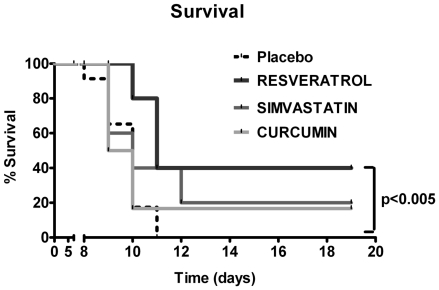
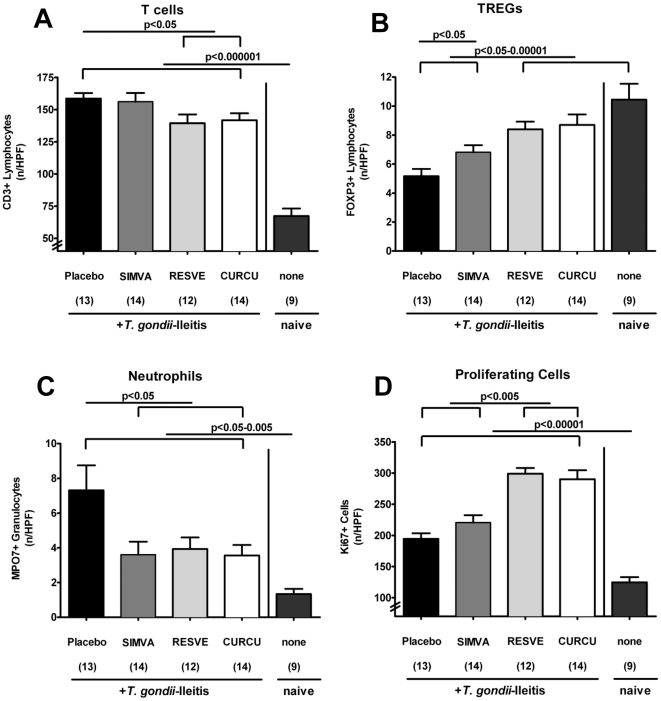
Methodology/principal findings: Here we show that after peroral administration of Resveratrol, Curcumin or Simvastatin, mice were protected from ileitis development and survived the acute phase of inflammation whereas all Placebo treated controls died. In particular, Resveratrol treatment resulted in longer-term survival. Resveratrol, Curcumin or Simvastatin treated animals displayed significantly increased numbers of regulatory T cells and augmented intestinal epithelial cell proliferation/regeneration in the ileum mucosa compared to placebo control animals. In contrast, mucosal T lymphocyte and neutrophilic granulocyte numbers in treated mice were reduced. In addition, levels of the anti-inflammatory cytokine IL-10 in ileum, mesenteric lymph nodes and spleen were increased whereas pro-inflammatory cytokine expression (IL-23p19, IFN-γ, TNF-α, IL-6, MCP-1) was found to be significantly lower in the ileum of treated animals as compared to Placebo controls. Furthermore, treated animals displayed not only fewer pro-inflammatory enterobacteria and enterococci but also higher anti-inflammatory lactobacilli and bifidobacteria loads. Most importantly, treatment with all three compounds preserved intestinal barrier functions as indicated by reduced bacterial translocation rates into spleen, liver, kidney and blood.

Conclusion/significance: Oral treatment with Resveratrol, Curcumin or Simvastatin ameliorates acute small intestinal inflammation by down-regulating Th1-type immune responses and prevents bacterial translocation by maintaining gut barrier function. These findings provide novel and potential prophylaxis and treatment options of patients with inflammatory bowel diseases.


Conflict of interest statement

Competing Interests: The authors have declared that no competing interests exist.

Figures

Figure 1
Figure 1. Survival rates of mice treated with Placebo (n = 23), Simvastain (n = 5), Resveratrol (n = 5) or Curcumin (n = 6) from d-2 until d8 p.i..
Mortality of animals was monitored daily until d19 p.i.. Significance levels (as compared with Placebo controls) were determined by Kaplan-Meier analysis.
Figure 2
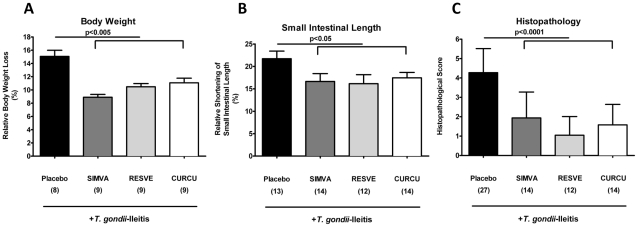
Figure 2. Less small intestinal immunopathology after treatment with Simvastain, Resveratrol or Curcumin (8 days after T. gondii infection).
(A) Relative body weight loss of mice after treatment with Placebo (n = 8), Simvastain (SIMVA; n = 9), Resveratrol (RESVE; n = 9) or Curcumin (CURCU; n = 9) from d-2 until d8 p.i. (B) Relative small intestinal shortening of mice after treatment with Placebo (n = 13), Simvastain (SIMVA; n = 14), Resveratrol (RESVE; n = 12) or Curcumin (CURCU; n = 14) from d-2 until d8 p.i. (C) Histopathology of the terminal ileum of mice treated with Placebo (n = 27), Simvastain (SIMVA; n = 14), Resveratrol (RESVE; n = 12) or Curcumin (CURCU; n = 14) from d-2 until d8 p.i.. Mean values, standard deviations, and significance levels as indicated were determined by the Student's t test. Data are pooled from at least three independent experiments.
Figure 3
Figure 3. Quantification of defined cell population in the ileum of mice in situ after treatment with Simvastain, Resveratrol or Curcumin (8 days after T. gondii infection).
The average number of cells positive for (A) CD3, (B) FOXP3, (C) MPO7 (Myeloperoxidase), and (D) Ki-67 from at least six high power fields (HPF, 400× magnification) per animal were determined microscopically in immunostained ileum sections at d8 p.i. after treatment of mice with Placebo, Simvastain (SIMVA), Resveratrol (RESVE), or Curcumin (CURCU) from d-2 until d8 p.i. and naïve, uninfected animals. Numbers of analyzed animals are given in parentheses. Mean values, standard errors of the mean, and significance levels as indicated were determined by the Student's t test. Data are pooled from at least three independent experiments.
Figure 4
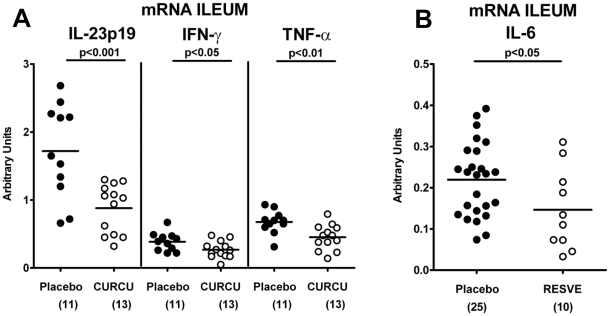
Figure 4. m-RNA Expression of pro-inflammatory cytokines in ilea of mice 8 days after T. gondii infection and treatment with (A) Curcumin or (B) Resveratrol from d-2 until d8 p.i. compared to Placebo controls.
RT-PCR results of IL-23p19, IFN-γ and TNF-α (A) and IL-6 (B) expression from individual mice are expressed as fold changes relative to HPRT mRNA expression (arbitrary units). Numbers of analyzed animals are given in parentheses. Mean values and significance levels as indicated were determined by the Student's t test. Data are pooled from at least three independent experiments.
Figure 5
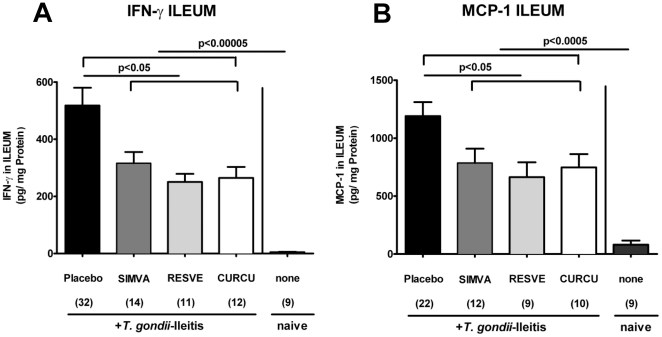
Figure 5. (A) IFN-γ and (B) MCP-1 concentrations (CBA-ELISA) in supernatants of ileum cultures from naïve, uninfected animals and mice treated with Simvastatin (SIMVA), Resveratrol (RESVE) or Curcumin (CURCU) from d-2 until d8 p.i. as compared to Placebo controls (8 days after T. gondii infection).
Numbers of analyzed animals are given in parentheses. Mean values, standard errors of the mean, and significance levels as indicated were determined by the Student's t test. Data are pooled from at least two independent experiments.
Figure 6
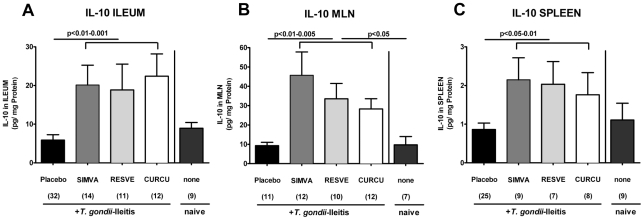
Figure 6. IL-10 concentrations (CBA-ELISA) in supernatants of Ileum (A), MLN (B) and spleen (C) cultures from naïve, uninfected animals and mice treated with Simvastatin (SIMVA), Resveratrol (RESVE) or Curcumin (CURCU) from d-2 until d8 p.i. as compared to Placebo controls (8 days after T. gondii infection).
Numbers of analyzed animals are given in parentheses. Mean values, standard errors of the mean, and significance levels as indicated were determined by the Student's t test. Data are pooled from at least two independent experiments.
Figure 7
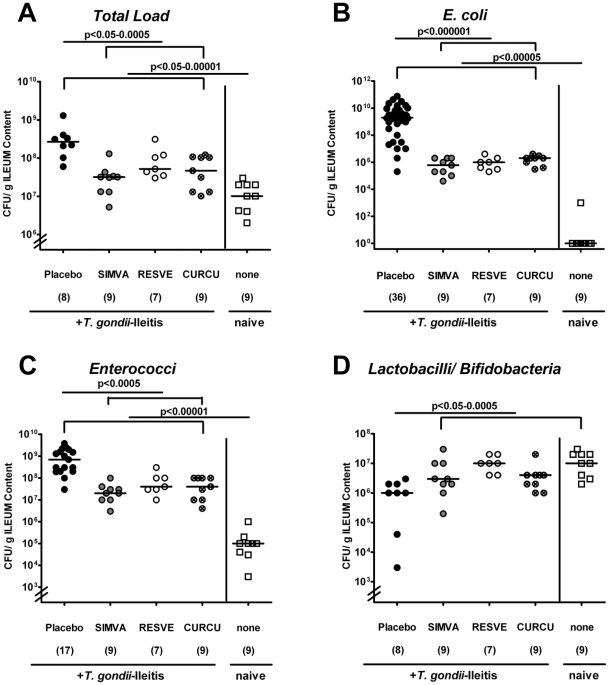
Figure 7. Changes in the composition of the luminal ileum flora obtained from uninfected animals (none) and T. gondii-infected mice treated with Simvastain (SIMVA), Resveratrol (RESVE) or Curcumin (CURCU) from d-2 until d8 p.i. as compared to Placebo controls (8 days after T. gondii infection).
Detailed cultural analysis was performed on appropriate selective media, bacterial species identified by biochemical analysis and reconfirmed by comparative sequence analysis (see Methods). Individual bacterial counts (CFU, colony forming units) of (A) Total bacterial load, (B) E. coli, (C) enterococci, (D) lactobacilli/bifidobacteria obtained from respectively treated mice (numbers of animals are given in parentheses), medians and levels of significance determined by Mann-Whitney-U test are indicated. Data are pooled from two representative experiments.
Figure 8
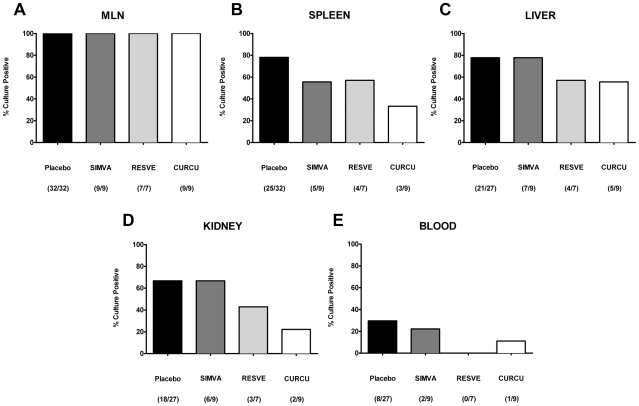
Figure 8. Bacterial translocation into (A) MLN, (B) Spleen, (C) Liver, (D) Kidney, and (E) Blood of mice treated with Simvastain (SIMVA), Resveratrol (RESVE) or Curcumin (CURCU) from d-2 until d8 p.i. as compared to Placebo controls (8 days after T. gondii infection).
Organs or blood were cultivated in thioglycolate broth for maximum 7 days. Turbid broths were sub-cultivated on solid media (refer to Materials). Indicated are relative rates of positive samples (in %) and absolute numbers of positive samples out of total number analyzed in parentheses.

References

    1. Jain SK. Ethnobotany and research on medicinal plants in India. Ciba Found Symp. 1994;185:153–164; discussion 164-158. - PubMed
    1. Kobashigawa JA, Katznelson S, Laks H, Johnson JA, Yeatman L, et al. Effect of pravastatin on outcomes after cardiac transplantation. N Engl J Med. 1995;333:621–627. - PubMed
    1. Baur JA, Pearson KJ, Price NL, Jamieson HA, Lerin C, et al. Resveratrol improves health and survival of mice on a high-calorie diet. Nature. 2006;444:337–342. - PMC - PubMed
    1. Elmali N, Baysal O, Harma A, Esenkaya I, Mizrak B. Effects of resveratrol in inflammatory arthritis. Inflammation. 2007;30:1–6. - PubMed
    1. Ma ZH, Ma QY, Wang LC, Sha HC, Wu SL, et al. Effect of resveratrol on peritoneal macrophages in rats with severe acute pancreatitis. Inflamm Res. 2005;54:522–527. - PubMed

Publication types

MeSH terms