. 2010 Nov 30;4(11):e901.
doi: 10.1371/journal.pntd.0000901.

Targeting the midgut secreted PpChit1 reduces Leishmania major development in its natural vector, the sand fly Phlebotomus papatasi

Affiliations

Targeting the midgut secreted PpChit1 reduces Leishmania major development in its natural vector, the sand fly Phlebotomus papatasi

Iliano V Coutinho-Abreu et al. PLoS Negl Trop Dis. .

Abstract

Background: During its developmental cycle within the sand fly vector, Leishmania must survive an early proteolytic attack, escape the peritrophic matrix, and then adhere to the midgut epithelia in order to prevent excretion with remnants of the blood meal. These three steps are critical for the establishment of an infection within the vector and are linked to interactions controlling species-specific vector competence. PpChit1 is a midgut-specific chitinase from Phlebotomus papatasi presumably involved in maturation and degradation of the peritrophic matrix. Sand fly midgut chitinases, such as PpChit1, whether acting independently or in a synergistic manner with Leishmania-secreted chitinase, possibly play a role in the Leishmania escape from the endoperitrophic space. Thus, we predicted that silencing of sand fly chitinase will lead to reduction or elimination of Leishmania within the gut of the sand fly vector.

Methodology/principal findings: We used injection of dsRNA to induce knock down of PpChit1 transcripts (dsPpChit1) and assessed the effect on protein levels post blood meal (PBM) and on Leishmania major development within P. papatasi. Injection of dsPpChit1 led to a significant reduction of PpChit1 transcripts from 24 hours to 96 hours PBM. More importantly, dsPpChit1 led to a significant reduction in protein levels and in the number of Le. major present in the midgut of infected P. papatasi following a infective blood meal.

Conclusion/significance: Our data supports targeting PpChit1 as a potential transmission blocking vaccine candidate against leishmaniasis.


Conflict of interest statement

The authors have declared that no competing interests exist.

Figures
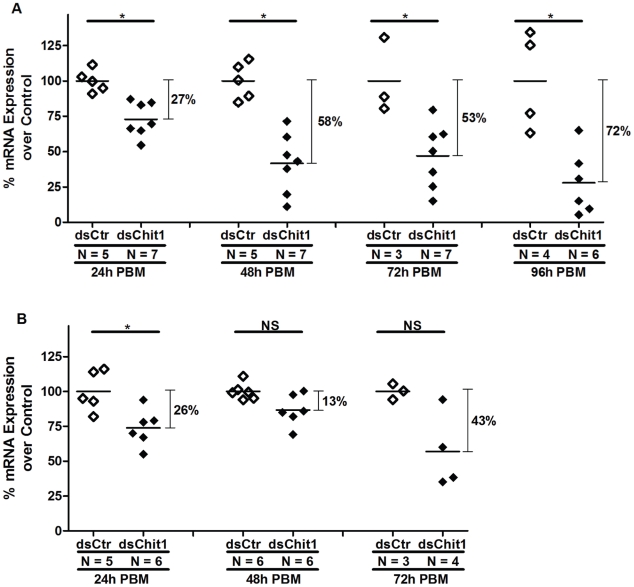
Figure 1
Figure 1. dsRNA effect on PpChit1 RNA levels.
Real-Time PCR comparing the mRNA level of PpChit1 between flies injected with 80.5 ng (A) or 144 ng (B) of dsPpChit1 (dsChit1) or dsControl (dsCtr) double-strand RNAs. Significant PpChit1 transcript reduction was exhibited by dsPpChit1 injected flies at 24 h (A and B), 48 h, 72 h, and 96 h PBM (A). PpChit1 mRNA levels were normalized with the S3 housekeeping gene. Results are presented as a percent of PpChit1 expression levels in dsPpChit1 injected flies over the mean of PpChit1 expression levels in dsControl injected flies (considered as 100%) for each time point. The variance in PpChit1 expression in dsControl injected flies is also shown. Each dot represents PpChit1 RNA levels in a single fly. Horizontal bars indicate mean expression level. *: Statistically significant at p<0.05.
Figure 2
Figure 2. dsRNA effect on PpChit1 protein levels.
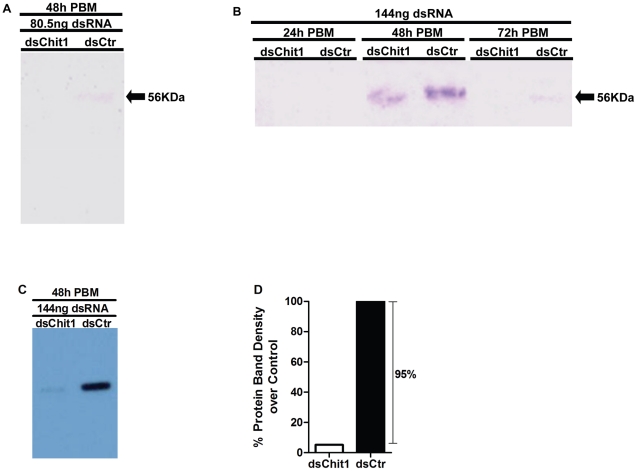
(A). Western blot assay pointing to PpChit1 knock down in dsPpChit1 injected flies (80.5 ng dsRNA) at 48 h PBM. (B). Midgut extracts from flies injected with 144 ng dsPpChit1 (dsChit1) displayed weaker bands (56 kDa) than dsControl (dsCtr) injected flies at 48 h and 72 h PBM. A–B, Colorimetric development. (C). Western blot assay depicting strong PpChit1 expression reduction in flies injected with 144 ng dsPpChit1 (dsChit1) compared with dsCtr injected ones at 48 h PBM (Chemiluminescence development). (D). Densitometry analysis of PpChit1 protein bands obtained in the chemiluminescence assay revealing 95% reduction in PpChit1 expression between dsPpChit1 and dsControl injected flies.
Figure 3
Figure 3. dsRNA effect on Le. major development.
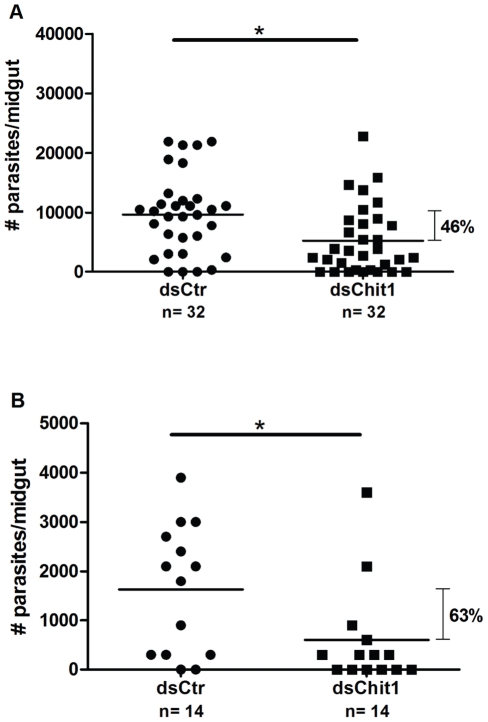
Intra-thoracic injections of dsPpChit1 (80.5 ng) reduce Le. major load in P. papatasi midgut. (A). At 48 h PBM, Le. major density was reduced on average 46% in dsPpChit1 (dsChit1) injected compared with dsControl (dsCtr) injected. (B). Le. major parasites per midgut were further reduced at 120 h PBM in dsPpChit1 injected flies, reaching on average 63% reduction over the dsControl injected ones. Each dot represents parasite number in a single P. papatasi midgut. Horizontal bars display mean parasite numbers. n: Number of flies analyzed. *: Statistically significant at p<0.05. Graphs represent one similar result of two independent experiments.
Figure 4
Figure 4. Effect of dsRNA injection on Le. major infection level in P. papatasi.
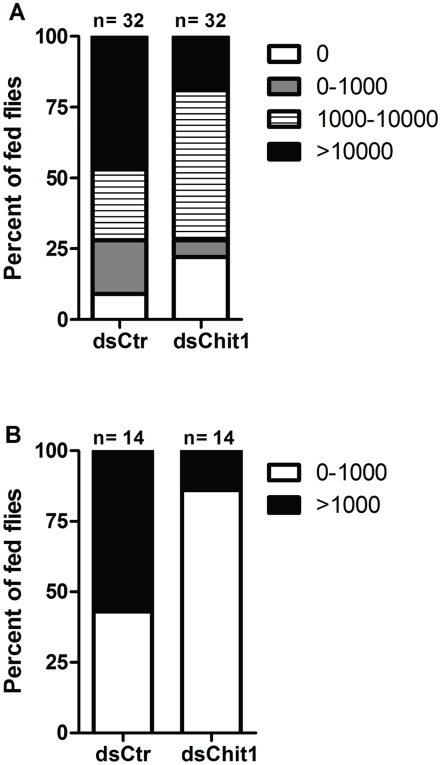
Parasite load was categorized according to the number of Le. major per midgut. (A) Percentage of sand flies injected with either dsCtr or dsChit1 exhibiting no infection (0 parasites), as well as light (1–1,000 parasites), moderate (1,000–10,000 parasites), or heavy (>10,000 parasites) infection at 48 h PBM. Differences are statistically significant (Chi-square, p = 0.01). (B) Percentage of sand flies injected with either dsCtr or dsChit1 exhibiting either no parasites or light infection (0–1000 parasites), or moderate infection (>1,000 parasites) at 120 h PBM. Differences are statistically significant (Fisher's exact test, p = 0.04). n: Number of flies dissected.

References

    1. Hill CA, Kafatos FC, Stansfield SK, Collins FH. Arthropod-borne diseases: vector control in the genomics era. Nat Rev Microbiol. 2005;3:262–268. - PubMed
    1. Coutinho-Abreu IV, Ramalho-Ortigao M. Transmission blocking vaccines to control insect-borne diseases: a review. Mem Inst Oswaldo Cruz. 2010;105:1–12. - PubMed
    1. Coutinho-Abreu IV, Zhu KY, Ramalho-Ortigao M. Transgenesis and paratransgenesis to control insect-borne diseases: current status and future challenges. Parasitol Int. 2009;59:1–8. - PMC - PubMed
    1. Borovsky D, Schlein Y. Trypsin and chymotrypsin-like enzymes of the sandfly Phlebotomus papatasi infected with Leishmania and their possible role in vector competence. Med Vet Entomol. 1987;1:235–242. - PubMed
    1. Dillon RJ, Lane RP. Bloodmeal digestion in the midgut of Phlebotomus papatasi and Phlebotomus langeroni. Med Vet Entomol. 1993;7:225–232. - PubMed

Publication types

MeSH terms