Dengue incidence in urban and rural Cambodia: results from population-based active fever surveillance, 2006-2008
- PMID: 21152061
- PMCID: PMC2994922
- DOI: 10.1371/journal.pntd.0000903
Dengue incidence in urban and rural Cambodia: results from population-based active fever surveillance, 2006-2008
Abstract
Background: Dengue vaccines are now in late-stage development, and evaluation and robust estimates of dengue disease burden are needed to facilitate further development and introduction. In Cambodia, the national dengue case-definition only allows reporting of children less than 16 years of age, and little is known about dengue burden in rural areas and among older persons. To estimate the true burden of dengue in the largest province of Cambodia, Kampong Cham, we conducted community-based active dengue fever surveillance among the 0-to-19-year age group in rural villages and urban areas during 2006-2008.
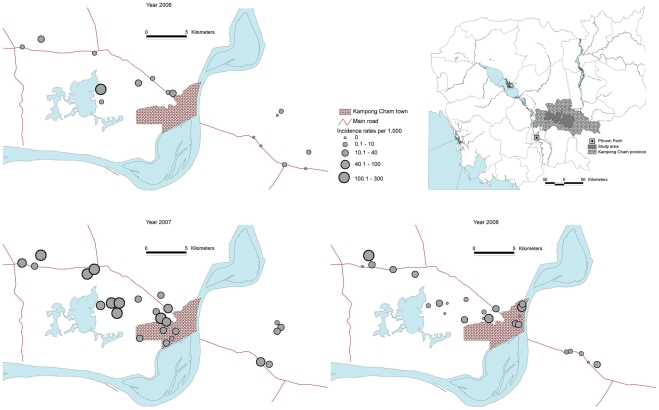
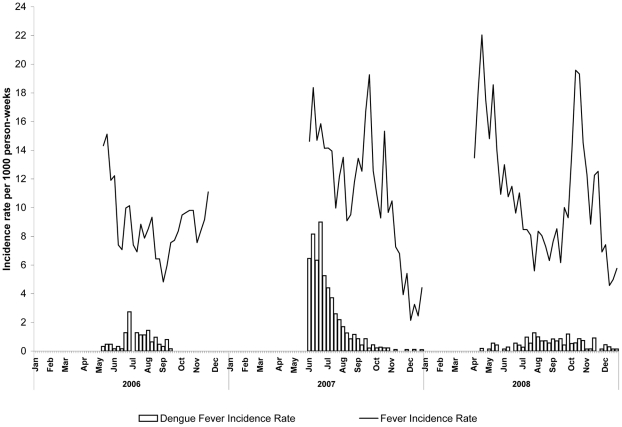
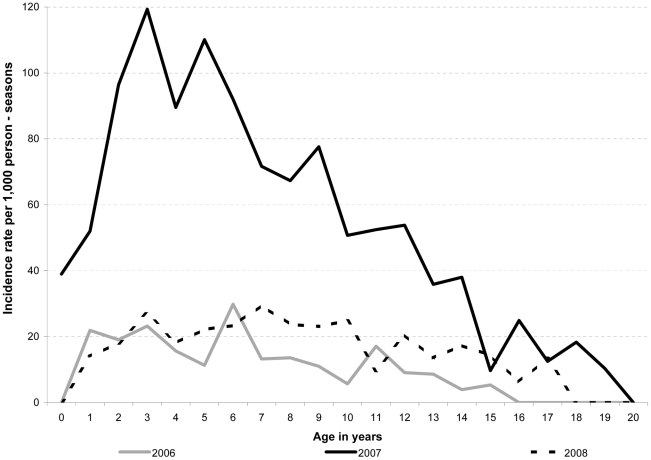
Methods and findings: Active surveillance for febrile illness was conducted in 32 villages and 10 urban areas by mothers trained to use digital thermometers combined with weekly home visits to identify persons with fever. An investigation team visited families with febrile persons to obtain informed consent for participation in the follow-up study, which included collection of personal data and blood specimens. Dengue-related febrile illness was defined using molecular and serological testing of paired acute and convalescent blood samples. Over the three years of surveillance, 6,121 fever episodes were identified with 736 laboratory-confirmed dengue virus (DENV) infections for incidences of 13.4-57.8/1,000 person-seasons. Average incidence was highest among children less than 7 years of age (41.1/1,000 person-seasons) and lowest among the 16-to-19-year age group (11.3/1,000 person-seasons). The distribution of dengue was highly focal, with incidence rates in villages and urban areas ranging from 1.5-211.5/1,000 person-seasons (median 36.5). During a DENV-3 outbreak in 2007, rural areas were affected more than urban areas (incidence 71 vs. 17/1,000 person-seasons, p<0.001).
Conclusion: The large-scale active surveillance study for dengue fever in Cambodia found a higher disease incidence than reported to the national surveillance system, particularly in preschool children and that disease incidence was high in both rural and urban areas. It also confirmed the previously observed focal nature of dengue virus transmission.
Conflict of interest statement
The authors have declared that no competing interests exist.
Figures
References
-
- Guzman MG, Kouri G. Dengue and dengue hemorrhagic fever in the Americas: lessons and challenges. J Clin Virol. 2003;27:1–13. - PubMed
-
- Guzman MG, Kouri G. Dengue: An update. Lancet Infect Dis. 2002;2:33–42. - PubMed
-
- Lang J. Recent progress on sanofi pasteur's dengue vaccine candidate. J Clin Virol. 2009;46(Suppl 2):S20–4. - PubMed
Publication types
MeSH terms
Substances
LinkOut - more resources
Full Text Sources
Other Literature Sources
Medical