. 2010 Nov 30;5(11):e15520.
doi: 10.1371/journal.pone.0015520.

Alkalizing reactions streamline cellular metabolism in acidogenic microorganisms

Affiliations

Alkalizing reactions streamline cellular metabolism in acidogenic microorganisms

Stefania Arioli et al. PLoS One. .

Abstract

An understanding of the integrated relationships among the principal cellular functions that govern the bioenergetic reactions of an organism is necessary to determine how cells remain viable and optimise their fitness in the environment. Urease is a complex enzyme that catalyzes the hydrolysis of urea to ammonia and carbonic acid. While the induction of urease activity by several microorganisms has been predominantly considered a stress-response that is initiated to generate a nitrogen source in response to a low environmental pH, here we demonstrate a new role of urease in the optimisation of cellular bioenergetics. We show that urea hydrolysis increases the catabolic efficiency of Streptococcus thermophilus, a lactic acid bacterium that is widely used in the industrial manufacture of dairy products. By modulating the intracellular pH and thereby increasing the activity of β-galactosidase, glycolytic enzymes and lactate dehydrogenase, urease increases the overall change in enthalpy generated by the bioenergetic reactions. A cooperative altruistic behaviour of urease-positive microorganisms on the urease-negative microorganisms within the same environment was also observed. The physiological role of a single enzymatic activity demonstrates a novel and unexpected view of the non-transcriptional regulatory mechanisms that govern the bioenergetics of a bacterial cell, highlighting a new role for cytosol-alkalizing biochemical pathways in acidogenic microorganisms.


Conflict of interest statement

Competing Interests: The authors have declared that no competing interests exist.

Figures

Figure 1
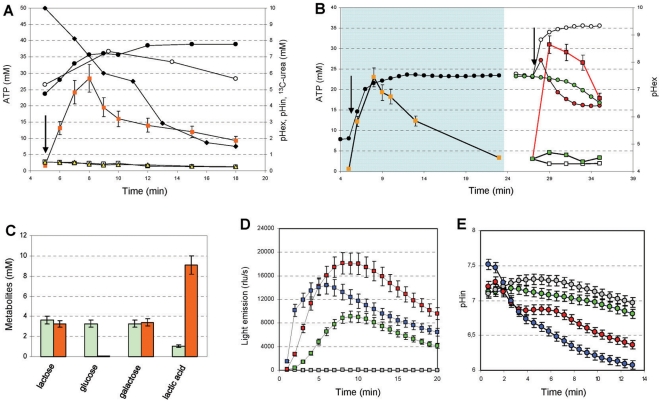
Figure 1. Effects of urea hydrolysis on cellular ATP concentration and homolactic fermentation.
A: Changes in the extracellular pH (pHex) (filled circles), intracellular pH (pHin) (open circles), intracellular ATP concentration (squares), and 13C-urea concentration (diamonds) in a suspension of wild-type S. thermophilus cells without (filled squares) or with (white squares) 10 µM of the urease inhibitor flurofamide during urea hydrolysis. The intracellular ATP concentration was also evaluated in the urease-negative mutant A16(ΔureC3) (triangles). Shaded panel in B: Changes in pHex (circles) and intracellular ATP concentration (squares) during the preparation of energetically discharged cells (EdC). White panel in B: changes in the pHex (circles) and the intracellular ATP concentration (squares) in EdC in the presence of either 10 mM urea (white symbols), 28 mM lactose (green symbols) or both lactose and urea (red symbols). In A and B the addition of urea and/or lactose is indicated by the arrows. C: the consumption of lactose and production of glucose, galactose, and lactic acid in EdC that were activated with lactose (green bars) or lactose and urea (orange bars) under the experimental conditions described in b (white panel). D: the intracellular ATP concentration (reported as light emission) and the intracellular pH, E. MIM945 EdC were activated with 14 mM lactose (green symbols), 14 mM lactose and 0.5 mM urea (red symbols), 14 mM lactose and 1 mM ammonia (blue symbols) or 14 mM lactose and 0.5 mM urea and 0.4 mM sodium oxamate (grey symbols). All of the experiments in this panel were performed in the presence of 100 µg/ml of chloramphenicol to block the protein synthesis. The error bars represent the SEM.
Figure 2
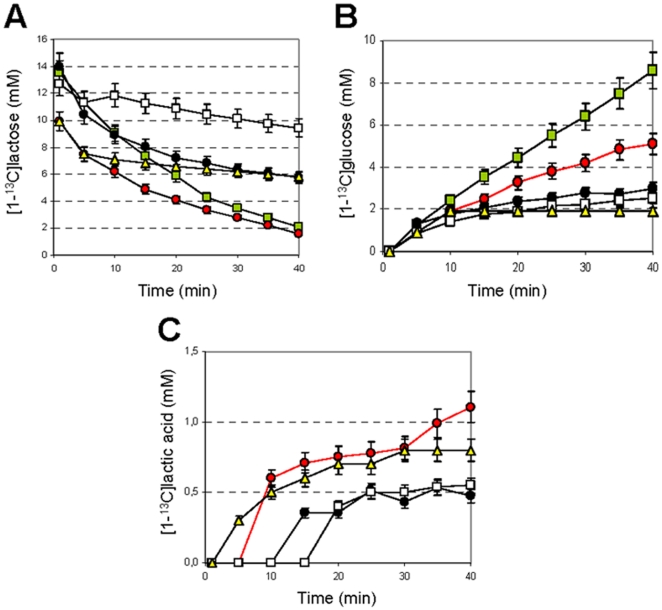
Figure 2. Dynamics of metabolite pools in S. thermophilus as determined by in vivo NMR.
Time course for (1-13C)lactose (14 mM) (A), -glucose (B), and -lactic acid (C), consumption/product formation in wild-type S. thermophilus. The metabolite concentrations were measured in in vivo 13C NMR experiments using EdC that were activated with 14 mM lactose (green symbols), 14 mM lactose and 0.5 mM urea (black symbols), 14 mM lactose and 10 mM urea (red symbols), 14 mM lactose and 1 mM ammonia (yellow symbols) or 14 mM lactose, 0.5 mM urea and 0.4 M sodium oxamate (white symbols). The (1-13C)-lactic acid concentration in EdC that were activated with 14 mM lactose was always below the detection limit using the instrument parameters that are listed in Materials and Methods S1. The error bars represent the SEM.
Figure 3
Figure 3. Raw isothermal titration calorimetry data (heat flux versus time) of Streptococcus thermophilus lactose metabolism alone (blue line) or in the presence of ammonia (green line) or urea (red line).
Lactose (70 µmol), ammonia (5 µmol) or urea (2.5 µmol), was injected into a 5 ml suspension of EdC at time zero. The inset represents the overall specific enthalpy (with respect to grams of total protein) versus time. The details of the experimental conditions are provided in the supplementary materials.
Figure 4
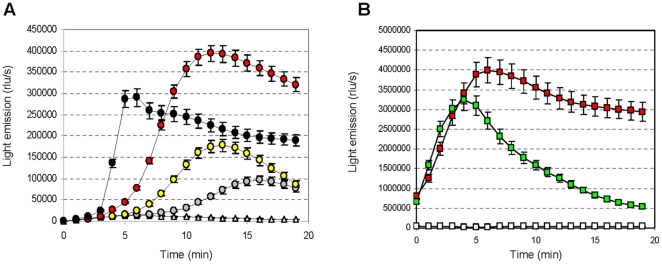
Figure 4. The cooperative and altruistic behaviour of S. thermophilus urease activity in mixed bacterial communities.
(A) The intracellular ATP concentration presented as light emission, in S. thermophilus A16-945 (urease-negative) EdC in mixed cultures. The A16-945 EdC were mixed with the wild-type EdC at the following ratios (v/v): 100% A16-945 (white triangles), 95% A16-945 (grey circles), 90% A16-945 (yellow circles), 80% A16-945 (red circles), and 50% A16-945 (black circles). The EdC were activated with 14 mM lactose/0.5 mM urea. (B) The intracellular ATP concentration, presented as light emission, in Lactococcus lactis 1403-945 (urease-negative) EdC in mixed cultures. The urease-negative EdC were mixed with the wild-type EdC at a 1∶1 ratio. The mixed EdC cultures were acitvated with 0.5 mM urea (white squares), 14 mM lactose (green squares) or 14 mM lactose/0.5 mM urea (red squares). The error bars represent the SEM.
Figure 5
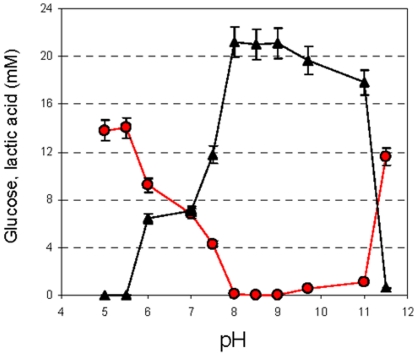
Figure 5. pH-dependent glucose consumption (red circles) and lactic acid production (black triangles) in EdC of S. thermophilus that were treated with 100 µM of the uncoupler gramicidine.
The error bars represent the SEM.
Figure 6
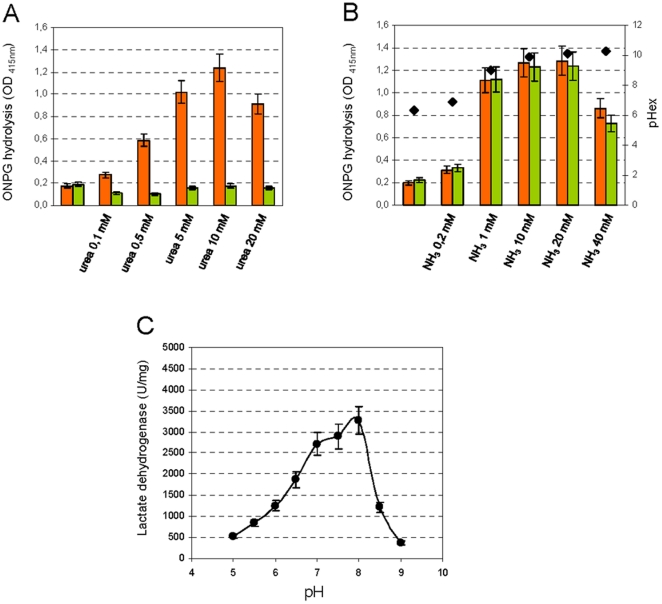
Figure 6. Urea-dependent β-galactosidase activity and pH-dependent lactate dehydrogenase activity.
The dependence of β-galactosidase activity on the urea (A) and ammonia concentration (B) in wild-type S. thermophilus wild-type (orange bars) and urease-negative A16(ΔureC3) (green bars) permeabilised cell suspensions. The extracellular pH (♦) is indicated. (B). The pH-dependent lactate dehydrogenase activity (C) was measured in crude cell extracts. All of the experiments in this panel were performed in presence of 100 µg/ml of chloramphenicol to block the protein synthesis. The error bars represent the SEM.

References

    1. Voit E, Neves AR, Santos H. The intricate side of systems biology. Proc Natl Acad Sci U S A. 2006;103:9452–9457. - PMC - PubMed
    1. Mora D, Maguin E, Masiero M, Ricci G, Parini C, et al. Characterization of urease genes cluster of Streptococcus thermophilus. J Appl Microbiol. 2004;96:209–219. - PubMed
    1. Hols P, Hancy F, Fontaine L, Grossiord B, Prozzi D, et al. New insights in the molecular biology and physiology of Streptococcus thermophilus revealed by comparative genomics. FEMS Microbiol Rev. 2005;29:435–463. - PubMed
    1. Monnet C, Pernoud S, Sepulchre A, Fremaux C, Corrieu G. Selection and properties of Streptococcus thermophilus mutants deficient in urease. J Dairy Sci. 2004;87:1634–1640. - PubMed
    1. Arioli S, Christophe M, Guglielmetti S, Parini C, De Noni I, et al. Aspartate biosynthesis is essential for the growth of Streptococcus thermophilus in milk, and aspartate availability modulates the level of urease activity. Appl Environ Microbiol. 2007;73:5789–5796. - PMC - PubMed

Publication types

MeSH terms