


doi: 10.1155/2010/730861.
A Review of the Pathophysiology and Novel Treatments for Erectile Dysfunction
Affiliations
- PMID: 21152267
- PMCID: PMC2997760
- DOI: 10.1155/2010/730861
Item in Clipboard
A Review of the Pathophysiology and Novel Treatments for Erectile Dysfunction
Adv Pharmacol Sci.
2010.
Abstract
Erectile dysfunction (ED) affects up to 50% of men between the ages of 40 and 70. Treatment with PDE-5 inhibitors is effective in the majority of men with ED. However, PDE-5 inhibitors are not effective when levels of nitric oxide (NO), the principle mediator of erection, are low. The pharmacologic actions of three new potential treatments for ED are discussed in this paper: (1) sGC stimulators/activators, (2) Rho-kinase inhibitors, and (3) sodium nitrite.
Figures
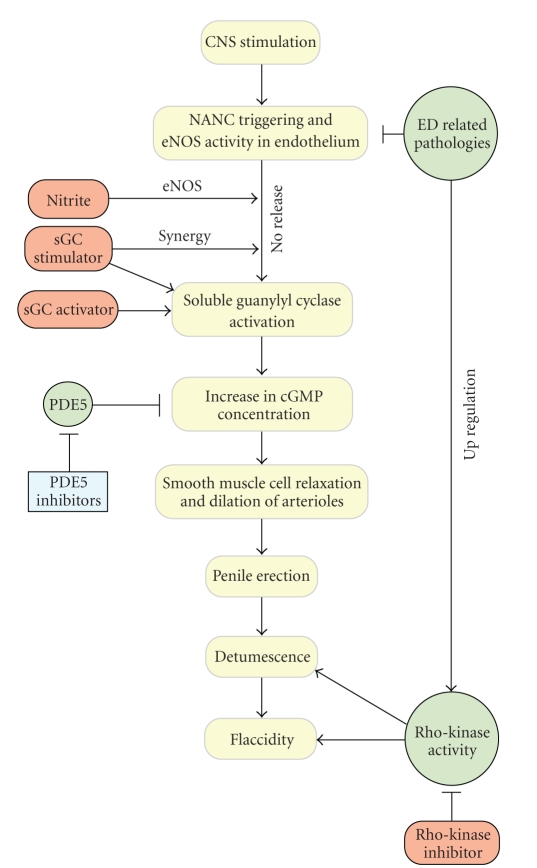
Pathway for the control of penile erection and detumescence. Stimulation of erection originates in the higher centers of the brain that result in upregulation of NANC and cholinergic activity and withdrawal of sympathetic activity in the nerves innervating the corpora cavernosa and small arteries of the penis. This increase in NANC and cholinergic activity results in upregulated NO release from the endothelium and NANC nerve terminals. The NO diffuses into the smooth muscle of the corpora cavernosa and small arteries/arterioles of the penis and binds to the reduced heme iron of soluble guanylate cyclase, activating the enzyme and increasing the formation of cGMP from GTP. cGMP-dependent protein kinase activity opens potassium channels in smooth muscle cells and increases the uptake of calcium into stores. This leads to a decrease in intracellular calcium concentration and smooth muscle cell relaxation. This increases blood flow into the corporal sinuses and the cavernosal sinuses expand trapping blood in the corpora producing a penile erection. Detumescence is initiated by release of vasoconstrictors from sympathetic terminals and endothelium. A cGMP specific phosphodiesterase (type 5) breaks down the cGMP to GTP and terminates the actions of cGMP. Three new pharmacologic targets for the treatment of erectile dysfunction (sGC stimulators/activators, Rho-kinase inhibitors and sodium nitrite) have been identified and may be effective in patients refractory to phosphodiesterase 5 inhibitor treatment. Recent experiments have shown that nitrite is capable of generating bioactive NO in the corpora cavernosa. Soluble guanylate cyclase stimulators (YC-1, A-350619, CFM-1571, and the Bayer compounds BAY 41-2272, BAY 41-8543, and BAY 63-2521) have been shown to act directly on the sGC enzyme and synergize with available NO which could be beneficial in disease states with low NO production and bioavailability. sGC activators (BAY 58-2667, BAY 60-2770 and HMR 1766/S3448) have also been shown to act on oxidized and heme-deficient sGC. Rho-kinase/RhoA activation has been shown to mediate detumescence and maintain flaccidity. Rho kinase inhibits the regulatory subunit of myosin phosphatase within smooth muscle cells and maintains contractile tone under low-cytosolic calcium concentrations. Upregulated Rho-kinase activity has been reported in ED, so Rho-kinase inhibitors (Y-27632 and SAR 407899) have potent erectile effects and offer another therapeutic target for the treatment of ED.
References
-
- Feldman HA, Goldstein I, Hatzichristou DG, Krane RJ, McKinlay JB. Impotence and its medical and psychosocial correlates: results of the Massachusetts Male Aging Study. Journal of Urology. 1994;151(1):54–61. - PubMed
-
- Aytaç IA, McKinlay JB, Krane RJ. The likely worldwide increase in erectile dysfunction between 1995 and 2025 and some possible policy consequences. British Journal of Urology International. 1999;84(1):50–56. - PubMed
-
- De Boer BJ, Bots ML, Lycklama A Nijeholt AAB, Moors JPC, Pieters HM, Verheij TJM. Erectile dysfunction in primary care: prevalence and patient characteristics. The ENIGMA study. International Journal of Impotence Research. 2004;16(4):358–364. - PubMed
-
- Laumann EO, Paik A, Rosen RC. Sexual dysfunction in the United States: prevalence and predictors. Journal of the American Medical Association. 1999;281(6):537–544. - PubMed
-
- Hellstrom WJG, Bivalacqua TJ. Peyronie’s disease: etiology, medical, and surgical therapy. Journal of Andrology. 2000;21(3):347–354. - PubMed
Grants and funding
LinkOut - more resources
Full Text Sources
Other Literature Sources
