


Effect of accelerator in green synthesis of silver nanoparticles
- PMID: 21152307
- PMCID: PMC2996783
- DOI: 10.3390/ijms11103898
Effect of accelerator in green synthesis of silver nanoparticles
Abstract
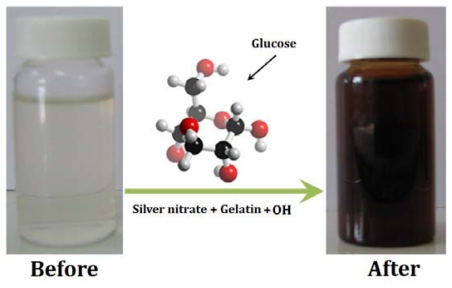
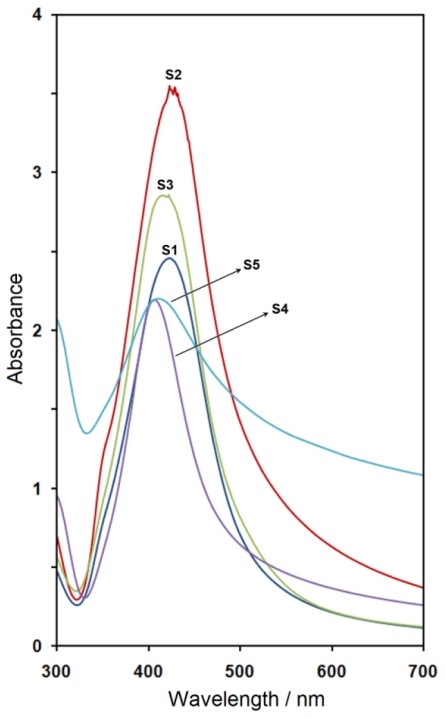
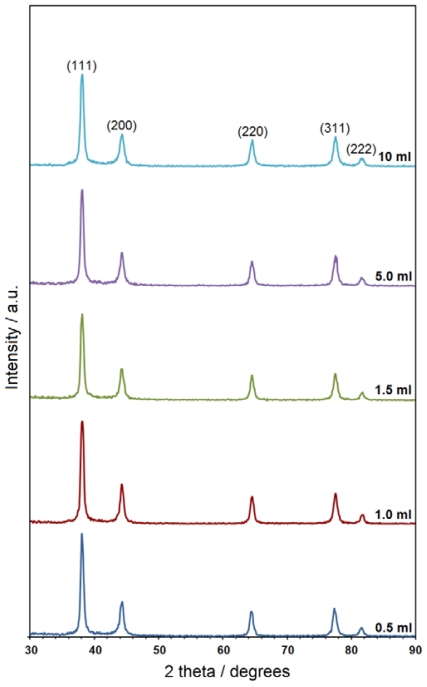
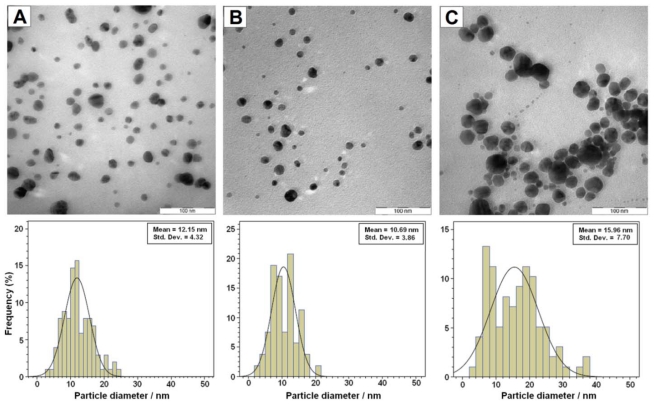
Silver nanoparticles (Ag-NPs) were successfully synthesized in the natural polymeric matrix. Silver nitrate, gelatin, glucose, and sodium hydroxide have been used as silver precursor, stabilizer, reducing agent, and accelerator reagent, respectively. This study investigated the role of NaOH as the accelerator. The resultant products have been confirmed to be Ag-NPs using powder X-ray diffraction (PXRD), UV-vis spectroscopy, and transmission electron microscopy (TEM). The colloidal sols of Ag-NPs obtained at different volumes of NaOH show strong and different surface plasmon resonance (SPR) peaks, which can be explained from the TEM images of Ag-NPs and their particle size distribution. Compared with other synthetic methods, this work is green, rapid, and simple to use. The newly prepared Ag-NPs may have many potential applications in chemical and biological industries.
Keywords: accelerator; gelatin; glucose; green synthesis; silver nanoparticles; stabilizer.
Figures
References
-
- Schultz DA. Plasmon resonant particles for biological detection. Curr. Opin. Biotech. 2003;14:13–22. - PubMed
-
- Parak WJ, Gerion D, Pellegrino T, Zanchet D, Micheel C, Williams SC, Boudreau R, Le Gros MA, Larabell CA, Alivisatos AP. Biological applications of colloidal nanocrystals. Nanotechnology. 2003;14:15–27.
-
- Nam JM, Thaxton CS, Mirkin CA. Nanoparticle-based bio-bar codes for the ultrasensitive detection of proteins. Science. 2003;301:1884–1886. - PubMed
-
- Haneda M, Kintaichi Y, Inaba M, Hamada H. Infrared study of catalytic reduction of nitrogen monoxide by propene over Ag/TiO2-ZrO2. Catal. Today. 1998;42:127–135.
-
- Husein MM, Rodil E, Vera JH. A novel method for the preparation of silver chloride nanoparticles starting from their solid powder using microemulsions. J. Colloid Interf. Sci. 2005;288:457–467. - PubMed
Publication types
MeSH terms
Substances
LinkOut - more resources
Full Text Sources
