


Altered immunoglobulin profiles in children with Tourette syndrome
- PMID: 21156204
- PMCID: PMC3056238
- DOI: 10.1016/j.bbi.2010.12.003
Altered immunoglobulin profiles in children with Tourette syndrome
Abstract
Background: Post-infectious autoimmunity and immune deficiency have been implicated in the pathogenesis of Tourette syndrome (TS). We asked here whether B cell immunity of patients with TS differs from healthy subjects.
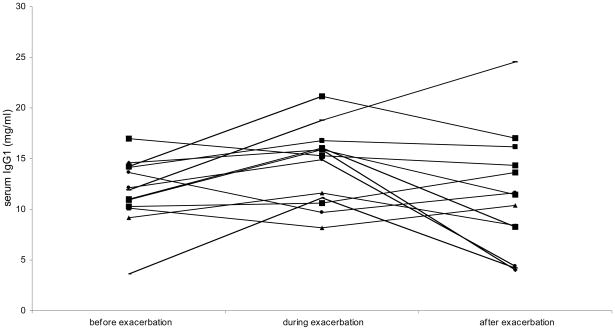
Methods: In two independent cross-sectional samples, we compared serum levels of IgG1, IgG2, IgG3, IgG4, IgM, IgA, and IgE in 21 patients with TS from Yale University (17 males, 4 females, 8-16 years) versus 21 healthy controls (13 males, 8 females, 7-17 years); and in 53 patients with TS from Groningen University (45 males, 8 females, 6-18 years) versus 53 healthy controls (22 males, 31 females, 6-18 years), respectively. We also investigated correlations between Ig concentrations and symptom severity. In 13 additional patients (9 males, 4 females, age range 9-14), we established Ig profiles at time points before, during, and after symptom exacerbations.
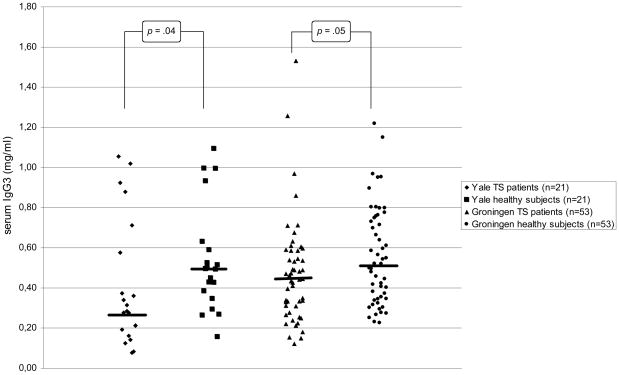
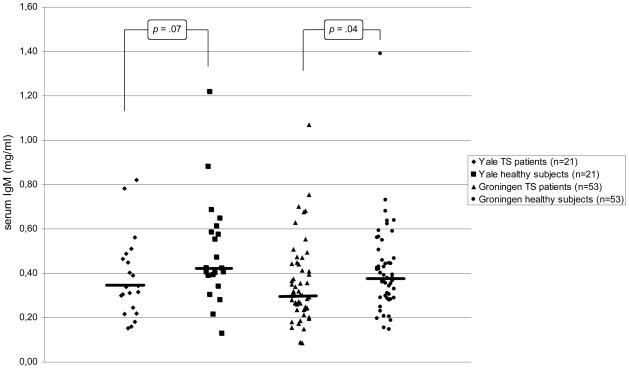
Results: IgG3 levels were significantly lower in Yale patients compared to healthy children (medians 0.28 versus 0.49 mg/ml, p=.04), while levels of IgG2, IgG4, and IgM in patients were lower at trend-level significance (p≤.10). Decreased IgG3 (medians 0.45 versus 0.52 mg/ml; p=.05) and IgM (medians 0.30 versus 0.38 mg/ml; p=.04) levels were replicated in the Groningen patients. Ig levels did not correlate with symptom severity. There was a trend-level elevation of IgG1 during symptom exacerbations (p=.09).
Conclusion: These pilot data indicate that at least some patients with TS have decreased serum IgG3, and possibly also IgM levels, though only few subjects had fully expressed Ig immunodeficiency. Whether these changes are related to TS pathogenesis needs to be investigated.
Copyright © 2010 Elsevier Inc. All rights reserved.
Figures
References
-
- American Psychiatric Association. Diagnostic and Statistical Manual of Mental Disorders. 4. Washington, DC: American Psychiatric Association; 2000. text revison (DSM-IV-TR)
-
- Baron-Cohen S, Scahill VL, Izaguirre J, Hornsey H, Robertson MM. The prevalence of Gilles de la Tourette syndrome in children and adolescents with autism: a large scale study. Psychol Med. 1999;29:1151–1159. - PubMed
-
- Boscarino JA. Posttraumatic stress disorder and physical illness: results from clinical and epidemiologic studies. Annals of the New York Academy of Sciences. 2004;1032:141–153. - PubMed
-
- Brynska A, Tomaszewicz-Libudzic E, Wolanczyk T. Obsessive-compulsive disorder and acquired toxoplasmosis in two children. European child & adolescent psychiatry. 2001;10:200–204. - PubMed
-
- Bussone G, Mouthon L. Autoimmune manifestations in primary immune deficiencies. Autoimmun Rev. 2009;8:332–336. - PubMed
Publication types
MeSH terms
Substances
Grants and funding
- R01NS42240/NS/NINDS NIH HHS/United States
- R01 MH066187/MH/NIMH NIH HHS/United States
- R01 MH061940/MH/NIMH NIH HHS/United States
- R01MH061940/MH/NIMH NIH HHS/United States
- P01MH049351/MH/NIMH NIH HHS/United States
- K05 MH076273/MH/NIMH NIH HHS/United States
- P01 MH049351/MH/NIMH NIH HHS/United States
- RR00125/RR/NCRR NIH HHS/United States
- M01RR006022/RR/NCRR NIH HHS/United States
- MH066187/MH/NIMH NIH HHS/United States
- MH014235/MH/NIMH NIH HHS/United States
- T32 MH014235/MH/NIMH NIH HHS/United States
- R01 NS042240/NS/NINDS NIH HHS/United States
- M01 RR000125/RR/NCRR NIH HHS/United States
- M01 RR006022/RR/NCRR NIH HHS/United States
LinkOut - more resources
Full Text Sources
Medical
Miscellaneous
