


Peer violence perpetration among urban adolescents: dispelling the myth of the violent immigrant
- PMID: 21156691
- PMCID: PMC3123437
- DOI: 10.1177/0886260510388288
Peer violence perpetration among urban adolescents: dispelling the myth of the violent immigrant
Abstract
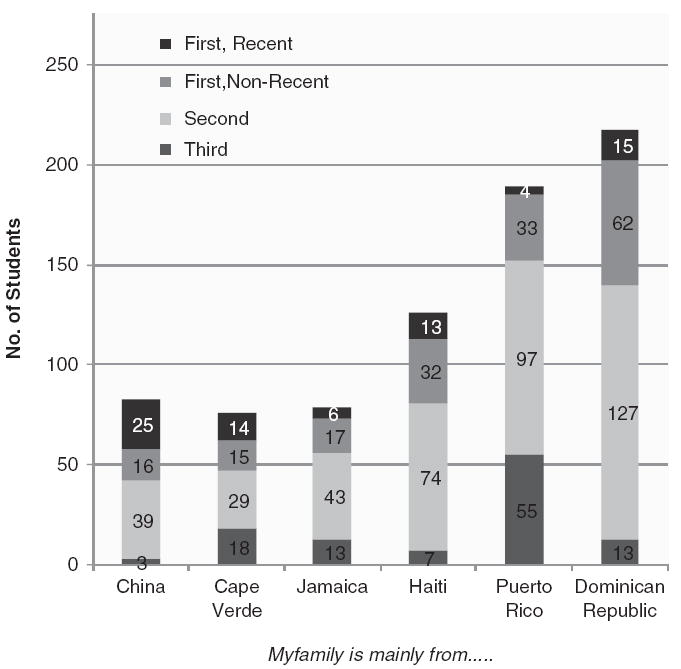
Researchers have found an inverse relationship between immigrant status and violence perpetration. Most studies have examined Mexican immigrants, and few have assessed immigration factors other than nativity. Additionally, the majority have focused on the most serious forms of violence despite the fact that moderate violence is more common. Using data from the 2008 Boston Youth Survey, we generated prevalence estimates of peer violence perpetration across immigration related factors, examined whether risk factors for peer violence differed by these variables, and explored the contribution of risk factors to peer violence perpetration. Recent immigrants had a significantly lower prevalence of peer violence compared to each other generations/time in U.S. group. Known risk factors for violence perpetration varied by generation/time in U.S.: compared to other groups, recent immigrants were less likely to have used substances, and were more likely earn A's and B's in school. Recent immigrants had a significantly lower risk of violence perpetration relative to U.S.-born (RR = 0.35, 95% CI: 0.19, 0.62). Adjusting for known risk factors did not attenuate differences in risk. While immigrant youth had a lower risk of peer violence, the protective effect was diminished among immigrants who had resided in the U.S. for >4 years. This pattern demonstrates that negative assimilation occurs within the first generation, not just across generations. Results suggest that perpetration of violence worsens with increased time in the U.S. Research is needed to identify factors that contribute to the acquisition of behaviors such as violence among recently arrived immigrant youth.
Conflict of interest statement
Figures
References
-
- Alaniz ML, Cartmill RS, Parker RN. Immigrants and violence: The importance of neighborhood context. Hispanic Journal of Behavioral Sciences. 1998;20:155–174.
Publication types
MeSH terms
Grants and funding
LinkOut - more resources
Full Text Sources
