Maintaining a high physical activity level over 20 years and weight gain
- PMID: 21156948
- PMCID: PMC3864556
- DOI: 10.1001/jama.2010.1843
Maintaining a high physical activity level over 20 years and weight gain
Erratum in
- JAMA. 2011 Jan 12;305(2):150
Abstract
Context: Data supporting physical activity guidelines to prevent long-term weight gain are sparse, particularly during the period when the highest risk of weight gain occurs.
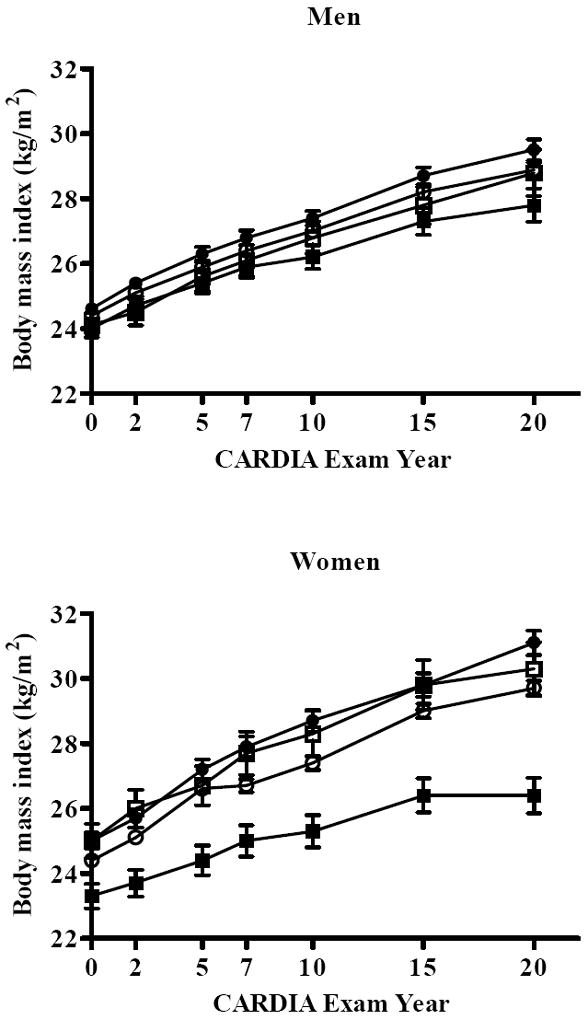
Objective: To evaluate the relationship between habitual activity levels and changes in body mass index (BMI) and waist circumference over 20 years.
Design, setting, and participants: The Coronary Artery Risk Development in Young Adults (CARDIA) study is a prospective longitudinal study with 20 years of follow-up, 1985-1986 to 2005-2006. Habitual activity was defined as maintaining high, moderate, and low activity levels based on sex-specific tertiles of activity scores at baseline. Participants comprised a population-based multicenter cohort (Chicago, Illinois; Birmingham, Alabama; Minneapolis, Minnesota; and Oakland, California) of 3554 men and women aged 18 to 30 years at baseline.
Main outcome measures: Average annual changes in BMI and waist circumference.
Results: Over 20 years, maintaining high levels of activity was associated with smaller gains in BMI and waist circumference compared with low activity levels after adjustment for race, baseline BMI, age, education, cigarette smoking status, alcohol use, and energy intake. Men maintaining high activity gained 2.6 fewer kilograms (0.15 BMI units per year; 95% confidence interval [CI], 0.11-0.18 vs 0.20 in the lower activity group; 95% CI, 0.17-0.23), and women maintaining higher activity gained 6.1 fewer kilograms (0.17 BMI units per year; 95% CI, 0.12-0.21 vs 0.30 in the lower activity group; 95% CI, 0.25-0.34). Men maintaining high activity gained 3.1 fewer centimeters in waist circumference (0.52 cm per year; 95% CI, 0.43-0.61 cm vs 0.67 cm in the lower activity group; 95% CI,0.60-0.75 cm) and women maintaining higher activity gained 3.8 fewer centimeters(0.49 cm per year; 95% CI, 0.39-0.58 cm vs 0.67 cm in the lower activity group; 95% CI, 0.60-0.75 cm) [corrected].
Conclusion: Maintaining high activity levels through young adulthood may lessen weight gain as young adults transition to middle age, particularly in women.
Figures
Comment in
-
Physical activity and weight gain over 20 years.JAMA. 2011 Apr 6;305(13):1297; author reply 1297-8. doi: 10.1001/jama.2011.397. JAMA. 2011. PMID: 21467280 No abstract available.
References
-
- Flegal KM, Carroll MD, Ogden CL, Curtin LR. Prevalence and trends in obesity among US adults, 1999-2008. Jama. 2010 Jan 20;303(3):235–241. - PubMed
-
- Visscher TL, Seidell JC. The public health impact of obesity. Annu Rev Public Health. 2001;22:355–375. - PubMed
-
- Daviglus ML, Liu K, Yan LL, et al. Relation of body mass index in young adulthood and middle age to Medicare expenditures in older age. Jama. 2004 Dec 8;292(22):2743–2749. - PubMed
-
- Kumanyika SK, Obarzanek E, Stettler N, et al. Population-based prevention of obesity: the need for comprehensive promotion of healthful eating, physical activity, and energy balance: a scientific statement from American Heart Association Council on Epidemiology and Prevention, Interdisciplinary Committee for Prevention (formerly the expert panel on population and prevention science) Circulation. 2008 Jul 22;118(4):428–464. - PubMed
-
- Fogelholm M, Kukkonen-Harjula K. Does physical activity prevent weight gain--a systematic review. Obes Rev. 2000 Oct;1(2):95–111. - PubMed
Publication types
MeSH terms
Grants and funding
- N01 HC095095/HL/NHLBI NIH HHS/United States
- N01 HC048050/HC/NHLBI NIH HHS/United States
- N01-HC-48047/HC/NHLBI NIH HHS/United States
- N01 HC048049/HL/NHLBI NIH HHS/United States
- N01-HC-95095/HC/NHLBI NIH HHS/United States
- N01 HC048049/HC/NHLBI NIH HHS/United States
- N01-HC-48049/HC/NHLBI NIH HHS/United States
- N01 HC048047/HL/NHLBI NIH HHS/United States
- N01 HC048050/HL/NHLBI NIH HHS/United States
- N01-HC-48048/HC/NHLBI NIH HHS/United States
- N01 HC048048/HL/NHLBI NIH HHS/United States
- N01 HC048047/HC/NHLBI NIH HHS/United States
- R01 HL078972/HL/NHLBI NIH HHS/United States
- N01 HC048048/HC/NHLBI NIH HHS/United States
- N01-HC-48050/HC/NHLBI NIH HHS/United States
- N01 HC095095/HC/NHLBI NIH HHS/United States