. 2011 Aug;27(8):877-87.
doi: 10.1089/AID.2010.0281. Epub 2011 Jan 19.

HIV type 1 Env precursor cleavage state affects recognition by both neutralizing and nonneutralizing gp41 antibodies

Affiliations

HIV type 1 Env precursor cleavage state affects recognition by both neutralizing and nonneutralizing gp41 antibodies

Bimal K Chakrabarti et al. AIDS Res Hum Retroviruses. 2011 Aug.

Abstract

HIV-1 is relatively resistant to antibody-mediated neutralization; however, rare antibodies to the exterior envelope glycoprotein, gp120, and the transmembrane glycoprotein, gp41, can neutralize a broad array of isolates. Two antibodies, 2F5 and 4E10, are directed against the gp41 membrane proximal external region (MPER); however, the kinetic neutralization signature of these antibodies remains unresolved. Previously, we reported that the fully cleaved, cell surface envelope glycoproteins (Env) derived from the primary isolate, JR-FL, are well recognized exclusively by gp120-directed neutralizing ligands and not by nonneutralizing gp120 antibodies. However, the gp120 nonneutralizing antibodies can recognize HIV spikes that are rendered fully cleavage defective by site-directed mutagenesis. Here, we extended such analysis to gp41 neutralizing and nonneutralizing antibodies and, relative to the rules of gp120-specific antibody recognition, we observed marked contrasts. Similar to gp120 recognition, the nonneutralizing gp41 cluster 1 or cluster 2 antibodies bound much more efficiently to cleavage-defective spikes when compared to their recognition of cleaved spikes. In contrast to gp120 neutralizing antibody recognition, the broadly neutralizing gp41 antibodies 2F5 and 4E10, like the nonneutralizing gp41 antibodies, did not efficiently recognize the predominantly cleaved, primary isolate JR-FL spikes. However, if the spikes were rendered cleavage defective, recognition by both the neutralizing and nonneutralizing ligand markedly increased. CD4 interaction with the cleaved spikes markedly increased recognition by most nonneutralizing gp41 antibodies, whereas such treatment had a minimal increase of 2F5 and 4E10 recognition. These data indicate again the profound influence that cleavage imposes on the quaternary packing of primary isolate spikes and have important implications for soluble trimer candidate immunogens.


Figures
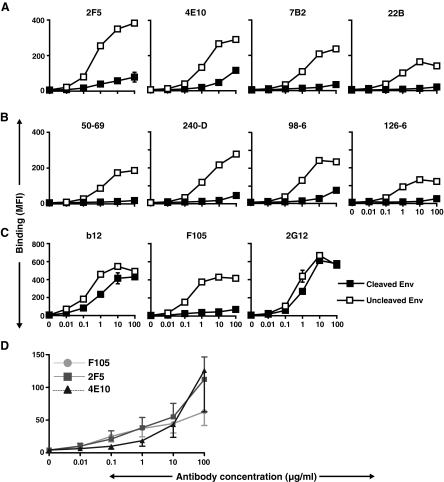
FIG. 1.
FIG. 1.
FACS-based binding curves derived by antibody binding to cell surface JR-FL Env. (A, B) Mean fluorescent intensity (MFI) values of both neutralizing (2F5 and 4E10) and nonneutralizing gp41-directed antibodies (7B2, 22B, 50-69, 240-D, 98-6, and 126-6) are shown to cleavage-competent (▪) and cleavage-defective (□) Env. (C) As controls, neutralizing (b12 and 2G12) and nonneutralizing (F105) gp120-directed antibody-binding profiles are shown. The data shown were derived from the same representative experiment performed in duplicate. The standard errors between duplicates were small and are not always visible since the error bars are often obscured by the symbols; data generated from as many as five other independent experiments displayed similar trends. (D) Comparative binding analysis of 2F5, 4E10, and the nonneutralizing antibody F105 to cleavage-competent JR-FL Env. Note that here the MFI data are presented on a different scale. The curves were generated by averaging the MFI values at each antibody concentration and were derived from five independent experiments; error bars are shown.
FIG. 2.
FIG. 2.
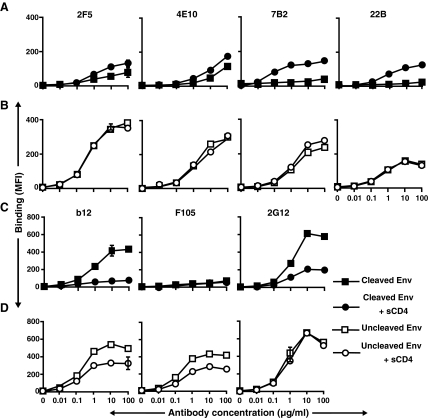
Effects of sCD4 on the binding of antibodies to cell-surface JR-FL Env. FACS-based cell-surface staining curves indicating the binding of gp41-directed antibodies to JR-FL (A) cleavage-competent without sCD4 (▪) and with sCD4 (•) and (B) cleavage-defective envelope without sCD4 (□) and with sCD4 (o). Both neutralizing (2F5 and 4E10) and nonneutralizing antibodies (7B2, 22B) directed to gp41 Env are shown in (A) and (B). (C) The bindings of both neutralizing (b12 and 2G12) and nonneutralizing (F105) antibodies directed toward gp120 in the absence and presence of sCD4 are shown as controls in (C) and (D). The data shown are from a single representative experiment, performed in duplicate, and the error bars are not often visible. The data generated from five other independent experiments showed similar trends.
FIG. 3.
FIG. 3.
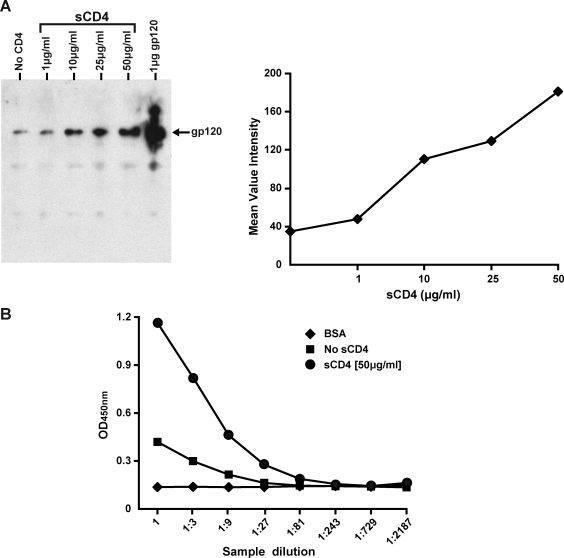
CD4-induced shedding of gp120 from JR-FL cell surface Env spikes. (A) The gp120 present in the cell supernatants (100 μl) derived from the JR-FL Env-expressing cells treated with increasing concentration of sCD4 (1–50 μg/ml) was immunoprecipitated by the anti-V3 monoclonal, 39F. The gp120 glycoproteins were resolved by sodium dodecyl sulfate polyacrylamide gel electrophoresis (SDS–PAGE) and the Western blot was developed by polyclonal rabbit anti-gp120 primary antibody followed by horseradish peroxidase (HRP)-conjugated goat antirabbit IgG secondary antibody. Untreated cells were used to evaluate the spontaneous shedding of gp120 from the cell surface spikes. Purified gp120 was used as a positive control (far right lane). The bands on the film were quantitated using the Quantity one software (Bio-Rad) and are plotted in the right panel. (B) The same set of cell supernatants was analyzed by ELISA to detect the presence of shed gp120 as shown. The gp120 present in the samples was captured on the ELISA plate precoated with lectin. Lectin-captured gp120 was then detected using the 39F monoclonal antibody.
FIG. 4.
FIG. 4.
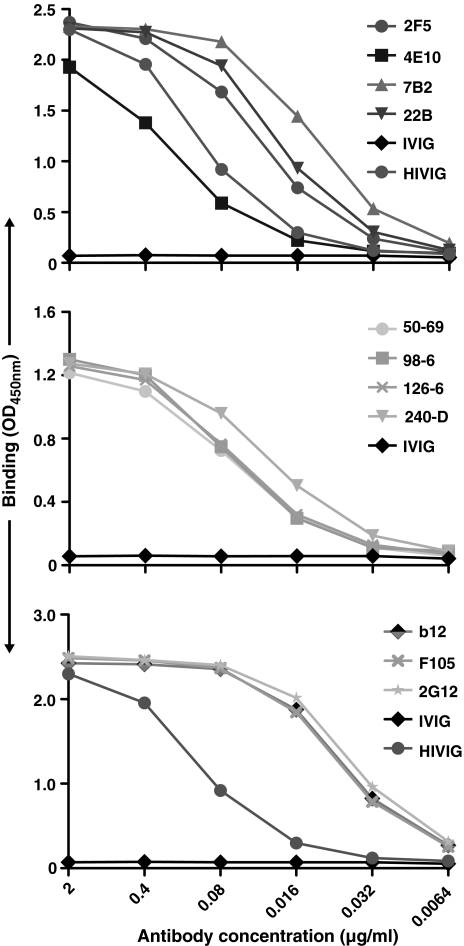
ELISA binding of selected monoclonal antibodies to soluble JR-FL gp140-foldon glycoprotein. (Top) ELISA binding of gp41-directed antibodies to purified JR-FLgp140-foldon trimers coated on the ELISA plate. (Middle) ELISA binding of the cluster 1 and cluster 2 gp41 antibodies to JR-FL gp140-foldon trimers. (Bottom) Selected control gp120-directed antibodies binding to the JR-FL gp140-foldon trimers.

References

    1. Center RJ. Leapman RD. Lebowitz J. Arthur LO. Earl PL. Moss B. Oligomeric structure of the human immunodeficiency virus type 1 envelope protein on the virion surface. J Virol. 2002;76(15):7863–7867. - PMC - PubMed
    1. Choe H. Farzan M. Sun Y, et al. The beta-chemokine receptors CCR3 and CCR5 facilitate infection by primary HIV-1 isolates. Cell. 1996;85(7):1135–1148. - PubMed
    1. Dalgleish AG. Beverley PC. Clapham PR. Crawford DH. Greaves MF. Weiss RA. The CD4 (T4) antigen is an essential component of the receptor for the AIDS retrovirus. Nature. 1984;312(5996):763–767. - PubMed
    1. Hallenberger S. Bosch V. Angliker H. Shaw E. Klenk HD. Garten W. Inhibition of furin-mediated cleavage activation of HIV-1 glycoprotein gp160. Nature. 1992;360(6402):358–361. - PubMed
    1. Weissenhorn W. Dessen A. Harrison SC. Skehel JJ. Wiley DC. Atomic structure of the ectodomain from HIV-1 gp41. Nature. 1997;387(6631):426–430. - PubMed

Publication types

MeSH terms