. 2010 Dec;52(9):771-83.
doi: 10.1111/j.1440-169X.2010.01213.x.

Functional analysis of Toll-related genes in Drosophila

Affiliations

Functional analysis of Toll-related genes in Drosophila

Yoshimasa Yagi et al. Dev Growth Differ. 2010 Dec.

Abstract

The Drosophila genome encodes a total of nine Toll and related proteins. The immune and developmental functions of Toll and 18Wheeler (18W) have been analyzed extensively, while the in vivo functions of the other Toll-related proteins require further investigation. We performed transgenic experiments and found that overexpression of Toll-related genes caused different extents of lethality and developmental defects. Moreover, 18w, Toll-6, Toll-7 and Toll-8 often caused related phenotypic changes, consistent with the idea that these four genes have more conserved molecular structure and thus may regulate similar processes in vivo. Deletion alleles of Toll-6, Toll-7 and Toll-8 were generated by targeted homologous recombination or P element excision. These mutant alleles were viable, fertile, and had no detectable defect in the inducible expression of antimicrobial peptide genes except for the Toll-8 mutant had some defects in leg development. The expression of 18w, Toll-7 and Toll-8 mRNA showed wide and overlapping patterns in imaginal discs and the 18w, Toll-8 double and Toll-7, Toll-8 double mutants showed substantially increased lethality. Overall our results suggest that some of the Toll-related proteins, such as 18W, Toll-7 and Toll-8, may have redundant functions in regulating developmental processes.


Figures

Fig. 1
Fig. 1
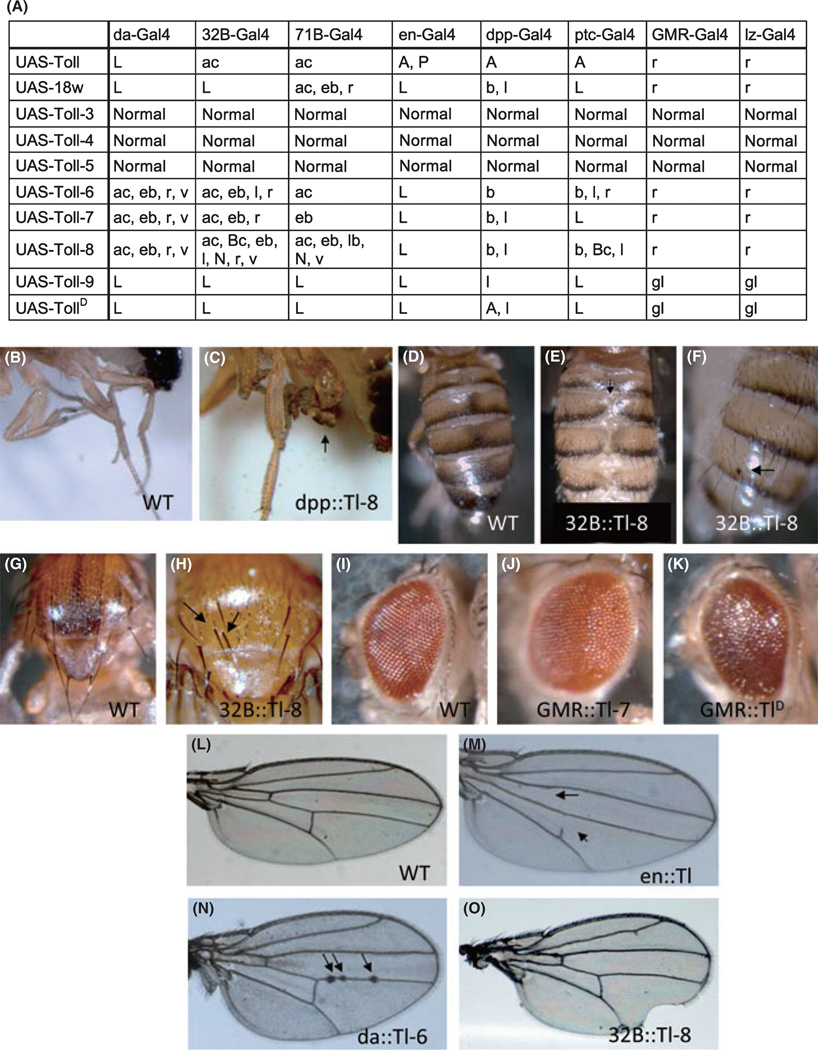
Transgenic expression of Toll-related genes induces multiple phenotypes. Toll-related genes were expressed under the UAS promoter driven by various Gal4 as indicated in panel A. The panel A table summarizes the phenotypes observed. The abbreviations of the phenotypes are: A, anterior cross vein defect; ac, abdominal closure defect; b, bifurcated wing; Bc, black cell-like phenotype; eb, extra bristle; gl, glazed eye; l, leg defect; L, lethal; lb, loss of bristle; N, notched wing; P, posterior cross vein defect; r, rough eye; v, vein thickening. Panels B–O are representative images of phenotypes in wild type (WT) flies or in transgenic flies expressing the indicated Toll-related gene, as indicated at the bottom of each panel. For example, dpp::Toll-8 is dpp-Gal4 / UAS-Toll-8. TollD was Toll781Y (Hu et al. 2004). Panel C is leg defect phenotype; E is abdominal closure defect; F is black cell-like phenotype; H is extra bristle; J is rough eye; K is glazed eye; M is cross vein defect (arrows); N is vein thickening (arrows); O is notched wing.
Fig. 2
Fig. 2
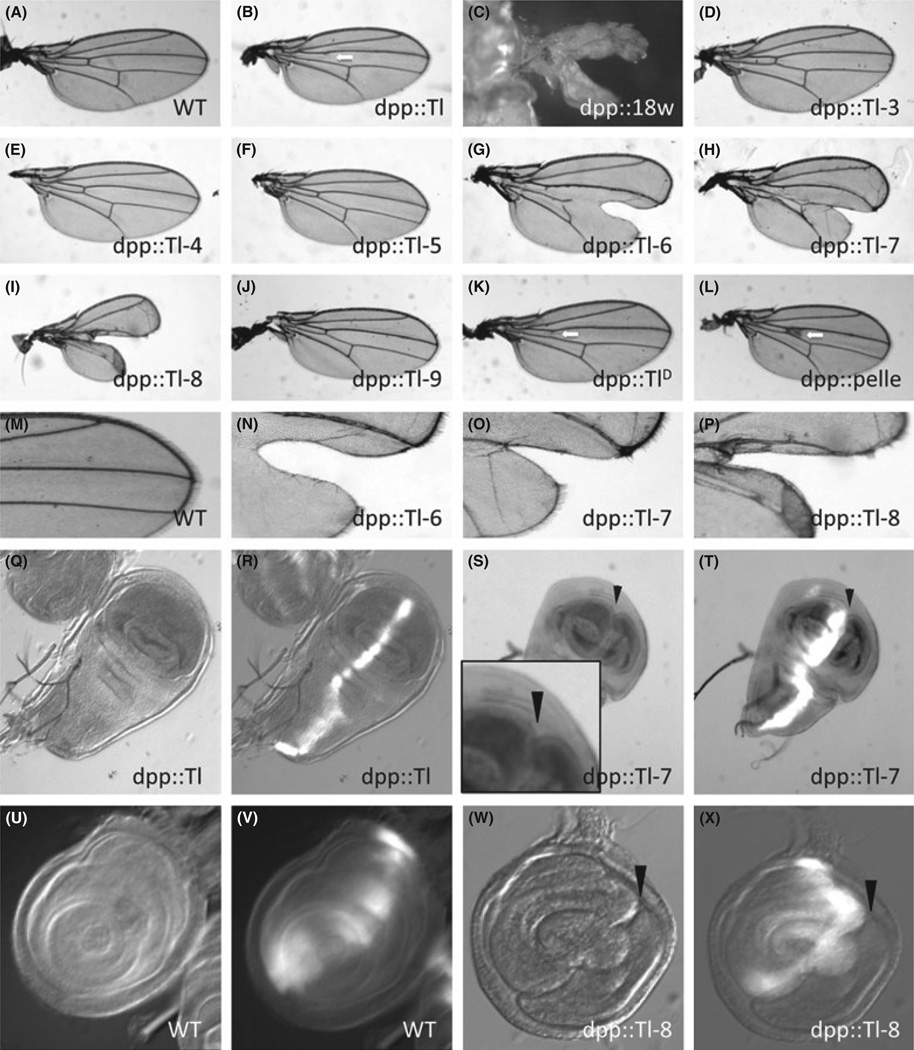
Wing-margin defects induced by the expression of the 18w, Toll-6, -7 and -8. Adult wing preparations are shown in panels A–P. The dpp-Gal4 driver was crossed with UAS lines as indicated at the bottom of each panel. Wild type (WT) was UAS-YFP, and TollD was Toll781Y. Panels M–P are enlarged images of panels A, G, H and I for WT, Toll-6, Toll-7 and Toll-8 overexpression, respectively. The expression of these Toll-related genes induced bifurcated wing phenotype. Overexpression of Toll (panel B) and TollD (panel K) caused the loss of anterior cross vein, while pelle (panel L) overexpression caused thickening of anterior cross vein (white arrows). Panels Q–X are images of imaginal discs that overexpressed the indicated constructs. All of these lines also included the UAS-YFP for visualizing the cells that should express the transgenes. The images in panels Q, S, U, W are light microscopy pictures, while panels R, T, V, X are mergers of light and fluorescent / YFP microscopy pictures. The expression of YFP alone (WT) or together with Toll showed normal disc morphology, while ectopic foldings were observed in Toll-7, -8 overexpressing discs (arroheads in S, T, W, X).
Fig. 3
Fig. 3
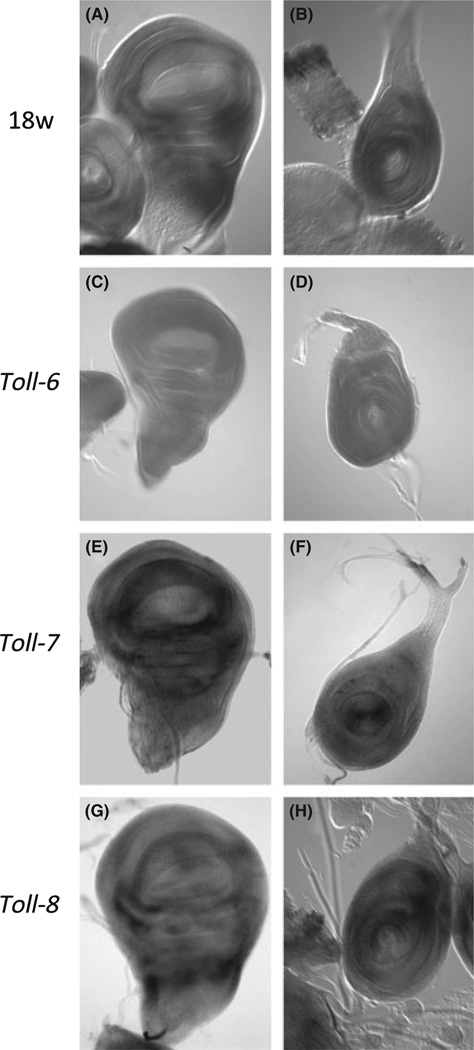
Expression patterns of 18w, Toll-6, Toll-7 and Toll-8 in imaginal discs. In situ hybridization was carried out to observe expression patterns of 18w, Toll-6, Toll-7 and Toll-8 mRNA in the imaginal discs. Panels A, C, E, G are wing discs, and panels B, D, F, H are leg discs. The in situ probes used are indicated to the left. The expression of 18w, Toll-7 and Toll-8 is similarly detectable around wing pouch and hinge region (A, E, G). 18w and Toll-8 expression is higher in the anterior segment / left half of leg discs (B, H). Toll-7 expression in the leg disc is higher around the A–P border of tarsal to tibia segment (F). No detectable staining was observed in the imaginal discs for the Toll-6 probe (C, D).
Fig. 4
Fig. 4
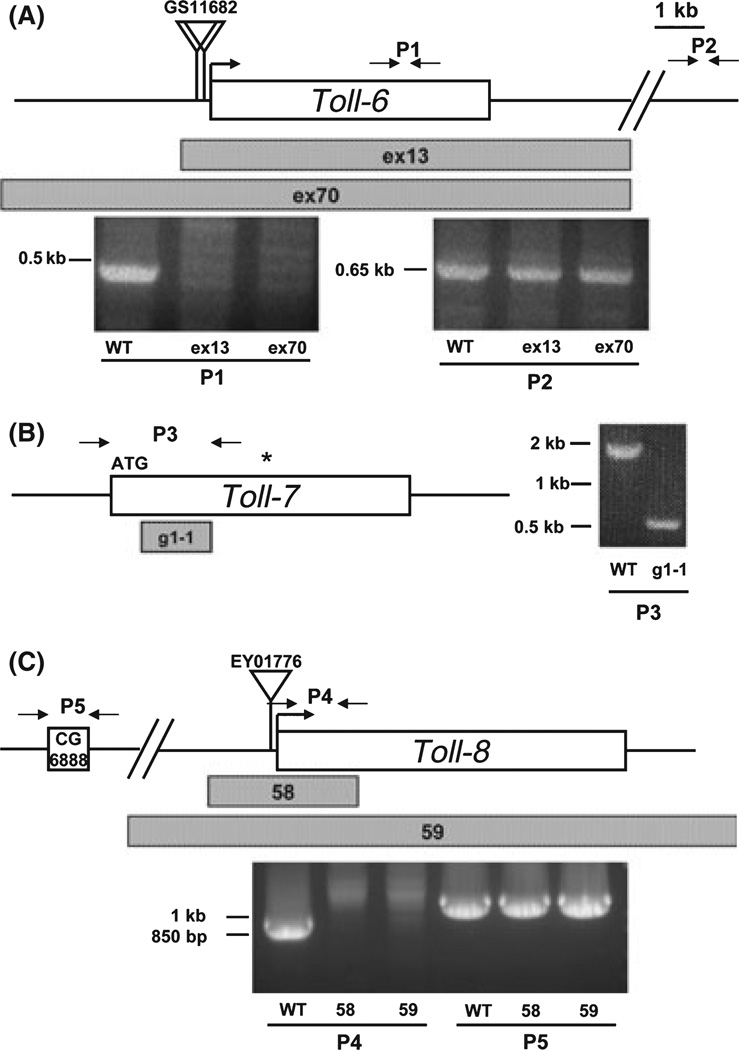
Genomic organization and mutant alleles of Toll-6, Toll-7 and Toll-8. The top of each panel shows the wild type genomic organization. The regions deleted are indicated by the shaded bars under each locus and the allele names are as shown. The gel images show the polymerase chain reaction (PCR) products with the primer pairs as shown. Genomic DNA from the indicated alleles are used as templates. Each of the primer pairs (P1 in panel A, P3 in panel B and P4 in panel C) within the coding regions gave positive amplification using wild type DNA but generated no or smaller products when using DNA from the deletion alleles. The control primer pairs (P2 and P5) outside the coding regions yielded the same products when using wild type and mutant DNA.
Fig. 5
Fig. 5
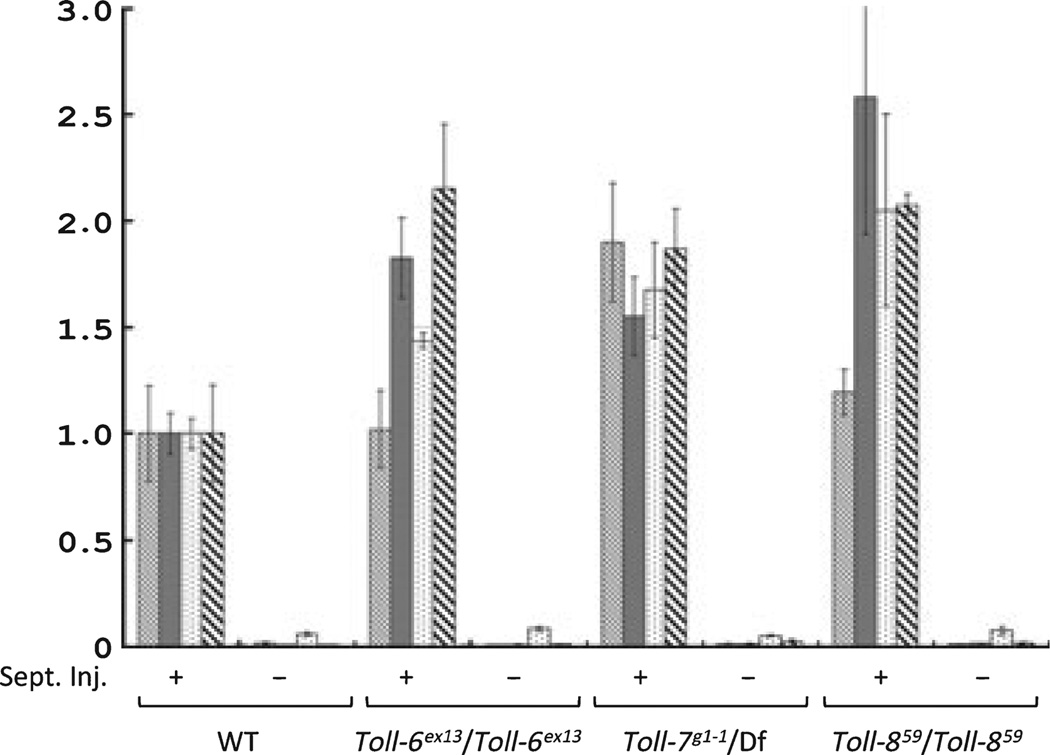
Normal induction of antimicrobial peptide genes in Toll-6, -7 and -8 mutants. Adult flies of the genotypes as indicated were collected and subject to septic injury. Antimicrobial peptide gene expression was measured by quantitative reverse transcription–polymerase chain reaction using gene-specific primers as indicated. The expression level was first normalized by the rp49 expression level in each sample. The value of each antimicrobial peptide gene in the wild type background after septic injury was then set to 1, and the expression levels in flies without septic injury and in other genetic backgrounds were calculated relative to this level of 1 for each gene separately. The plot as shown is an average of three independent experiments. Error bars represent standard error. AttA is AttacinA (formula image); Dipt is Diptericin (formula image); Drs is Drosomycin (formula image); Mtk is Metchnikowin (formula image). The inducibility of the antimicrobial peptide genes tested remains high in the mutants as in the wild type flies.
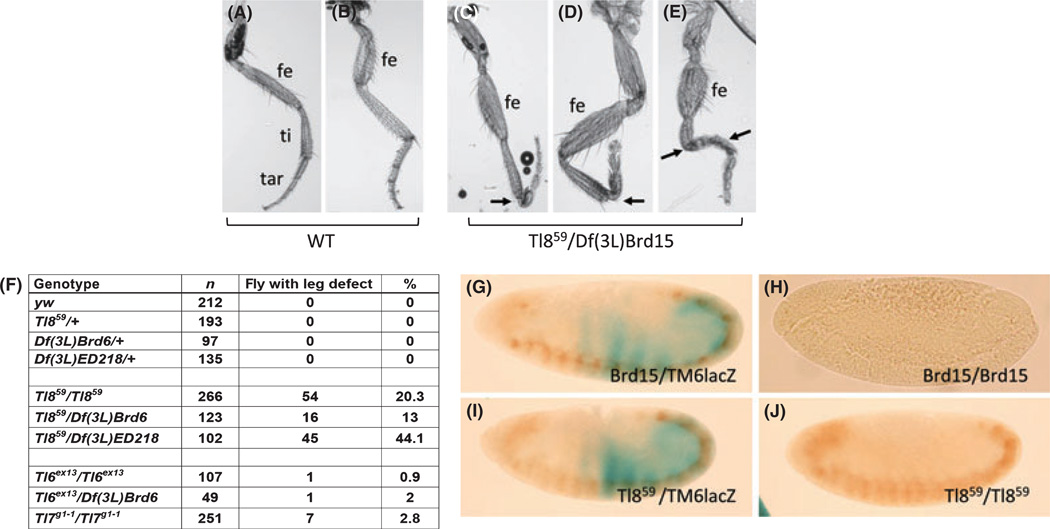
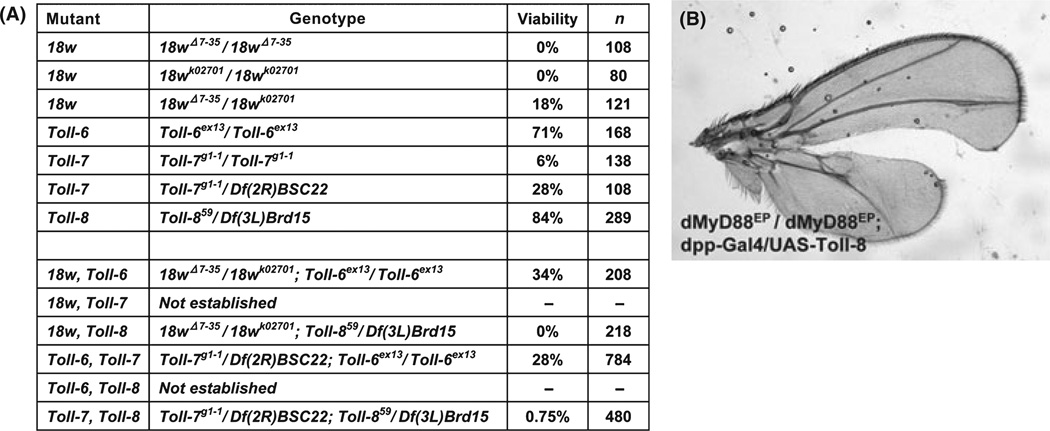
Fig. 6
Fig. 6
Toll-8 mutants have defects in adult legs but not in embryonic central nervous system (CNS). (A–B) Wild type legs showing normal arrangement of different segments, from femur (fe) to tibia (ti) and tarsus (tar). (C–E) Malformed legs from the Toll-859 / deficiency mutant flies. Most segments have similar length but the first tarsal segment is frequently bent as indicated by the arrows. The distal end of the leg in panel D is lost. Panel E is a more severely malformed leg, in which bending occurs in both tibia and tarsal segments as indicated by the arrows and the femur is malformed. The whole leg is therefore twisted. (F) A table summarizing the penetrance of malformed leg phenotype. Flies with one or more malformed leg were counted. A high percentage (13–44%) of Toll-8 mutants have such developmental defects. Toll-6 (1%) and Toll-7 (3%) mutants have very low penetrance of this phenotype. (G–J) CNS morphology was visualized by anti-horse radish peroxidase (HRP) staining (brown). The balancer chromosome contained a lacZ transgene and the embryos that lacked β-galactosidase expression (blue staining) were homozygous mutants for Toll-8. The genotypes of the embryos were G: Df(3R)Brd15 / TM6B AbdB-lacZ, H: Df(3R)Brd15 / Df(3R)Brd15, I: Toll-859 / TM6B AbdB-lacZ, J: Toll-859 / Toll-859. The Df(3R)Brd15 homozygous embryos lost anti-HRP antigen but Toll-8 homozygous mutant embryos showed normal anti-HRP antigen.
Fig. 7
Fig. 7
Viability assay of double mutant combinations of Toll-related genes of Drosophila and epistatic analysis of a Toll downstream factor on Toll-8 overexpression phenotype. (A) Viability assay for mutant combinations of 18w, Toll-6, Toll7 and Toll-8. The table shows the total number of flies (n) and the percentage of viable flies of single and double mutants of 18w, Toll-6, Toll-7, and Toll-8. The percent viability is calculated as number of viable homozygotes over the number of expected homozygotes based on the number of other flies hatched. The numbers of viable homozygotes and trans-heterozygotes suggest that 18w and Toll-7 mutant chromosomes have other mutations that cause increased lethality. Therefore, trans-heterozygotes were used whenever possible for double mutant analysis. The 18w, Toll-7 and Toll-6, Toll-8 recombinations were not attempted because the genes are located very close to each other. The combinations of 18w, Toll-8 and Toll-7, Toll-8 showed reduced viability, while 18w, Toll-6 and Toll-6, Toll-7 did not. (B) A dMyD88 allele did not suppress bifurcated wing phenotype. A wing of yw; dMyD88EP2133 / dMyD88EP2133; dpp-Gal4 / UAS-Toll-8 fly is shown. Reduced activity of dMyD88 did not affect bifurcated wing phenotype.

References

    1. Anderson KV, Jurgens G, Nusslein-Volhard C. Establishment of dorsal-ventral polarity in the Drosophila embryo: genetic studies on the role of the Toll gene product. Cell. 1985;42:779–789. - PubMed
    1. Aoki K, Perlman M, Lim JM, Cantu R, Wells L, Tiemeyer M. Dynamic developmental elaboration of N-linked glycan complexity in the Drosophila melanogaster embryo. J. Biol. Chem. 2007;282:9127–9142. - PubMed
    1. Bettencourt R, Tanji T, Yagi Y, Ip YT. Toll and Toll-9 in Drosophila innate immune response. J. Endotoxin Res. 2004;10:261–268. - PubMed
    1. Brennan CA, Anderson KV. Drosophila: the genetics of innate immune recognition and response. Annu. Rev. Immunol. 2004;22:457–483. - PubMed
    1. Cheng TC, Zhang YL, Liu C, Xu PZ, Gao ZH, Xia QY, Xiang ZH. Identification and analysis of Toll-related genes in the domesticated silkworm, Bombyx mori. Dev. Comp. Immunol. 2008;32:464–475. - PubMed

Publication types

Substances