. 2011 Feb 20;410(2):283-90.
doi: 10.1016/j.virol.2010.11.010. Epub 2010 Dec 14.

Expression of human papillomavirus type 16 E7 is sufficient to significantly increase expression of angiogenic factors but is not sufficient to induce endothelial cell migration

Affiliations

Expression of human papillomavirus type 16 E7 is sufficient to significantly increase expression of angiogenic factors but is not sufficient to induce endothelial cell migration

Joanna Walker et al. Virology. .

Abstract

Tumor suppressors negatively regulate angiogenesis, an essential step in tumor progression. Together, HPV 16 E6 and E7 proteins, which target p53 and pRb family members, respectively, for degradation, increase the expression of two angiogenic inducers, VEGF and IL-8, in primary foreskin keratinocytes (HFKs). Conditioned media from such cells are sufficient to alter endothelial cell behavior. Here, the individual contribution of E6 and E7 to angiogenesis was investigated. E7 and, to a lesser extent E6, increased expression of VEGF and IL-8. Nevertheless, neither conditioned media from HPV 16 E6 nor E7-expressing HFKs were sufficient to induce migration of endothelial cells. Conditioned media from HFKs expressing the HPV 16 E6 and the E7 mutant E7C24G, which can target p107 and p130 but not pRb for degradation, contained increased levels of VEGF and IL-8. The results suggest that the mechanism of HPV 16 E7-mediated increased levels of VEGF is pRb-independent.


Figures

Figure 1
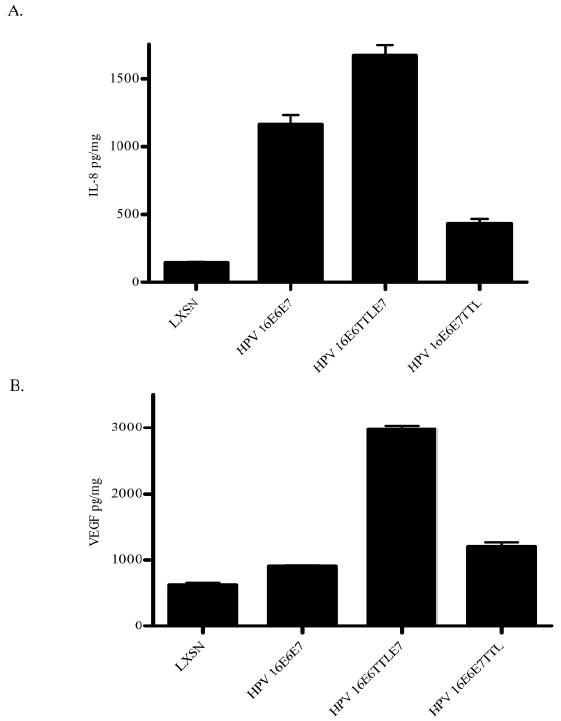
Figure 1. Level of IL-8 and VEGF in conditioned media was increased in cells expressing either E6 or E7
(A) The quantity of IL-8 was determined by ELISA and normalized to total protein in the conditioned media. The data represent mean ± SEM and are representative of three experiments each conducted in triplicate. p < 0.0001 for LXSN vs HPV 16E6E7 and LXSN vs HPV 16E6TTLE7; p< 0.001 for LXSN vs HPV 16E6E7TTL; p< 0.001 for HPV 16E6E7 vs HPV 16E6TTLE7 and p< 0.0005 for HPV 16E6E7 vs HPV 16E6E7TTL. (B) The quantity of VEGF was determined by ELISA and normalized to total protein in the conditioned media. The data represent mean ± SEM and are representative of three experiments each conducted in triplicate. p < 0.001 for LXSN vs HPV 16E6E7; p< 0.0001 for LXSN vs HPV 16E6TTLE7; p< 0.001 for LXSN vs HPV 16E6E7TTL; p< 0.0001 for HPV 16E6E7 vs HPV 16E6TTLE7 and p< 0.001 for HPV 16E6E7 vs HPV 16E6E7TTL.
Figure 2
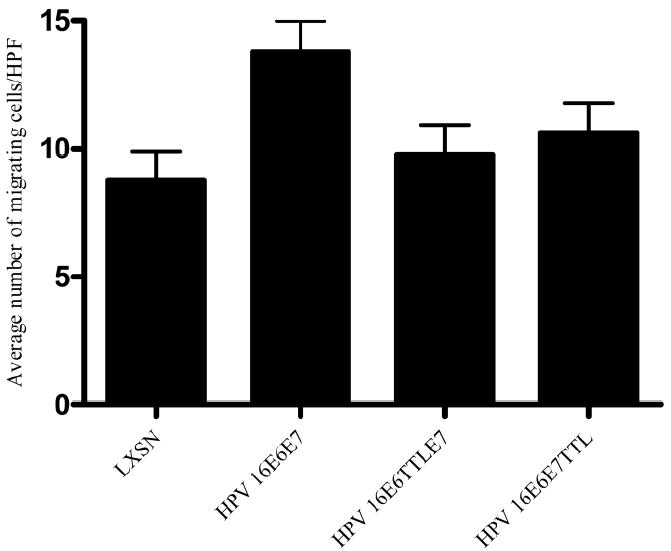
Figure 2. Conditioned media from HFKs transduced with either E6 or E7 did not induce migration of HMVECs in vitro
HMVECs were plated on collagen-coated transwell membranes. Conditioned media from HFKs retroviral transduced with LXSN, HPV 16E6E7, HPV 16E6TTLE7 and HPV 16E6E7TTL were added to the bottom chamber. After 3 hrs, 6 high power fields (HPF) of cells on the bottom were counted. The results (mean number of migrated cells per high power field (HPF) ± SEM) are representative of three experiments each conducted in triplicate. p< 0.005 for LXSN vs HPV 16E6E7 and p< 0.02 for HPV 16E6E7 and HPV 16E6TTLE7 or HPV 16E6E7TTL.
Figure 3
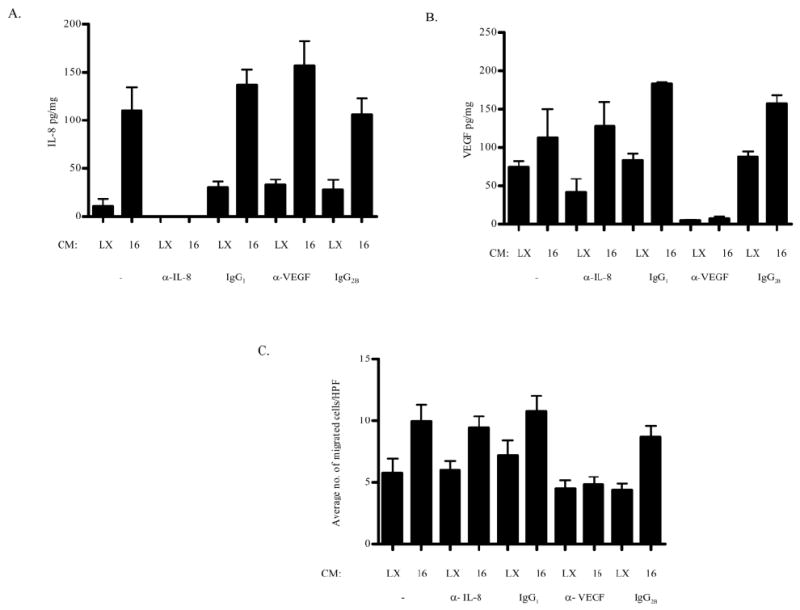
Figure 3. VEGF, but not IL-8, is required for the increased migration of HMVECs in vitro
Conditioned media from HFKs retrovirally transduced with LXSN and HPV 16E6E7 depleted of (A) IL-8 or (B) VEGF were (C) tested for the ability to induce migration of endothelial cells as in Figure 2. The results (mean number of migrated cells per high power field (HPF) ± SEM) are representative of three experiments each conducted in triplicate. p< 0.0001 for LXSN vs HPV 16E6E7 (control isotype IgG2B); p< 0.002 for LXSN vs HPV 16E6E7 (depleted IL-8) and LXSN vs HPV 16E6E7 (control isotype IgG1).
Figure 4
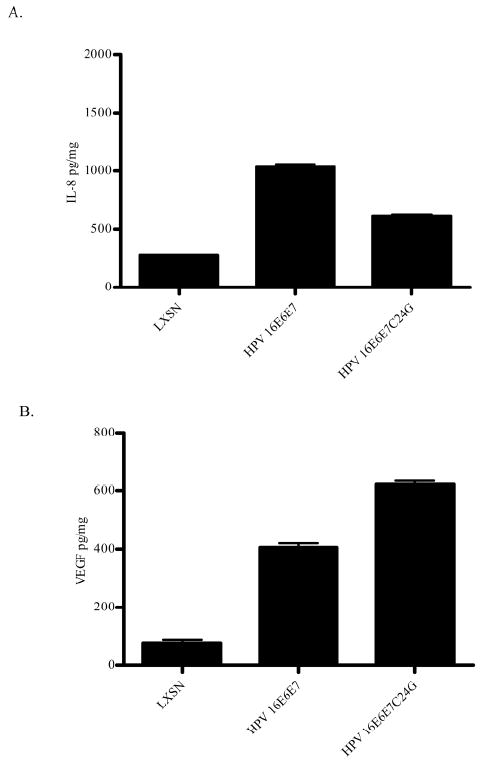
Figure 4. Levels of IL-8 and VEGF in conditioned media were increased in cells expressing HPV 16E6E7C24G
The experiment was conducted as in Figure 1. (A) The quantity of IL-8 was determined by ELISA and normalized to total protein in the conditioned media. The data represent mean ± SEM and are representative of three experiments each conducted in triplicate. p < 0.0001 for LXSN vs HPV 16E6E7; LXSN vs HPV 16E6E7C24G and p< 0.0002 for HPV 16E6E7 vs HPV 16E6E7C24G. (B) The quantity of VEGF was determined by ELISA and normalized to total protein in the conditioned media. The data represent mean ± SEM and are representative of three experiments each conducted in triplicate. p < 0.001 for LXSN vs HPV 16E6E7; LXSN vs HPV 16E6E7C24G and p< 0.0003 for HPV 16E6E7C24G vs HPV 16E6E7.
Figure 5
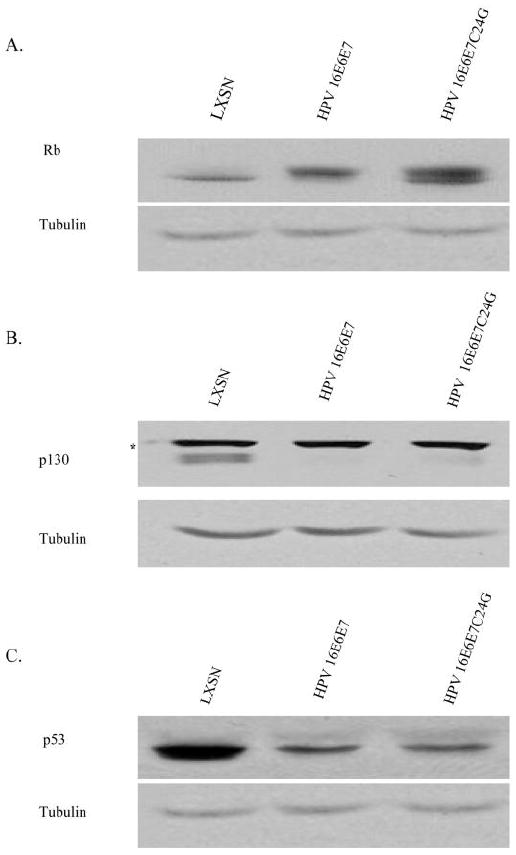
Figure 5. HPV 16E6E7C24G, which does not associate with pRb, is still capable of targeting p130 for degradation
Whole cell lysates from HFKs transduced with LXSN, HPV 16E6E7 and HPV 16E6E7C24G, were analyzed by Western Blot to determine the steady state levels of (A) pRb, (B) p130, (C) p53 expression. Tubulin serves as a loading control. * = unknown cross-reacting protein.

References

    1. Alani RM, Munger K. Human papillomaviruses and associated malignancies. J Clin Oncol. 1998;16:330–337. - PubMed
    1. Antinore MJ, Birrer MJ, Patel D, Nader L, McCance DJ. The human papillomavirus type 16 E7 gene product interacts with and trans-activates the AP1 family of transcription factors. EMBO J. 1996;15:1950–1960. - PMC - PubMed
    1. Bardos JI, Ashcroft M. Negative and positive regulation of HIF-1: a complex network. Biochim Biophys Acta. 2005;1755:107–120. - PubMed
    1. Bequet-Romero M, Lopez-Ocejo O. Angiogenesis modulators expression in culture cell lines positives for HPV-16 oncoproteins. Biochem Biophys Res Commun. 2000;277:55–61. - PubMed
    1. Bernat A, Avvakumov N, Mymryk JS, Banks L. Interaction between the HPV E7 oncoprotein and the transcriptional coactivator p300. Oncogene. 2003;22:7871–7881. - PubMed

Publication types

MeSH terms

Substances