


Change in follicle-stimulating hormone and estradiol across the menopausal transition: effect of age at the final menstrual period
- PMID: 21159842
- PMCID: PMC3047231
- DOI: 10.1210/jc.2010-1746
Change in follicle-stimulating hormone and estradiol across the menopausal transition: effect of age at the final menstrual period
Abstract
Background and objective: To determine whether patterns of change in serum estradiol (E2) and FSH across the menopausal transition were associated with age at the final menstrual period (FMP).
Design and setting: The Study of Women's Health Across the Nation (SWAN) is a seven-site, multiethnic, longitudinal study of the menopausal transition being conducted in 3302 menstruating women who were aged 42-52 yr at the 1996 study baseline.
Measurements: Annually collected serum was assayed for E2 and FSH levels. Patterns of hormone change were evaluated in the 1215 women with a documented natural FMP by follow-up visit 9 (2006) using semiparametric stochastic and piecewise linear mixed modeling.
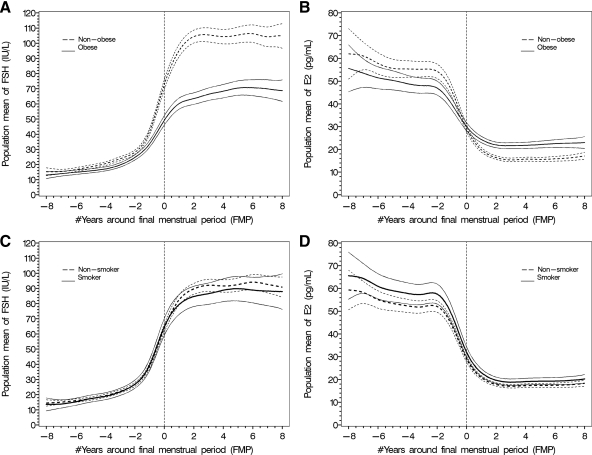
Results: The FSH pattern across the menopausal transition began with an increase 6.10 yr before the FMP, an acceleration 2.05 yr before the FMP, deceleration beginning 0.20 yr before the FMP, and attainment of stable levels 2.00 yr after the FMP, independent of age at the FMP, race/ethnicity, or smoking status. Obesity attenuated the FSH rise and delayed the initial increase to 5.45 yr before the FMP. The mean E2 concentration did not change until 2.03 yr before the FMP when it began decreasing, achieving maximal rate of change at the FMP, then decelerating to achieve stability 2.17 yr after the FMP. Obesity, smoking behavior, and being Chinese or Japanese were associated with some variation in E2 levels but not the pattern of E2 change.
Conclusions: Time spans and overall patterns of change in serum FSH and E2 across the menopausal transition were not related to age at FMP or smoking, whereas time spans but not overall patterns were related to obesity and race/ethnicity.
Figures

References
-
- Robertson DM, Hale GE, Jolley D, Fraser IS, Hughes CL, Burger HG. 2009. Interrelationships between ovarian and pituitary hormones in ovulatory menstrual cycles across reproductive age. J Clin Endocrinol Metab 94:138–144 - PubMed
-
- Hale GE, Burger HG. 2009. Hormonal changes and biomarkers in late reproductive age, menopausal transition and menopause. Best Pract Res Clin Obstet Gynaecol 23:7–23 - PubMed
-
- McKinlay SM, Brambilla DJ, Posner JG. 1992. The normal menopause transition. Maturitas 14:103–115 - PubMed
-
- Gold EB, Bromberger J, Crawford S, Samuels S, Greendale GA, Harlow SD, Skurnick J. 2001. Factors associated with age at natural menopause in a multiethnic sample of midlife women. Am J Epidemiol 153:865–874 - PubMed
-
- Metcalf MG, Donald RA, Livesey JH. 1982. Pituitary-ovarian function before, during and after the menopause: a longitudinal study. Clin Endocrinol (Oxf) 17:489–494 - PubMed
Publication types
MeSH terms
Substances
Grants and funding
- AG012553/AG/NIA NIH HHS/United States
- AG012554/AG/NIA NIH HHS/United States
- AG012539/AG/NIA NIH HHS/United States
- AG012531/AG/NIA NIH HHS/United States
- U01 AG012495/AG/NIA NIH HHS/United States
- U01 AG012505/AG/NIA NIH HHS/United States
- AG012535/AG/NIA NIH HHS/United States
- AG012546/AG/NIA NIH HHS/United States
- NR004061/NR/NINR NIH HHS/United States
- U01 AG012554/AG/NIA NIH HHS/United States
- U01 AG012535/AG/NIA NIH HHS/United States
- U01 AG012553/AG/NIA NIH HHS/United States
- U01 NR004061/NR/NINR NIH HHS/United States
- U01 AG012539/AG/NIA NIH HHS/United States
- AG012495/AG/NIA NIH HHS/United States
- U01 AG012546/AG/NIA NIH HHS/United States
- U01 AG012531/AG/NIA NIH HHS/United States
- AG012505/AG/NIA NIH HHS/United States
LinkOut - more resources
Full Text Sources
Medical
Molecular Biology Databases
