. 2010 Dec 1:4:176.
doi: 10.3389/fnbeh.2010.00176. eCollection 2010.

Disruption of Adult Neurogenesis in the Olfactory Bulb Affects Social Interaction but not Maternal Behavior

Affiliations

Disruption of Adult Neurogenesis in the Olfactory Bulb Affects Social Interaction but not Maternal Behavior

Claudia E Feierstein et al. Front Behav Neurosci. .

Abstract

Adult-born neurons arrive to the olfactory bulb (OB) and integrate into the existing circuit throughout life. Despite the prevalence of this phenomenon, its functional impact is still poorly understood. Recent studies point to the importance of newly generated neurons to olfactory learning and memory. Adult neurogenesis is regulated by a variety of factors, notably by instances related to reproductive behavior, such as exposure to mating partners, pregnancy and lactation, and exposure to offspring. To study the contribution of olfactory neurogenesis to maternal behavior and social recognition, here we selectively disrupted OB neurogenesis using focal irradiation of the subventricular zone in adult female mice. We show that reduction of olfactory neurogenesis results in an abnormal social interaction pattern with male, but not female, conspecifics; we suggest that this effect could result from the inability to detect or discriminate male odors and could therefore have implications for the recognition of potential mating partners. Disruption of OB neurogenesis, however, neither impaired maternal-related behaviors, nor did it affect the ability of mothers to discriminate their own progeny from others.

Keywords: irradiation; mate recognition; maternal behavior; neurogenesis; offspring recognition; olfaction; social interaction.


Figures
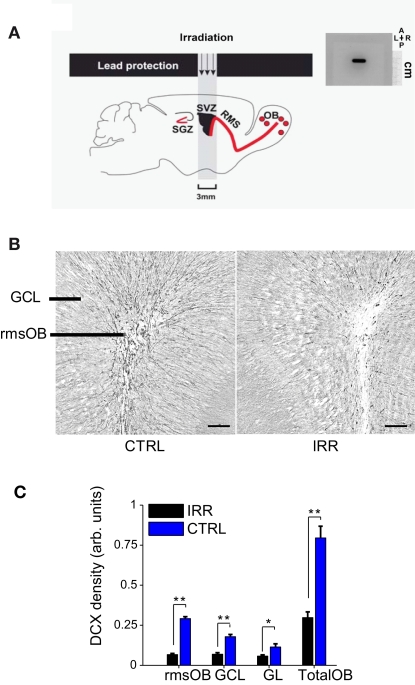
Figure 1
Figure 1
Reduced OB neurogenesis in SVZ-irradiated female mice. (A)Left, targeted irradiation was achieved by exposing a brain area encompassing the SVZ and protecting the rest of the brain with lead shields (see Materials and Methods and Lazarini et al., 2009) SGZ, subgranular zone; RMS, rostral migratory stream. Right, autoradiographic film showing the window of reach of irradiation (black staining). The film was positioned in the irradiator at the same place where mice were placed for irradiation. As shown by the film, irradiation was focal and restricted to a window of 3 mm × 11 mm. A, anterior; P, posterior; L, left; R, right. The scale is indicated. (B) Doublecortin (DCX) immunoreactivity in OB slices of IRR (right panel) and CTRL (left panel) females, 6.5 months after SVZ irradiation. rmsOB, rostral migratory stream at the OB; GCL, granule cell layer; GL, glomerular layer. Images are centered in the rmsOB. Scale bar, 100 μm. (C) DCX staining was quantified as optical density (OD; see Materials and Methods). Data are expressed as mean OD across mice in each treatment (IRR, n = 6; CTRL, n = 6), 6.5 months after irradiation, and for the different OB regions. For each mouse, OD was calculated for six slices and an average value was assigned to that mouse. Error bars represent SEM. *p < 0.05; **p < 0.01 (Mann–Whitney test, see Table A1 in Appendix).
Figure 2
Figure 2
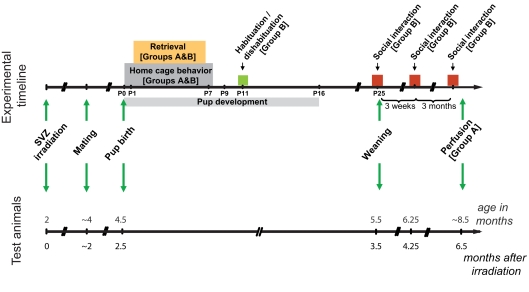
Experimental timeline. Timeline showing the sequence of events and behavioral testing the animals underwent. Color boxes represent behavioral testing; arrows indicate punctual events such as the time of irradiation, mating, birth, and weaning. Two groups of animals were used: all animals in Group B were included in the behavioral testing; for Group A, only a subset of animals was included in the behavior, and the whole group was sacrificed 6.5 months after irradiation for immunohistochemical analysis.
Figure 3
Figure 3
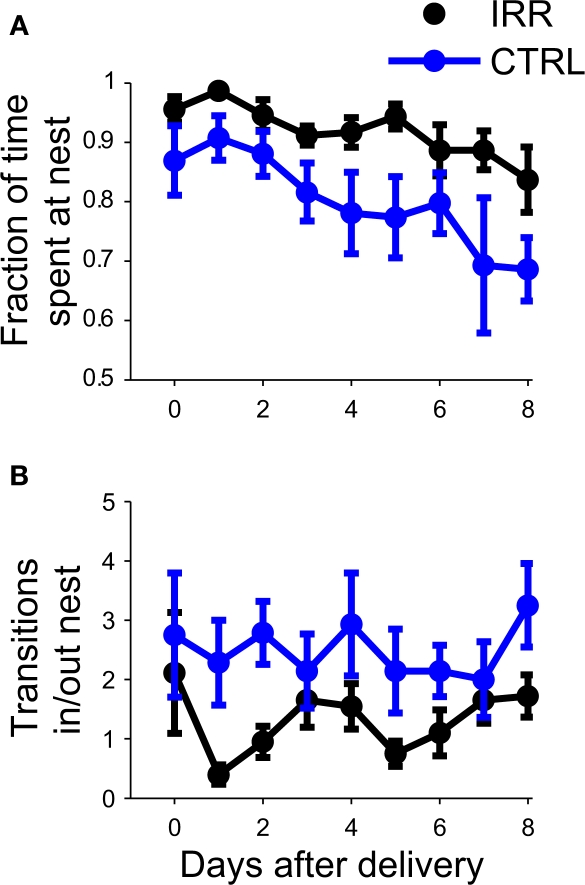
Irradiated females spent more time at the nest. (A) The fraction of time spent at the nest (number of observations at nest/total number of observations) was determined for eight consecutive days, starting at pup birth (P0). For each mouse, daily data is calculated as the average of two sessions. Data are represented as the mean across mice in each treatment (IRR, black, n = 10 mice; CTRL, blue, n = 7 mice). Error bars represent SEM. p(IRR vs. CTRL) = 0.0196, p(days after delivery) = 0.0096 with a two way rmANOVA. (B) Control mice shuttle more in and out of the nest. The number of transitions into or out of the nest was determined from P0 to P8. Data represent mean across mice, computed as in (A). p(IRR vs. CTRL) = 0.0222, p(days after delivery) > 0.05 with a two-way rmANOVA.
Figure 4
Figure 4
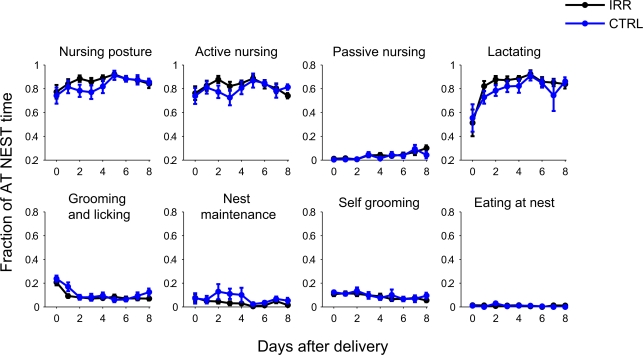
Irradiated and control females displayed indistinguishable behavioral repertoires while at the nest. Behavior at nest was further classified as: mother in a nursing posture, which could be an active or passive nursing posture, grooming and licking pups, doing nest maintenance, self-grooming or eating; and pups lactating (see Materials and Methods for a more detailed description of the behavioral categories and Figure A1B in Appendix for examples). Note that each behavior is scored as a fraction of the time the female was at the nest (number of observations of behavior/number observations at nest). Data represent mean across mice in each group; for each mouse, data is the average of two daily sessions. IRR (black), n = 10 mice; CTRL (blue), n = 7 mice. For none of the behaviors the time allocated (while at nest) differed between IRR and CTRL mice (p > 0.05 for all treatment comparisons, two-way rmANOVA).
Figure 5
Figure 5
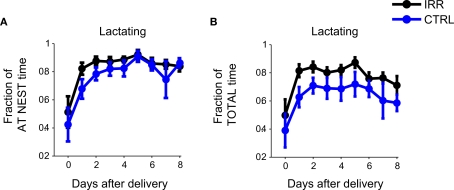
Longer times at the nest resulted in longer net lactating times for irradiated litters. Irradiated and control females, while at nest, spent the same proportion of time engaged in lactating (A, data is replicated from Figure 4). However, because IRR female mice spent more time at the nest (Figure 3A) they tended to show a net increase in total lactation time (B) compared to controls. p(IRR vs. CTRL) = 0.0506, p(days after delivery) = 0.0397, with a two-way rmANOVA.
Figure 6
Figure 6
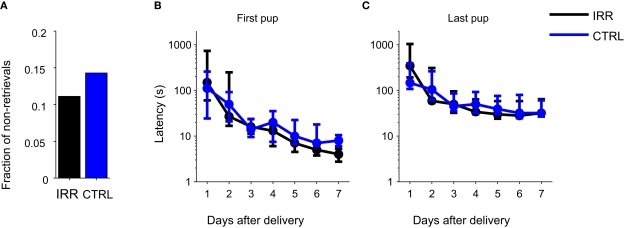
Irradiated and control females showed similar latencies in a pup retrieval test. (A) Fraction of females that failed to retrieve pups on the first day of testing (P1). IRR (black), n = 9 mice; CTRL (blue), n = 7 mice. (B,C) Latencies to retrieve the first (B) and last (C) pups. Latency to retrieve pups decreased across days (first pup: p = 0.0392, last pup: p = 0.0105) but did not differ between groups (first pup: p = 0.4815, last pup: p = 0.2418; two-way rmANOVA). Data are shown as median latencies, in logarithmic scale. Note that error bars represent 25th and 75th percentiles. IRR, n = 9 mice; CTRL, n = 7 mice.
Figure 7
Figure 7
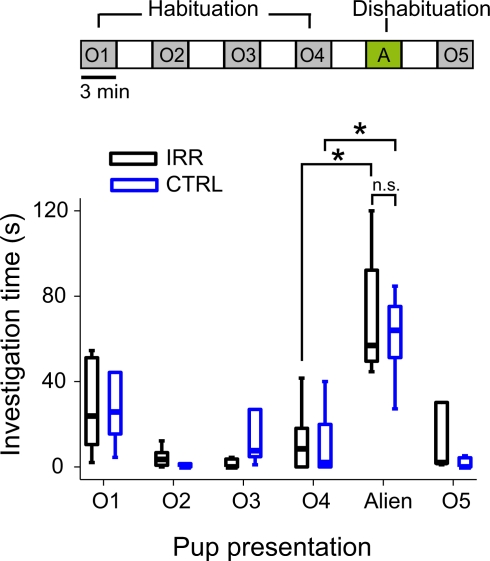
Irradiated females showed intact ability to discriminate pups in a habituation/dishabituation paradigm. Females were subjected sequentially (top scheme) to four 3-min presentations of a pup from their own litter (O1–O4, habituation phase), followed by a 3-min presentation of a pup from a different litter (alien, A, dishabituation), and another presentation of their own pup (O5). Presentations were separated by 3-min intervals. Investigation time is shown in boxplots (central line shows median investigation time; outliers are omitted). The time spent investigating own pups decreased after the first presentation for both CTRL (blue, n = 5) and IRR (black, n = 5) females (p < 0.05, Wilcoxon matched-pairs test). Presentation of an alien pup resulted in a marked increase in investigation time in females in both groups – compare alien to O4 (*p < 0.05, Wilcoxon matched-pairs test).
Figure 8
Figure 8
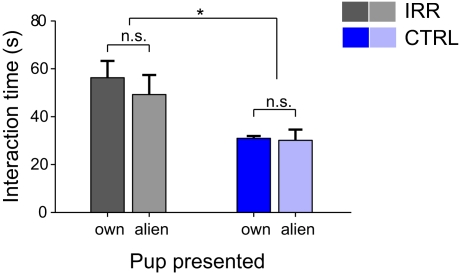
Irradiated females show elevated social interaction at weaning. Social interaction of experimental females toward different “stimulus” individuals was evaluated in 3-min sessions, 30 min after weaning. IRR, n = 5 mice; CTRL, n = 5 mice. Females did not show preference in their interaction with a juvenile male of their own litter (own) compared to a juvenile from another (alien) litter. However, irradiated females showed a marked increase in interaction time compared to controls (*p = 0.027, two-way rmANOVA). Data represent mean interaction time for each group.
Figure 9
Figure 9
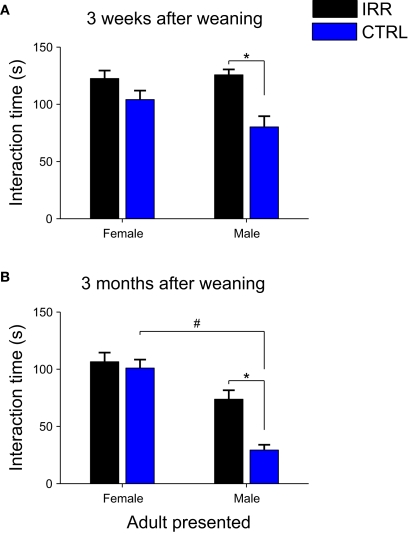
Increased social interaction persists at later times, and is the result of altered interaction with males. Social interaction of experimental females toward male and female adults was evaluated in 3-min sessions, 3 weeks (A) and 3 months (B) after weaning. IRR (black), n = 5 mice; CTRL (blue), n = 5 mice. (A) Irradiated females showed increased interaction with a male mouse when compared to controls (*p = 0.0367, IRR vs. CTRL, Mann–Whitney U test). However, interaction with a female intruder did not significantly differ between control and irradiated mice. Data represent the mean across experimental females; for each female, investigation times of own and alien pups did not differ (data not shown) and are averaged together. (B) Irradiated females showed significantly longer interactions with male stimuli compared to controls (*p < 0.05, Bonferroni). Note also that CTRL females showed a shorter interaction time with males than with females (#p < 0.05, Bonferroni). Data represent the mean across experimental females; for each female, investigation times of related (own) and unrelated (alien) young adults were averaged together.
Figure 10
Figure 10
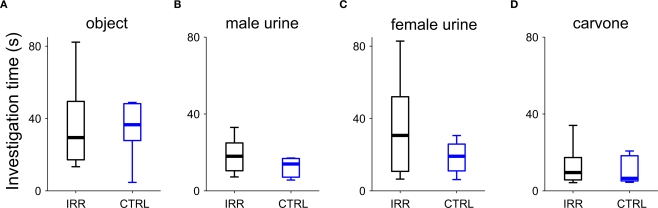
Object and odor investigation were unaltered in SVZ-irradiated females. Investigation time of an object (A), an object scented with male urine (B), an object scented with female urine (C), or an object scented with carvone (D) were determined. Data are shown in boxplots, where central lines represent the median investigation time. No differences in investigation times were found between groups (p > 0.05 for CTRL vs. IRR in all conditions, Mann–Whitney U test). IRR (black), n = 5 mice; CTRL (blue), n = 5 mice.
Figure A1
Figure A1
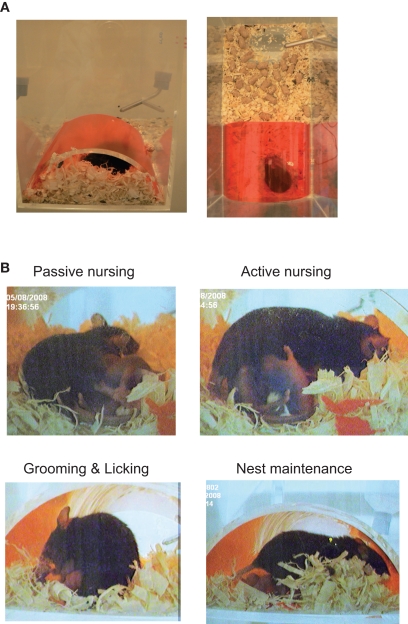
Observation of maternal behavior. (A) Animals were provided with a red transparent shelter, where they preferentially built their nest. Left, lateral view of the observation cages. Right, top view of the cage. (B) Representative frames depicting some of the behaviors recorded (see Materials and Methods for definition).
Figure A2
Figure A2
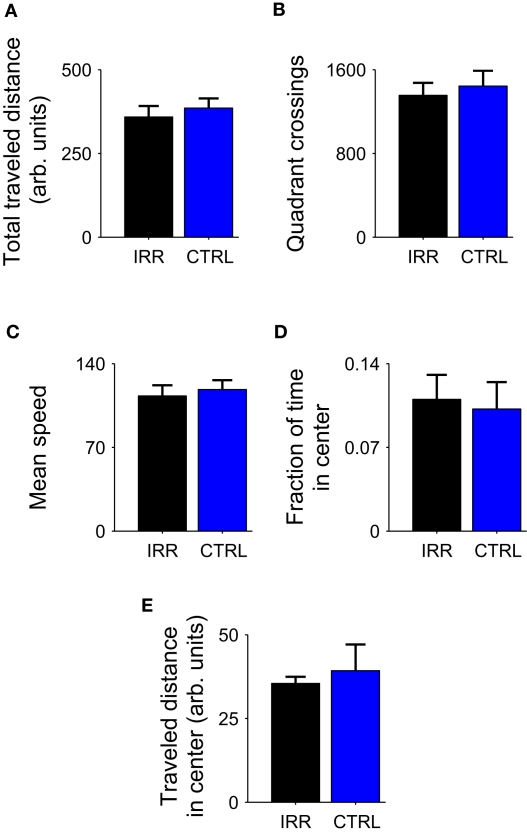
Irradiated mice showed normal locomotor activity and no signs of anxiety-related behaviors in an open field test. Locomotor activity (A-C) and anxiety-related behaviors (D,E) did not differ between control (blue) and irradiated (black) female mice (p < 0.05 for all comparisons; Mann-Whitney U test). Data are presented as mean ± SEM for each treatment (n = 5 mice per group). (A) Total traveled distance, in arbitrary units (see Materials and Methods for detailed description). (B) The arena was virtually divided in sixteen quadrants, and the number of quadrant crossings was determined. (C) Mean speed (session average of instantaneous speed; see Materials and Methods). (D) Fraction of time spent in the center of the arena (number of observations in center/total number of observations). (E) Distance traveled in the center of the arena, in arbitrary units.
Figure A3
Figure A3
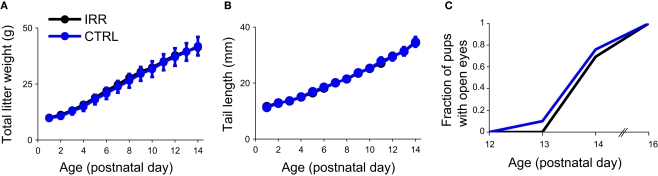
Pup development did not differ between litters from irradiated and control mothers. (A,B) Body growth was indistinguishable in litters from IRR and CTRL mothers. The total litter weight (A) and tail length (B) were determined from days P1 to P14. For each treatment, data show mean across litters; error bars represent SEM. p < 0.05 for both comparisons. (C) Fraction of pups with open eyes in litters from IRR (black) and CTRL mothers (blue) at different times after birth. Eye opening time did not differ between litters (p < 0.05, Kolmogorov-Smirnov test for the distributions of pups with open eyes).
Figure A4
Figure A4
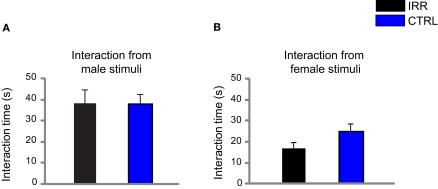
"Intruders" behave equally toward irradiated and control females. Social interaction was evaluated 3 months after weaning. Interactions from the male (A) and female (B) conspecifics introduced as "stimuli" subjects did not differ when the interactions were directed to irradiated or control females (p < 0.05, IRR vs. CTRL, Mann-Whitney U test). Note that this analysis is complementary to that of Figure 9B. Data represent the mean across "stimuli" of the same sex. IRR (black), n = 10 mice; CTRL (blue), n = 10 mice.

References

    1. Abraham N. M., Egger V., Shimshek D. R., Renden R., Fukunaga I., Sprengel R., Seeburg P. H., Klugmann M., Margrie T. W., Schaefer A. T., Kuner T. (2010). Synaptic inhibition in the olfactory bulb accelerates odor discrimination in mice. Neuron 65, 399–41110.1016/j.neuron.2010.01.009 - DOI - PMC - PubMed
    1. Alonso M., Viollet C., Gabellec M.-M., Meas-Yedid V., Olivo-Marin J.-C., Lledo P.-M. (2006). Olfactory discrimination learning increases the survival of adult-born neurons in the olfactory bulb. J. Neurosci. 26, 10508–1051310.1523/JNEUROSCI.2633-06.2006 - DOI - PMC - PubMed
    1. Alvarez-Buylla A., Garcia-Verdugo J. M. (2002). Neurogenesis in adult subventricular zone. J. Neurosci. 22, 629–634 - PMC - PubMed
    1. Barnard C. J., Fitzsimons J. (1988). Kin recognition and mate choice in mice: the effects of kinship, familiarity and social interference on intersexual interaction. Anim. Behav. 36, 1078–109010.1016/S0003-3472(88)80067-8 - DOI
    1. Baum M. J., Kelliher K. R. (2009). Complementary roles of the main and accessory olfactory systems in mammalian mate recognition. Annu. Rev. Physiol. 71, 141–16010.1146/annurev.physiol.010908.163137 - DOI - PubMed