. 2010 Feb 15;2(2):85-97.
doi: 10.4251/wjgo.v2.i2.85.

Multidisciplinary therapy for treatment of patients with peritoneal carcinomatosis from gastric cancer

Affiliations

Multidisciplinary therapy for treatment of patients with peritoneal carcinomatosis from gastric cancer

Yutaka Yonemura et al. World J Gastrointest Oncol. .

Abstract

There is no standard treatment for peritoneal carcinomatosis (PC) from gastric cancer. A novel multidisciplinary treatment combining bidirectional chemotherapy [neoadjuvant intraperitoneal-systemic chemotherapy protocol (NIPS)], peritonectomy, hyperthermic intraperitoneal chemoperfusion (HIPEC) and early postoperative intraperitoneal chemotherapy has been developed. In this article, we assess the indications, safety and efficacy of this treatment, review the relevant studies and introduce our experiences. The aims of NIPS are stage reduction, the eradication of peritoneal free cancer cells, and an increased incidence of complete cytoreduction (CC-0) for PC. A complete response after NIPS was obtained in 15 (50%) out of 30 patients with PC. Thus, a significantly high incidence of CC-0 can be obtained in patients with a peritoneal cancer index (PCI) ≤ 6. Using a multivariate analysis to examine the survival benefit, CC-0 and NIPS are identified as significant indicators of a good outcome. However, the high morbidity and mortality rates associated with peritonectomy and perioperative chemotherapy make stringent patient selection important. The best indications for multidisciplinary therapy are localized PC (PCI ≤ 6) from resectable gastric cancer that can be completely removed during a peritonectomy. NIPS and complete cytoreduction are essential treatment modalities for improving the survival of patients with PC from gastric cancer.

Keywords: Chemotherapy; Gastric cancer; Peritoneal carcinomatosis.


Figures
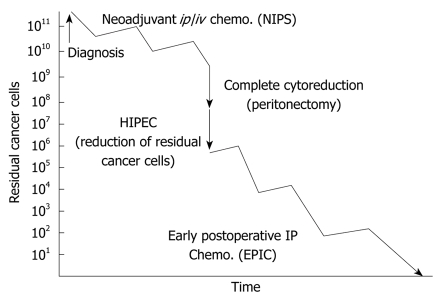
Figure 1
Figure 1
Treatment strategy for PC from gastric cancer. PC: Peritoneal carcinomatosis; NIPS: Neoadjuvant intraperitoneal-systemic chemotherapy protocol; HIPEC: Hyperthermic intraperitoneal chemoperfusion; EPIC: Early postoperative intraperitoneal chemotherapy.
Figure 2
Figure 2
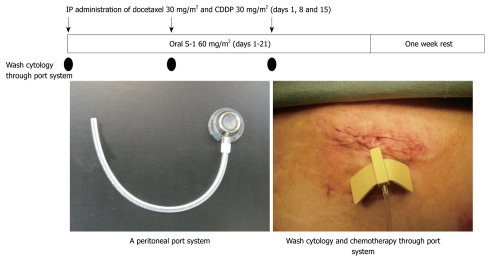
Bidirectional chemotherapy for peritoneal carcinomatosis from gastric cancer.
Figure 3
Figure 3
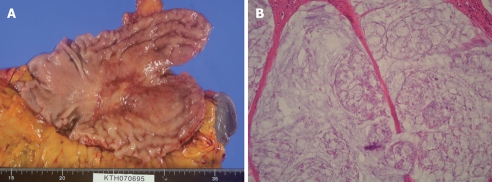
A 34-year old female patient with PC from type 4 gastric cancer treated with NIPS. A: Macroscopic finding of resected stomach of patients treated with NIPS; B: Histologic finding of resected stomach of patient treated with NIPS. Almost all cancer cells disappear and mucin alone was depicted in the primary tumor (histological grade 3).
Figure 4
Figure 4
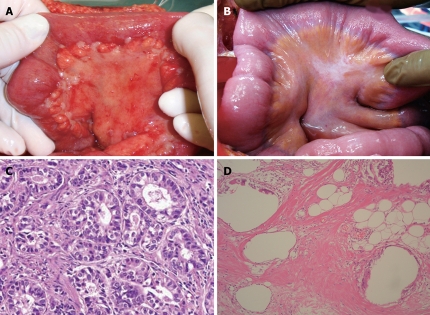
A 48-year old male patient with PC from gastric cancer treated with NIPS. A: Macroscopic finding of PC on bowel mesentery; B: After 2 courses of NIPS, PC nodules shows fibrotic changes; C: Histologic findings of PC nodule obtained at the first operation of Figure 4A; D: Complete degeneration of cancer cells in PC nodule obtained at second look operation after NIPS.
Figure 5
Figure 5
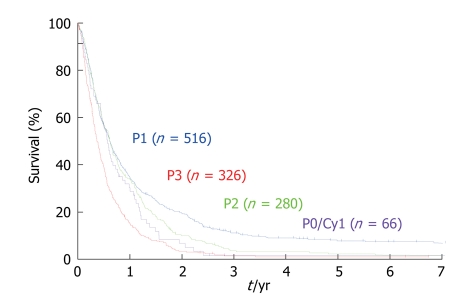
Survival curves of patients with PC, according to the Japanese classification. P1 vs P2: P < 0.025, χ2 = 4.979; P1 vs P3: P < 0.001, χ2 = 61.13; P0/Cy1 vs P2, P3: Not significant.
Figure 6
Figure 6
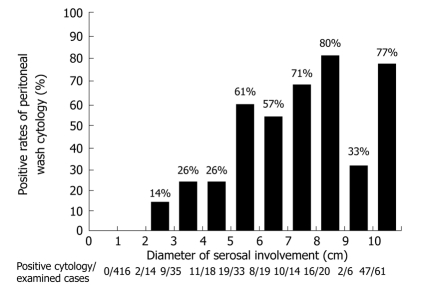
Positive rates of peritoneal wash cytology according to the diameter of serosal involvement of primary tumor. Intraoperative cytological examination of the peritoneal wash solution using 200 mL of saline in 637 patients who had no macroscopic PC.
Figure 7
Figure 7
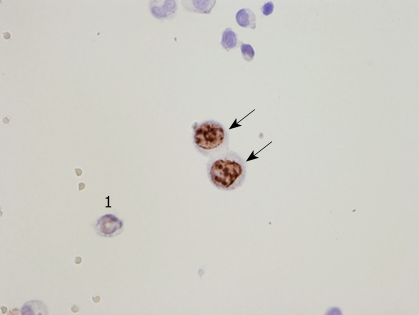
Ki-67 expression in PFCCs (immunocytochemical staining using MIB-1). 1Cancer cell without expression of Ki-67. Arrows indicate Ki-67 positive PFCCs with proliferative activity.
Figure 8
Figure 8
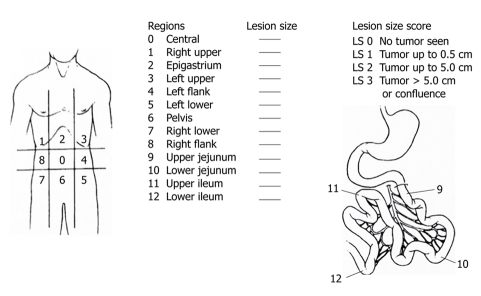
Peritoneal cancer index (PCI). Peritoneal cavity is divided into 13 parts, which ranges from 0 to 12. Accurate measurement of each region is scored as lesion size 0 through 3. LS 0: No implants. LS 1 refers to implants up to 0.5 cm in diameter; LS 2 refers to implants greater than 0.5 cm and up to 5 cm; and SL3 refers to those 5 cm or greater in diameter.
Figure 9
Figure 9
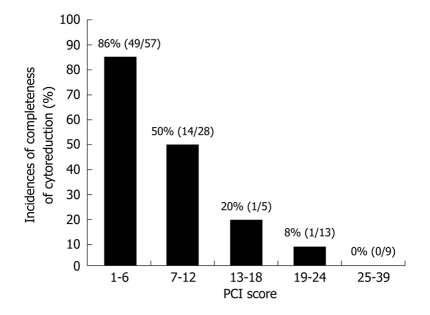
PCI scores and completeness of cytoreduction in 92 gastric cancer with PC, who underwent CRS.
Figure 10
Figure 10
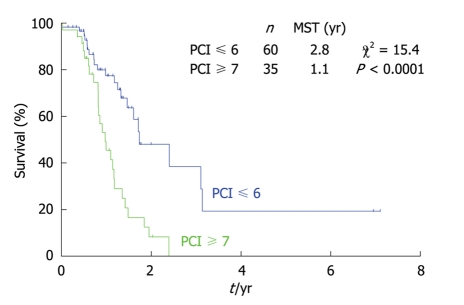
Survival differences of gastric cancer patients with PC, according to the PCI score.
Figure 11
Figure 11
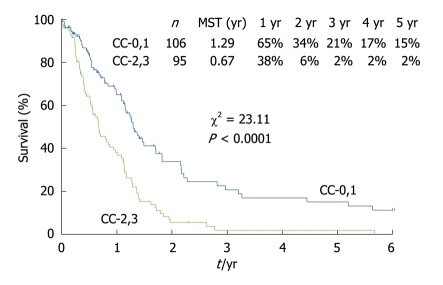
Survival curves of gastric cancer patients with PC after cytoreductive surgery and HIPEC using the CC score. The assessment of the CC is classified into 3 categories. CC-0: The complete cytoreduction with no residual macroscopic nodule; CC-1: No macroscopic tumor but positive margin histologically or suspicious residual nodules less than 5 mm; CC-2: Apparent macroscopic residual tumors greater than 5 mm but up to 5 cm; and CC-3: Residual PC greater than 5 cm in diameter.
Figure 12
Figure 12
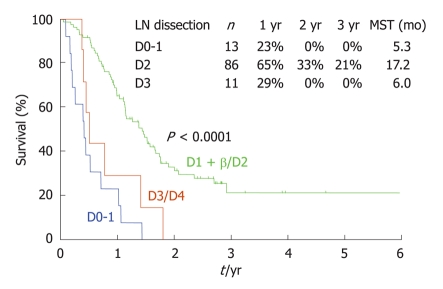
Survival curves of P0/Cy1 patients without distant metastasis, according to the extent of lymph node dissection.
Figure 13
Figure 13
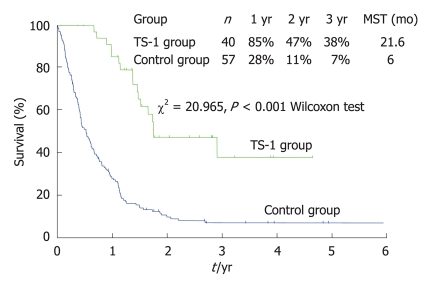
Survival of P0, Cy1 patients treated with gastrectomy+ postoperative TS-1 therapy and gastrectomy alone.

References

    1. Yonemura Y, Kawamura T, Bandou E, Tsukiyama G, Endou Y, Miura M. The natural history of free cancer cells in the peritoneal cavity. In: Gonzalez-Moreno S, editor. Advances in peritoneal surface oncology. Berlin: Springer; 2007. pp. 11–23. - PubMed
    1. Chu DZ, Lang NP, Thompson C, Osteen PK, Westbrook KC. Peritoneal carcinomatosis in nongynecologic malignancy. A prospective study of prognostic factors. Cancer. 1989;63:364–367. - PubMed
    1. Sugarbaker PH, Yonemura Y. Clinical pathway for the management of resectable gastric cancer with peritoneal seeding: best palliation with a ray of hope for cure. Oncology. 2000;58:96–107. - PubMed
    1. Yonemura Y, Bandou E, Kinoshita K, Kawamura T, Takahashi S, Endou Y, Sasaki T. Effective therapy for peritoneal dissemination in gastric cancer. Surg Oncol Clin N Am. 2003;12:635–648. - PubMed
    1. MacDonald JS, Schein PS, Woolley PV, Smythe T, Ueno W, Hoth D, Smith F, Boiron M, Gisselbrecht C, Brunet R, et al. 5-Fluorouracil, doxorubicin, and mitomycin (FAM) combination chemotherapy for advanced gastric cancer. Ann Intern Med. 1980;93:533–536. - PubMed