. 2011 Jan;49(1):27-38.
doi: 10.1007/s10858-010-9458-0. Epub 2010 Dec 14.

A novel strategy for NMR resonance assignment and protein structure determination

Affiliations

A novel strategy for NMR resonance assignment and protein structure determination

Alexander Lemak et al. J Biomol NMR. 2011 Jan.

Abstract

The quality of protein structures determined by nuclear magnetic resonance (NMR) spectroscopy is contingent on the number and quality of experimentally-derived resonance assignments, distance and angular restraints. Two key features of protein NMR data have posed challenges for the routine and automated structure determination of small to medium sized proteins; (1) spectral resolution - especially of crowded nuclear Overhauser effect spectroscopy (NOESY) spectra, and (2) the reliance on a continuous network of weak scalar couplings as part of most common assignment protocols. In order to facilitate NMR structure determination, we developed a semi-automated strategy that utilizes non-uniform sampling (NUS) and multidimensional decomposition (MDD) for optimal data collection and processing of selected, high resolution multidimensional NMR experiments, combined it with an ABACUS protocol for sequential and side chain resonance assignments, and streamlined this procedure to execute structure and refinement calculations in CYANA and CNS, respectively. Two graphical user interfaces (GUIs) were developed to facilitate efficient analysis and compilation of the data and to guide automated structure determination. This integrated method was implemented and refined on over 30 high quality structures of proteins ranging from 5.5 to 16.5 kDa in size.


Figures
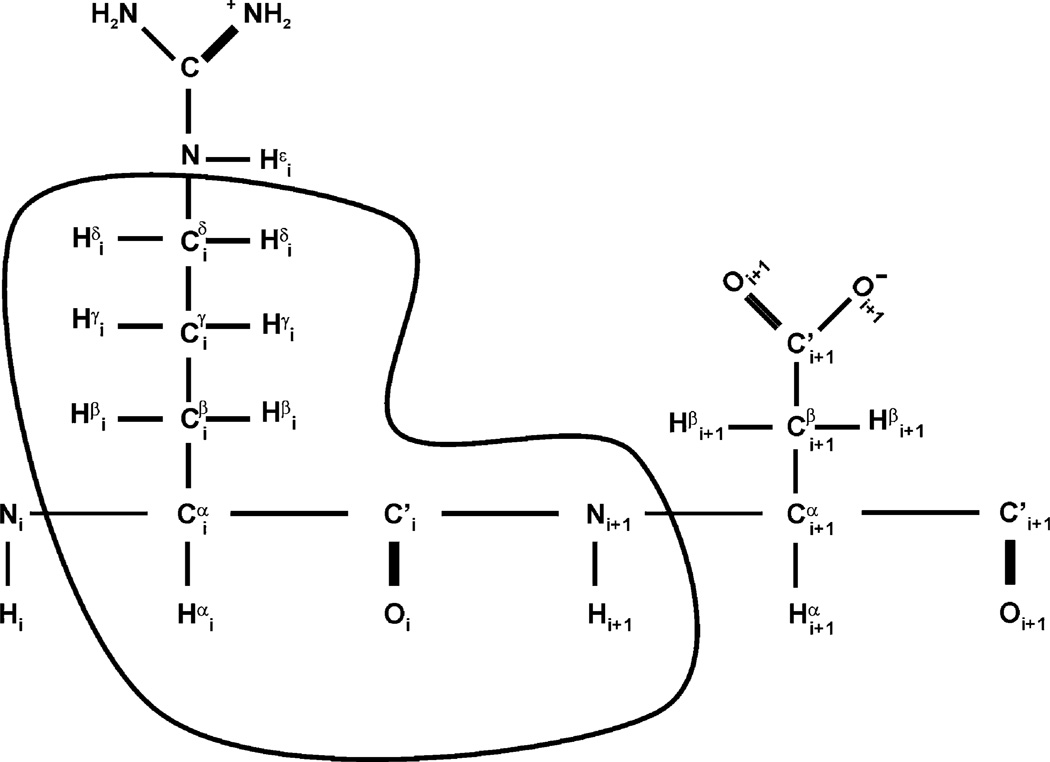
Fig. 1
Fig. 1
Definition of a PB spin system. The PB (peptide bond) spin system (circled) is the basic structural unit in the ABACUS protocol
Fig. 2
Fig. 2
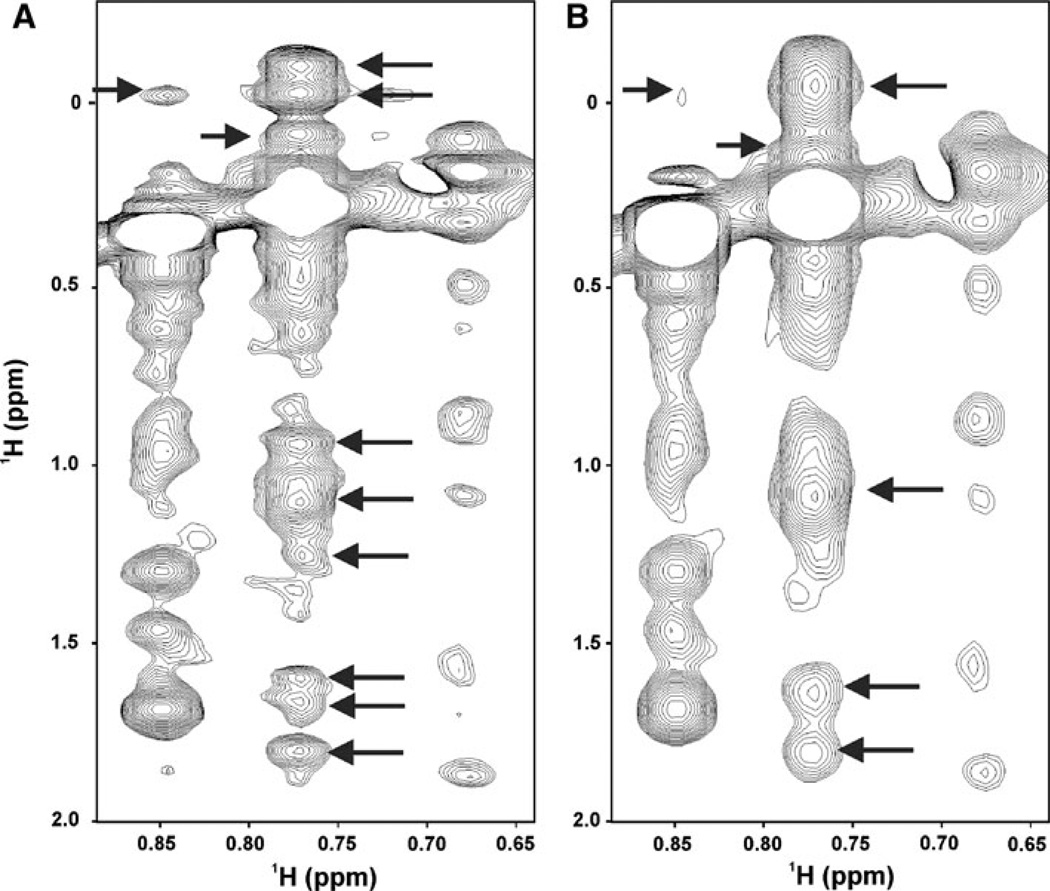
NUS and MDD increase the resolution of multidimensional NMR data. 13C-edited NOESY spectrum collected for a 121 residue protein, Atu0922, from Agrobacterium tumefaciens with a 100 ms mixing time at 800 MHz. (a) 300 complex points in 1H indirect dimension without spectral folding whereas and processed with MDD. (b) The spectrum in A was reprocessed with half the number of indirect complex points, employing parameters commonly used in the collection of fully sampled/Fourier Transformed data. Arrows in (a) indicate peaks that are not clearly resolved in a conventional NOESY spectrum
Fig. 3
Fig. 3
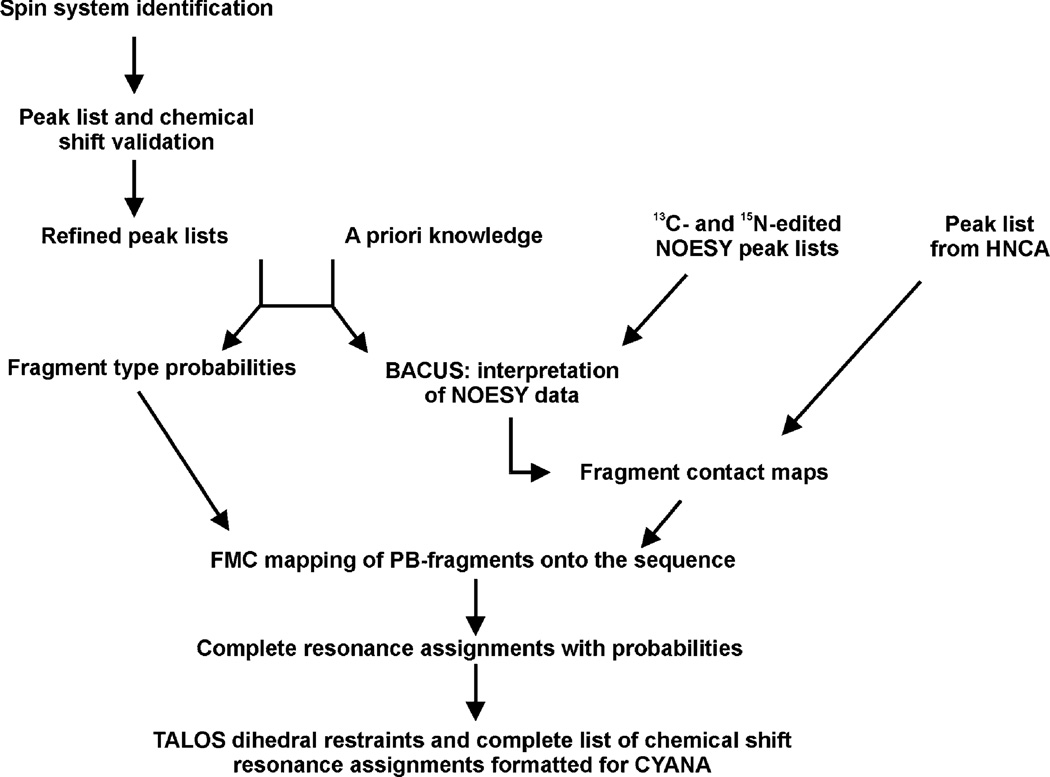
Overview of ABACUS and structure calculation workflow. Peaks are manually picked in the HNCO, HNCA, CBCA(CO)NH, HBHA (CBCACO)NH, H(C)CH- and (H)CCH-TOCSY experiments, along with those obtained from the HNCA and 13C- and 15N-edited NOESY. These peak lists are prerequisites for the ABACUS protocol. A reference BMRB chemical shift list identifies potential mismatches or deviations between experimental spin systems and those of standard amino acids. The amino acid sequence and the peak lists from the scalar-coupled experiments are used to match individual spin systems with corresponding amino acid types. NOESY and HNCA data are used to establish connectivities (e.g. contact maps). Fragment type probabilities and contact maps are utilized in FMC simulations to map corresponding spin systems to specific positions in the amino acid sequence. The result is a complete chemical shift list that is used to generate angular and distance constraints for subsequent use in CYANA
Fig. 4
Fig. 4
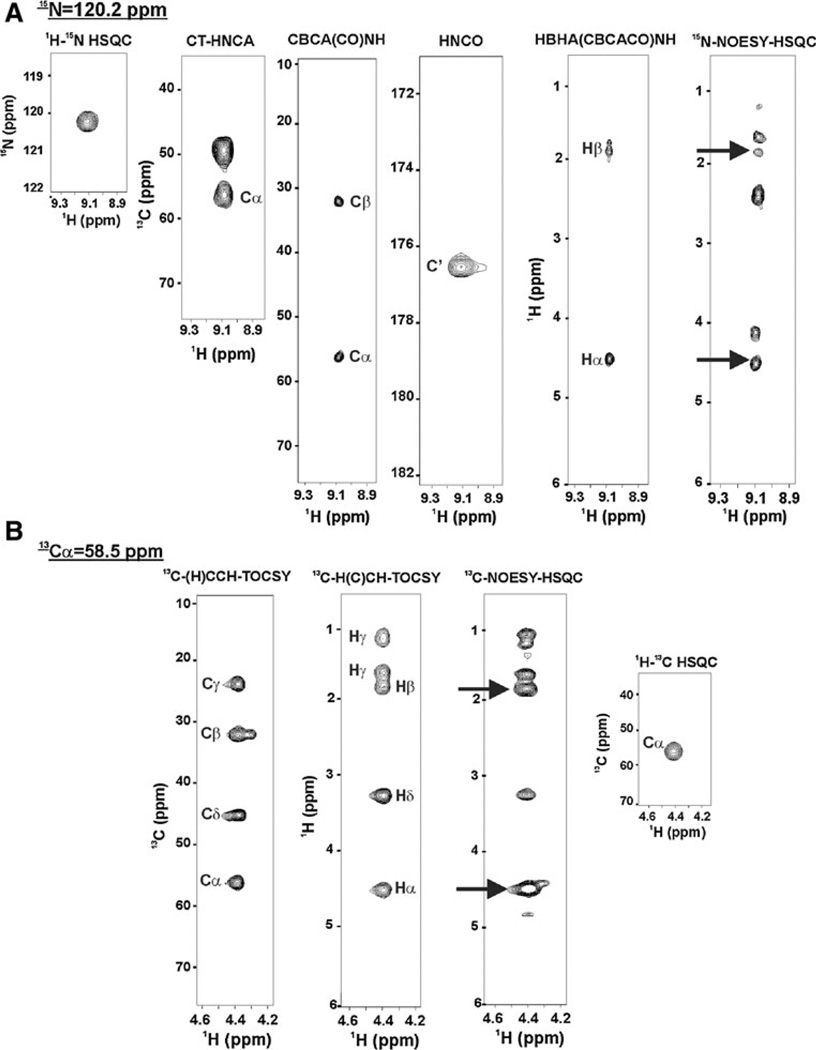
Summary of the algorithm used by FMCGUI and ABACUS to define spin systems and sequential connectivities based on peak lists from the minimal dataset. The procedure begins by identifying spins for the PB fragment highlighted in Fig. 1: in (a) The 15N-1H HSQC is used as a reference spectrum to define the 1H-15N correlation for the aspartate residue, the CBCACONH and HNCA identify Cα and Cβ for the arginine, the HNCO is used to define C’ for later use in TALOS and to identify overlapping spin systems. The HBHA(CBCACO)NH confirms the Hα and Hβ in the 15N-edited NOESY (arrows identify through-space NOE correlations of protons). In (b) Complementary (H)CCH-TOCSY and H(C)CH-TOCSY experiments allow for facile assignment of side chain resonances beyond β carbon that can be easily mapped to the corresponding strip in the 13C-edited NOESY and correlation peak in the constant time 1H-13C HSQC. Peak lists are generated for these experiments and are loaded into FMCGUI for implementation of the FAWN and/or ABACUS protocols
Fig. 5
Fig. 5
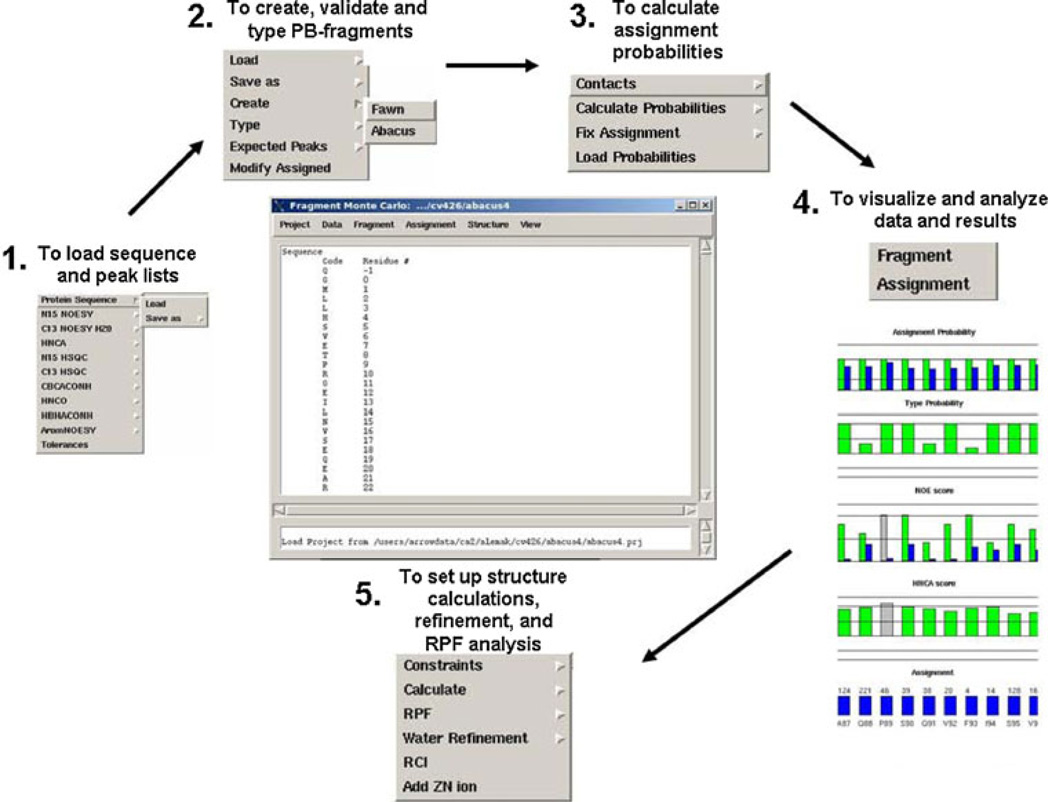
FMCGUI overview. The process begins by loading in the amino acid sequence and respective peak lists from corresponding experiments defined in the minimal dataset (Panel 1). Tolerances are set to improve the reliability of the automated assignment process. The Fragment menu item helps to organize the information for each PB spin system into individual fragments (Panel 2). Once all of the fragments (spin systems) are assembled, FMCGUI has a built-in chemical shift databank that quickly searches for errors in the peak picking process. In addition, the user-friendly interface identifies potential errors in the peak lists which may produce errors in the assignment list. Assignment probabilities are determined using a Fragment Monte Carlo routine with ABACUS and/or FAWN approaches (Panel 3). Confidence in the final chemical shift assignment list is highly dependent on the NOE and HNCA scores (Panel 4). These data are easily manipulated and can be readily exported into CYANA and TALOS formats (Panel 5). Structural ensembles are read back into FMCGUI to assist in the calculation of recall and precision scores and structure refinement in CNS
Fig. 6
Fig. 6
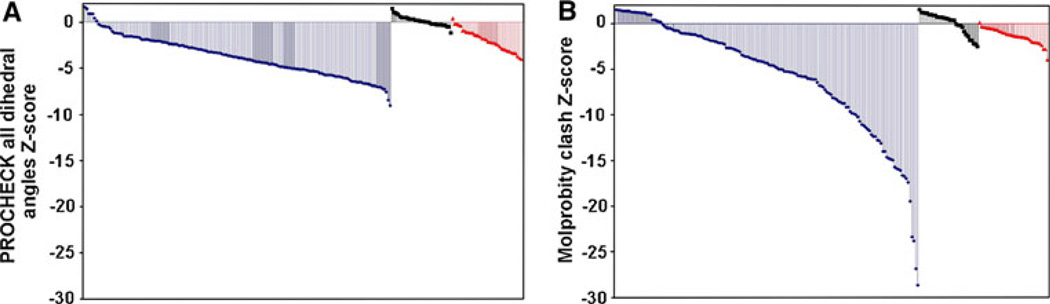
Approach yields high quality protein structures. As one measure of structure quality, we compare the PROCHECK all dihedral angle (a) and Molprobity clash Z-scores (b) for NUS/MDD/ ABACUS derived structures (red; PDB accession codes 2JTV, 2KP6, 2KEO, 2KFV, 2KQ9, 2K4X, 2JYN, 2×8N, 2K8E, 2K2P, 2K28, 2JOQ, 2KKX, 2KR1, 2KO6, 2KKY, 2JXX, 2JQ4, 2JYA, 2K4V, 2KDB, 2JQ5, 2K54, 2K1B, 2KLC, 2K7I, 2KNR, 2KCO, 2K2C, 2KGO, 2IDA, 2KVR, 2JUF, 2KJZ, 2JN4, 2KKU), high-resolution X-ray crystal structures of similar sized proteins deposited in April 2009 with a resolution of < 2Å (black), and other similarly sized proteins determined by conventional NMR methods from non-Structural Genomics groups (blue), deposited in the PDB from January 1st, 2008–June 30th, 2009

References

    1. Atreya H, Sahu SC, Chary KV, Govil G. A tracked approach for automated NMR assignments in proteins (TATAPRO) J Biomol NMR. 2000;17:125–136. - PubMed
    1. Bahrami A, Assadi AH, Markley JL, Eghbalnia HR. Probabilistic interaction network of evidence algorithm and its application to complete labeling of peak lists from protein NMR spectroscopy. PLoS Comput Biol. 2009;5:1–12. - PMC - PubMed
    1. Barna J, Laue ED. Conventional and exponential sampling for 2D NMR experiments with application to a 2D NMR spectrum of a protein. J Magn Reson. 1987;75:387–389.
    1. Bax A, Clore GM, Gronenborn AM. 1H-1H correlation via isotropic mixing of 13C magnetization: a new three-dimensional approach for assigning 1H and 13C spectra of 13C-enriched proteins. J Magn Reson B. 1990;88:425–431.
    1. Bhattacharya A, Tejero R, Montelione GT. Evaluating protein structures deterined by structural genomics consortia. Proteins. 2007;66:778–795. - PubMed

Publication types