


Is learning in problem-based learning cumulative?
- PMID: 21161374
- PMCID: PMC3167394
- DOI: 10.1007/s10459-010-9267-y
Is learning in problem-based learning cumulative?
Abstract
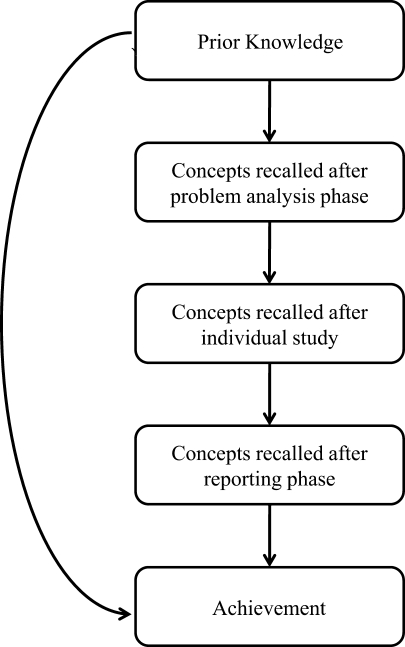
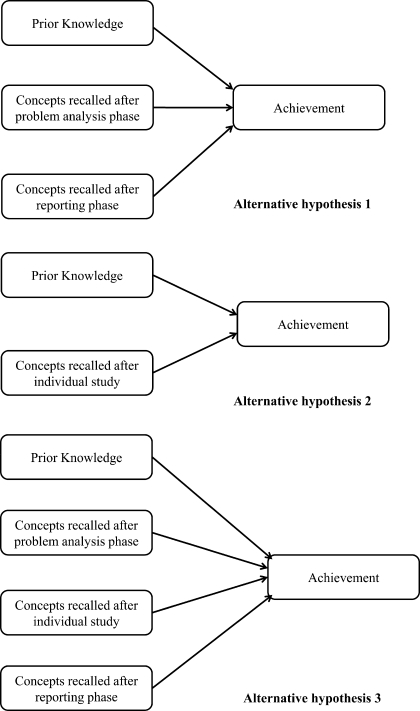
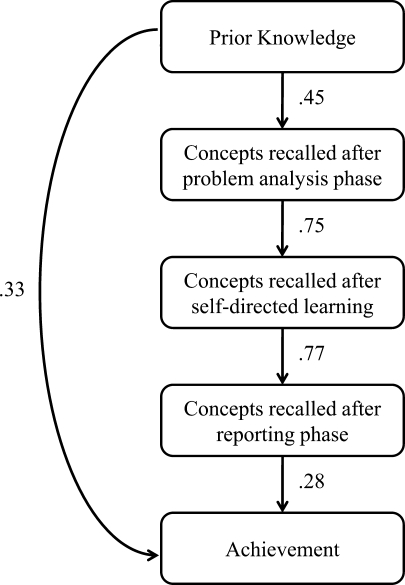
Problem-based learning (PBL) is generally organized in three phases, involving collaborative and self-directed learning processes. The hypothesis tested here is whether learning in the different phases of PBL is cumulative, with learning in each phase depending on that of the previous phase. The scientific concepts recalled by 218 students at the end of each PBL phase were used to estimate the extent of students' learning. The data were then analyzed using structural equation modeling. Results show that our hypothesized model fits the data well. Alternative hypotheses according to which achievement is predicted either by collaborative learning alone or by self-directed learning alone did not fit the data. We conclude that the learning in each PBL phase is cumulative, and strongly influenced by the earlier phase, thus providing support for the PBL cycle of problem analysis, self-directed learning, and a subsequent reporting phase. We also demonstrate an efficient method to capture and quantify students' learning during the PBL process.
Figures
References
-
- Arbuckle JL. Amos 7.0 user’s guide. Chicago: SPSS; 2006.
-
- Barrows HS. The tutorial process. Springfield, Illinois: Southern Illinois University School of Medicine; 1988.
-
- Barrows HS. Problem-based learning in medicine and beyond: A brief overview. In: Wilkerson L, Gijselaers WH, editors. New directions for teaching and learning (Vol. 68) San Francisco: Jossey-Bass Publishers; 1996. pp. 3–11.
-
- Bonwell CC, Eison JA. Creating excitement in the classroom. Washington, DC: George Washington University, School of Education and Human Development; 1991.
MeSH terms
LinkOut - more resources
Full Text Sources
