Review
. 2011 Oct;51(4):607-13.
doi: 10.1016/j.yjmcc.2010.11.020. Epub 2010 Dec 13.

Targeting GSK-3 family members in the heart: a very sharp double-edged sword

Affiliations
Review

Targeting GSK-3 family members in the heart: a very sharp double-edged sword

Hui Cheng et al. J Mol Cell Cardiol. 2011 Oct.

Abstract

The GSK-3 family of serine/threonine kinases, which is comprised of two isoforms (α and β), was initially identified as a negative regulator of glycogen synthase, the rate limiting enzyme of glycogen synthesis [1,2]. In the 30 years since its initial discovery, the family has been reported to regulate a host of additional cellular processes and, consequently, disease states such as bipolar disorders, diabetes, inflammatory diseases, cancer, and neurodegenerative diseases including Alzheimer's Disease and Parkinson's Disease [3,4]. As a result, there has been intense interest on the part of the pharmaceutical industry in developing small molecule antagonists of GSK-3. Herein, we will review the roles played by GSK-3s in the heart, focusing primarily on recent studies that have employed global and tissue-specific gene deletion. We will highlight roles in various pathologic processes, including pressure overload and ischemic injury, focusing on some striking isoform-specific effects of the family. Due to space limitations and/or the relatively limited data in gene-targeted mice, we will not be addressing the family's roles in ischemic pre-conditioning or its many interactions with various pro- and anti-apoptotic factors. This article is part of a special issue entitled "Key Signaling Molecules in Hypertrophy and Heart Failure."


Figures

Figure 1
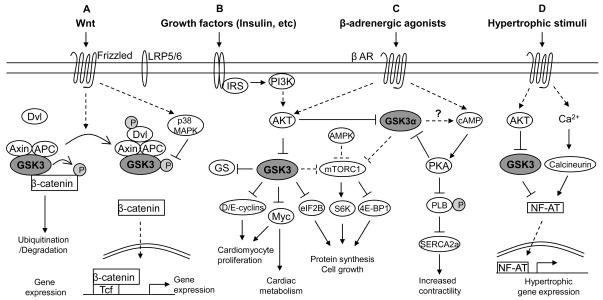
Figure 1. Pathways regulated by GSK-3
A. Canonical Wnt signaling. In the absence of a Wnt signal (left side), the multiprotein complex assembled on axin and APC (the adenomatous polyposis coli gene product) includes active GSK-3 and β-catenin. GSK-3 phosphorylates β-catenin (the transcriptional co-activator that, together with the Tcf family of transcription factors regulates Wnt-dependent gene expression). Phosphorylation of β-catenin by GSK-3 leads to the ubiquitination and degradation of β-catenin by the proteasome, preventing gene expression. In the presence of a Wnt signal (right side), GSK-3 is re-directed to the LRP5/6 coreceptor via a somewhat unclear mechanism involving disheveled (Dvl). β-catenin is stabilized, and then translocates to the nucleus where it displaces transcriptional repressors (Groucho family) from Tcf/Lef, leading to gene expression. Wnt-dependent genes regulate a host of processes from carcinogenesis to cardiac hypertrophy [28]. An alternative mechanism to inhibit GSK-3 in this setting is mediated by p38 [5, 6]. B. Growth factor signaling: Insulin as an example. Following growth factor binding to cognate receptors, the PI3K/Akt pathway is activated, leading to inhibition of GSK-3. GSK-3 negatively regulates a host of factors downstream of growth factor receptors, so the consequences of GSK-3 inhibition are activation of these factors including: 1) glycogen synthase, leading to increased glycogen storage, 2) D- and E-type cyclins that promote cell cycle progression, 3) Myc, which also promotes cell cycle progression as well as regulating metabolic status of the cardiomyocyte, 4) mTORC1 which regulates protein synthesis and, secondarily, cell growth via interactions with a number of factors (2 are shown). In the heart, GSK-3α appears to be the dominant negative regulator of mTOR activity. Also shown is AMPK, the master energy sensor in the cell, that, in the presence of reduced energy stores, phosphorylates mTOR, priming it for further inhibitory phosphorylation by GSK-3. C. β-adrenergic responsiveness. In the setting of stress, the β-adrenergic receptor (β-AR) is activated leading to increased cAMP and activation of PKA, which increases contractility in part by phosphorylating and inhibiting phospholamban, thereby activating SERCA2a. GSK-3α, via unclear mechanisms, amplifies the response by enhancing cAMP production. The enhanced PKA signaling eventually provides a negative feedback to inhibit GSK-3α, terminating the β-AR signal. D. Hypertrophic signaling. Numerous hypertrophic stimuli (e.g. angiotensin II, α–adrenergic agonists, cell stretch, etc.) work through increasing Ca2+ and, in some cases, activating Akt to lead to inhibition of GSK-3. Increased Ca2+ activates calcineurin which de-phosphorylates NF-AT family members, allowing NF-ATs to translocate to the nucleus and activate hypertrophic gene expression. GSK-3 antagonizes hypertrophic signaling by phosphorylating NF-ATs, leading to their exclusion from the nucleus. CaMKII (not shown) promotes hypertrophy via a variety of effectors, but it is unclear at this point whether there is cross-talk between CaMKII and GSK-3.

References

    1. Woodgett JR. Molecular cloning and expression of glycogen synthase kinase-3/factor A. EMBO J. 1990;9:2431–8. - PMC - PubMed
    1. Woodgett JR, Cohen P. Multisite phosphorylation of glycogen synthase. Molecular basis for the substrate specificity of glycogen synthase kinase-3 and casein kinase-II (glycogen synthase kinase-5) Biochim Biophys Acta. 1984;788:339–47. - PubMed
    1. Doble BW, Woodgett JR. GSK-3: tricks of the trade for a multi-tasking kinase. J Cell Sci. 2003;116:1175–86. - PMC - PubMed
    1. Sugden PH, Fuller SJ, Weiss SC, Clerk A. Glycogen synthase kinase 3 (GSK3) in the heart: a point of integration in hypertrophic signalling and a therapeutic target? A critical analysis. Br J Pharmacol. 2008 Mar;153(Suppl 1):S137–53. - PMC - PubMed
    1. Bikkavilli RK, Feigin ME, Malbon CC. p38 mitogen-activated protein kinase regulates canonical Wnt-beta-catenin signaling by inactivation of GSK3beta. J Cell Sci. 2008 Nov 1;121(Pt 21):3598–607. - PubMed

MeSH terms

Substances