


Monitoring protein aggregation and toxicity in Alzheimer's disease mouse models using in vivo imaging
- PMID: 21163350
- PMCID: PMC3049845
- DOI: 10.1016/j.ymeth.2010.12.009
Monitoring protein aggregation and toxicity in Alzheimer's disease mouse models using in vivo imaging
Abstract
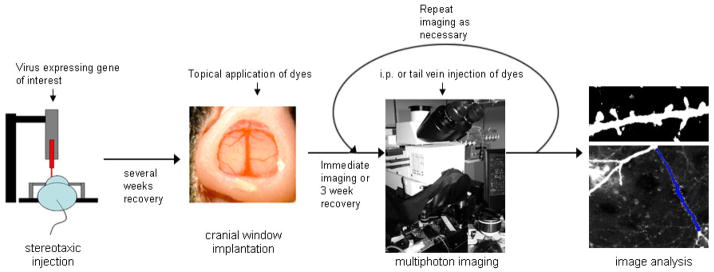
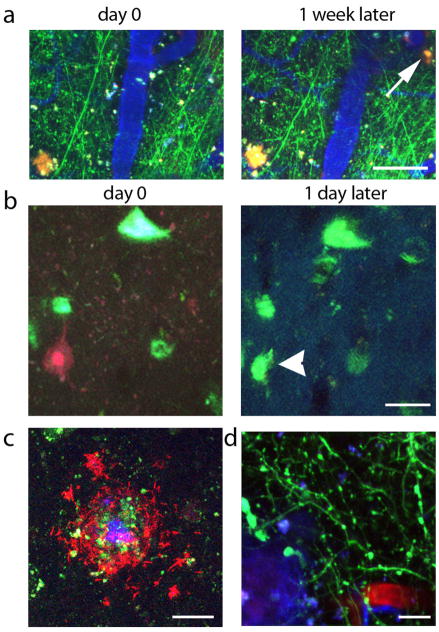
Aggregation of amyloid beta peptide into senile plaques and hyperphosphorylated tau protein into neurofibrillary tangles in the brain are the pathological hallmarks of Alzheimer's disease. Despite over a century of research into these lesions, the exact relationship between pathology and neurotoxicity has yet to be fully elucidated. In order to study the formation of plaques and tangles and their effects on the brain, we have applied multiphoton in vivo imaging of transgenic mouse models of Alzheimer's disease. This technique allows longitudinal imaging of pathological aggregation of proteins and the subsequent changes in surrounding neuropil neurodegeneration and recovery after therapeutic interventions.
Copyright © 2010 Elsevier Inc. All rights reserved.
Figures
References
-
- Alzheimer A. Allgemeine Zeitschrift fur Psychiatrie und Psychisch-Gerichtliche Medizin. 1907;64:146–48.
-
- Gomez-Isla T, Spires T, de Calignon A, Hyman BT. In: Handbook of clinical Neurology. Aminoff MJ, Boller F, Swaab DF, editors. Vol. 89. Elsevier; Edinburgh: 2008.
-
- Walsh DM, Selkoe DJ. J Neurochem. 2007;101:1172–84. - PubMed
-
- Gomez-Isla T, Hollister R, West H, Mui S, Growdon JH, Petersen RC, Parisi JE, Hyman BT. Ann Neurol. 1997;41:17–24. - PubMed
-
- Hsiao K, Chapman P, Nilsen S, Eckman C, Harigaya Y, Younkin S, Yang F, Cole G. Science. 1996;274:99–102. - PubMed
Publication types
MeSH terms
Substances
Grants and funding
LinkOut - more resources
Full Text Sources
Medical
