Review
. 2010 Nov 30;15(12):525-32.
doi: 10.1186/2047-783x-15-12-525.

Treatment of complicated intra-abdominal infections in the era of multi-drug resistant bacteria

Affiliations
Review

Treatment of complicated intra-abdominal infections in the era of multi-drug resistant bacteria

T Herzog et al. Eur J Med Res. .

Abstract

The management of severe intra-abdominal infections remains a major challenge facing surgeons and intensive care physicians, because of its association with high morbidity and mortality. Surgical management and intensive care medicine have constantly improved, but in the recent years a rapidly continuing emergence of resistant pathogens led to treatment failure secondary to infections with multi-drug resistant bacteria. In secondary peritonitis the rate of resistant germs at the initial operation is already 30 %. The lack of effective antibiotics against these pathogens resulted in the development of new broad-spectrum compounds and antibiotics directed against resistant germs. But so far no "super-drug" with efficacy against all resistant bacteria exists. Even more, soon after their approval, reports on resistance against these novel drugs have been reported, or the drugs were withdrawn from the market due to severe side effects. Since pharmaceutical companies reduced their investigations on antibiotic research, only few new antimicrobial derivates are available. - In abdominal surgery you may be in fear that in the future more and more patients with tertiary peritonitis secondary to multi-drug resistant species are seen with an increase of mortality after secondary peritonitis. - This article reviews the current treatment modalities for complicated intra-abdominal infections with special reference to the antibiotic treatment of complicated intra-abdominal infections with multi-drug resistant species.


Figures
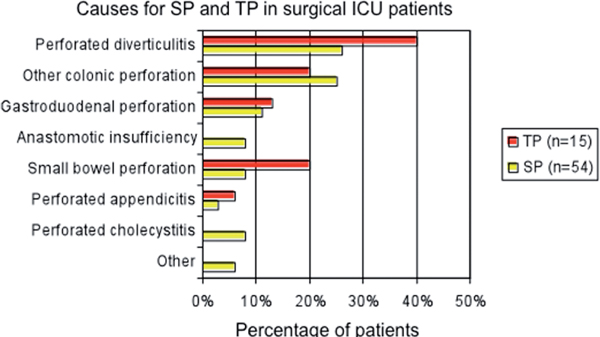
Figure 1
Figure 1
Causes for SP and TP in surgical ICU patients, modified by [18]. Infection source for patients with SP at the index operation, who further developed TP (n = 15, red bars) and for patients who did not (SP, n = 54, yellow bars).
Figure 2
Figure 2
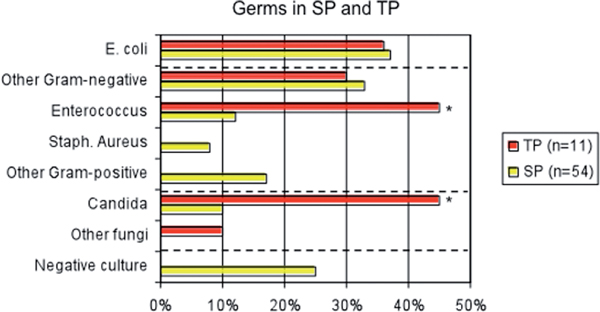
Germs in SP and TP, modified by [18]. Microbiological isolates in TP (n = 11, red bars), vs. SP (n = 54, yellow bars). The microbial isolates of TP were obtained from the re-laparotomy that was diagnostic for TP. Isolates of SP were obtained at the index operation. The rate of Enterococcus and Candida was significantly higher in TP vs. SP (*p ≤ 0.05).
Figure 3
Figure 3
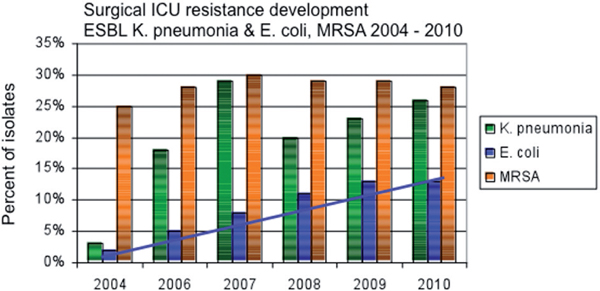
Surgical ICU resistance development. Percentage of resistant pathogens among isolates. The blue line indicates the increasing rate of ESBL producing E. coli (blue bars), while the rate of ESBL producing Klebsiella pneumonia (green bars) and MRSA (orange bars) remains stable. (Own data, surgical ICU, St. Josef Hospital Bochum; Department for Medical Microbiology, University of Bochum).

References

    1. Barie PS, Hydo LJ, Eachempati SR. Longitudinal outcomes of intra-abdominal infection complicated by critical illness. Surg Infect (Larchmt) 2004;5(4):365–73. doi: 10.1089/sur.2004.5.365. - DOI - PubMed
    1. Dellinger EP, Wertz MJ, Meakins JL. et al. Surgical infection stratification system for intra-abdominal infection. Multicenter trial. Arch Surg. 1985;120(1):21–9. doi: 10.1001/archsurg.1985.01390250015003. - DOI - PubMed
    1. Finfer S, Bellomo R, Lipman J. et al. Adult-population incidence of severe sepsis in Australian and New Zealand intensive care units. Intensive Care Med. 2004;30(4):589–96. doi: 10.1007/s00134-004-2157-0. - DOI - PubMed
    1. Vincent JL, Rello J, Marshall J. et al. International study of the prevalence and outcomes of infection in intensive care units. Jama. 2009;302(21):2323–9. doi: 10.1001/jama.2009.1754. - DOI - PubMed
    1. Wittmann DH, Schein M, Condon RE. Management of secondary peritonitis. Ann Surg. 1996;224(1):10–8. doi: 10.1097/00000658-199607000-00003. - DOI - PMC - PubMed