


Impact of non-linear smoking effects on the identification of gene-by-smoking interactions in COPD genetics studies
- PMID: 21163806
- PMCID: PMC3312798
- DOI: 10.1136/thx.2010.146118
Impact of non-linear smoking effects on the identification of gene-by-smoking interactions in COPD genetics studies
Abstract
Background: The identification of gene-by-environment interactions is important for understanding the genetic basis of chronic obstructive pulmonary disease (COPD). Many COPD genetic association analyses assume a linear relationship between pack-years of smoking exposure and forced expiratory volume in 1 s (FEV(1)); however, this assumption has not been evaluated empirically in cohorts with a wide spectrum of COPD severity.
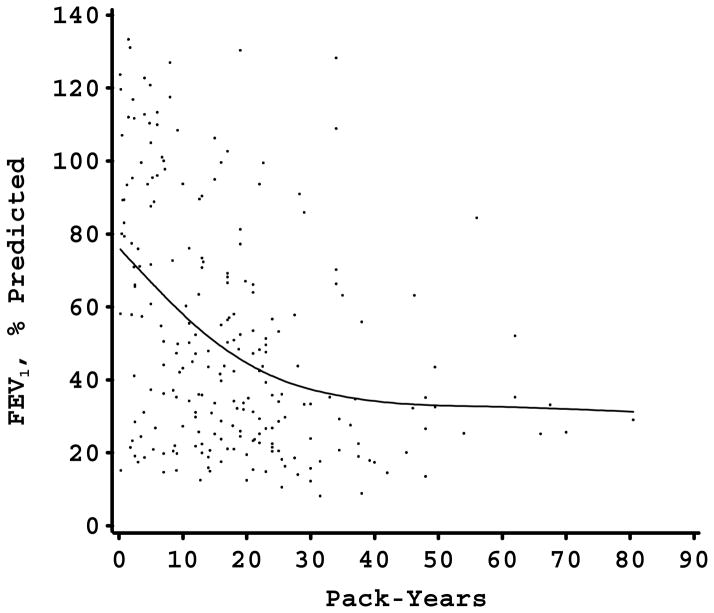
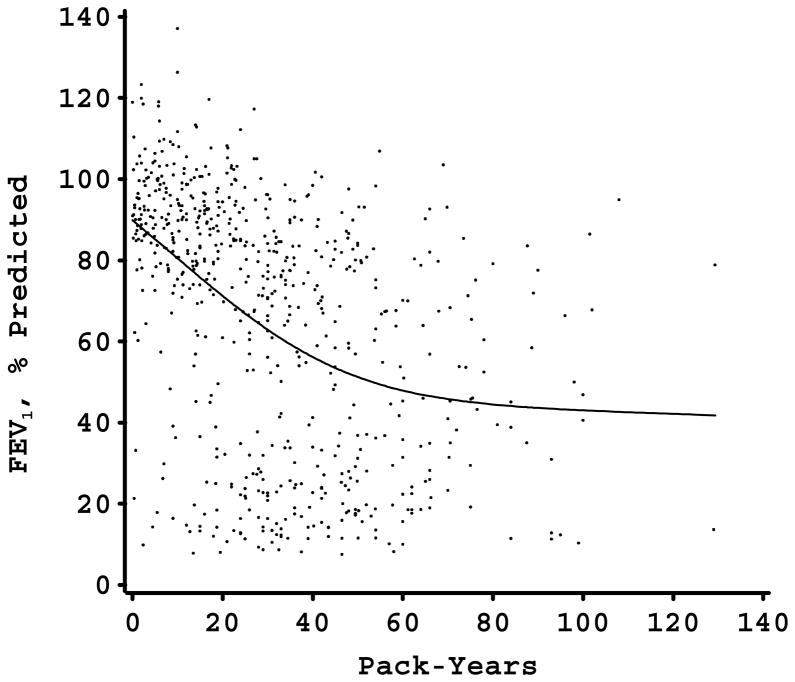
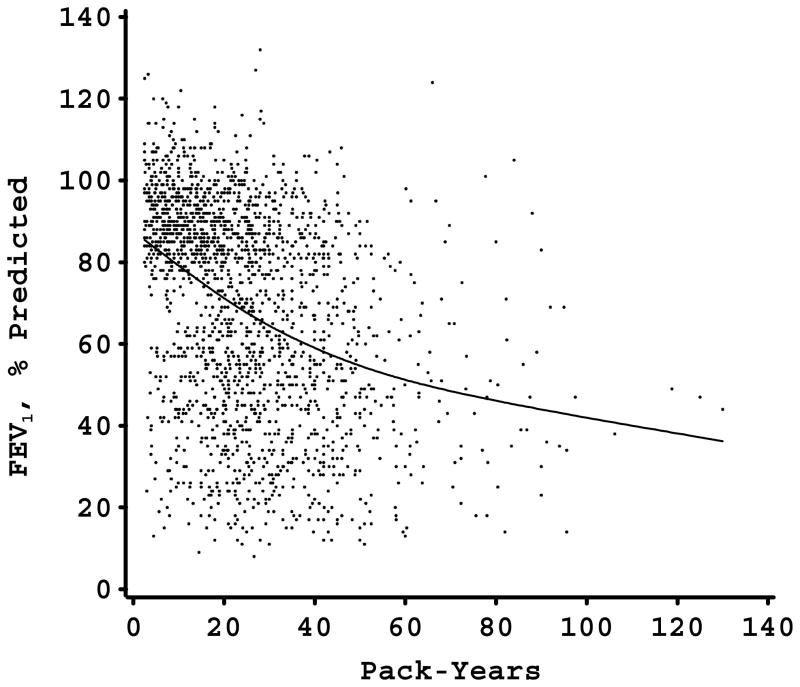
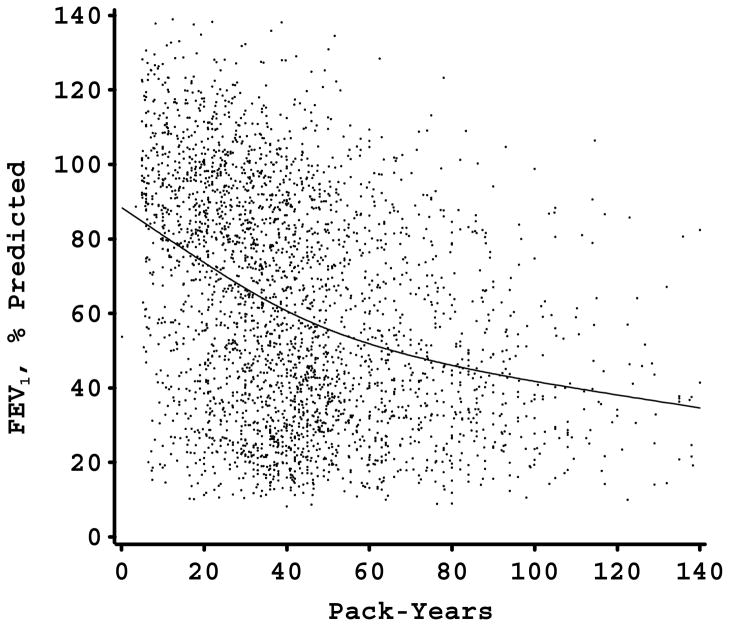
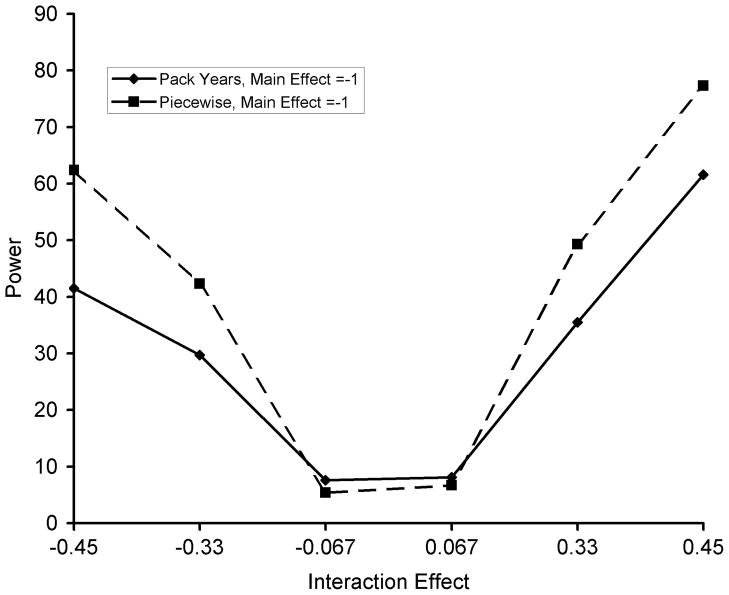
Methods: The relationship between FEV(1) and pack-years of smoking exposure was examined in four large cohorts assembled for the purpose of identifying genetic associations with COPD. Using data from the Alpha-1 Antitrypsin Genetic Modifiers Study, the accuracy and power of two different approaches to model smoking were compared by performing a simulation study of a genetic variant with a range of gene-by-smoking interaction effects.
Results: Non-linear relationships between smoking and FEV(1) were identified in the four cohorts. It was found that, in most situations where the relationship between pack-years and FEV(1) is non-linear, a piecewise linear approach to model smoking and gene-by-smoking interactions is preferable to the commonly used total pack-years approach. The piecewise linear approach was applied to a genetic association analysis of the PI*Z allele in the Norway Case-Control cohort and a potential PI*Z-by-smoking interaction was identified (p=0.03 for FEV(1) analysis, p=0.01 for COPD susceptibility analysis).
Conclusion: In study samples of subjects with a wide range of COPD severity, a non-linear relationship between pack-years of smoking and FEV(1) is likely. In this setting, approaches that account for this non-linearity can be more powerful and less biased than the more common approach of using total pack-years to model the smoking effect.
Conflict of interest statement
PDP served on the Advisory Board for Talecris Biotherapeutics and received grant support from GSK, Merck, $100,001 or more, the NIH $50,001–$100,000, CIHR (Canada), and AllerGenNCE $100,001 or more.
Figures
Comment in
-
A spline for the time.Thorax. 2011 Oct;66(10):841-2. doi: 10.1136/thx.2010.154195. Epub 2011 May 26. Thorax. 2011. PMID: 21617170 No abstract available.
References
-
- Rachet B, Siemiatycki J, Abrahamowicz M, Leffondre K. A flexible modeling approach to estimating the component effects of smoking behavior on lung cancer. Journal of Clinical Epidemiology. 2004;57(10):1076–1085. - PubMed
-
- Hoffmann K, Bergmann MM. Re: “Modeling smoking history: a comparison of different approaches”. American Journal of Epidemiology. 2003;158(4):393–394. - PubMed
-
- Dockery DW, Speizer FE, Ferris BG, Jr, Ware JH, Louis TA, Spiro A., III Cumulative and reversible effects of lifetime smoking on simple tests of lung function in adults. American Review of Respiratory Disease. 1988;137(2):286–292. - PubMed
-
- Burrows B, Knudson RJ, Cline MG, Lebowitz MD. Quantitative relationships between cigarette smoking and ventilatory function. American Review of Respiratory Disease. 1977;115(2):195–205. - PubMed
-
- Xu X, Dockery DW, Ware JH, Speizer FE, Ferris BG., Jr Effects of cigarette smoking on rate of loss of pulmonary function in adults: a longitudinal assessment. American Review of Respiratory Disease. 1992;146(5 Pt 1):1345–1348. - PubMed
Publication types
MeSH terms
Substances
Grants and funding
LinkOut - more resources
Full Text Sources
Medical
Research Materials
Miscellaneous
