Safety and effectiveness of central venous catheterization in patients with cancer: prospective observational study
- PMID: 21165289
- PMCID: PMC2995228
- DOI: 10.3346/jkms.2010.25.12.1748
Safety and effectiveness of central venous catheterization in patients with cancer: prospective observational study
Abstract
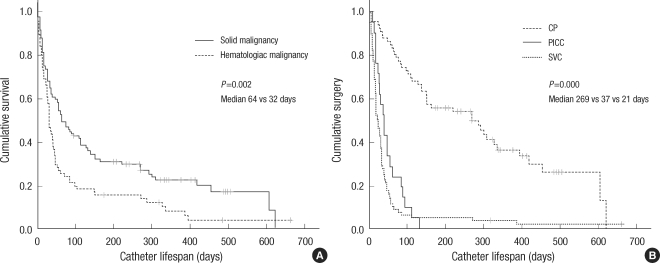
This study investigated the safety and effectiveness of each type of central venous catheters (CVC) in patients with cancer. We prospectively enrolled patients with cancer who underwent catheterization involving a subclavian venous catheter (SVC), peripherally inserted central venous catheter (PICC), or chemo-port (CP) in our department. From March 2007 to March 2009, 116 patients underwent 179 episodes of catheterization. A SVC was inserted most frequently (46.4%). Fifty-four complications occurred (30.1%): infection in 23 cases, malpositioning or migration of the tip in 18 cases, thrombosis in eight cases, and bleeding in five cases. Malpositioning or migration of the tip occurred more frequently with a PICC (P<0.001); infection occurred more often with a tunneled catheter (P=0.028) and was observed more often in young patients (P=0.023). The catheter life span was longer for patients with solid cancer (P=0.002) than for those with hematologic cancer, with a CP (P<0.001) than a PICC or SVC, and for an indwelling catheter with image guidance (P=0.014) than a blind procedure. In conclusion, CP is an effective tool for long term use and the fixation of tip is important for the management of PICC.
Keywords: Catheterization, Central Venous; Complications; Neoplasms.
Figures
References
-
- Scott WL. Central venous catheters. An overview of Food and Drug Administration activities. Surg Oncol Clin N Am. 1995;4:377–393. - PubMed
-
- Mansfield PF, Hohn DC, Fornage BD, Gregurich MA, Ota DM. Complications and failures of subclavian-vein catheterization. N Engl J Med. 1994;331:1735–1738. - PubMed
-
- Yildizeli B, Laçin T, Batirel HF, Yüksel M. Complications and management of long-term central venous access catheters and ports. J Vasc Access. 2004;5:174–178. - PubMed
-
- Cortelezzia A, Fracchiolla NS, Maisonneuve P, Moia M, Luchesini C, Ranzi ML, Monni P, Pasquini MC, Lambertenghi-Deliliers G. Central venous catheter-related complications in patients with hematological malignancies: a retrospective analysis of risk factors and prophylactic measures. Leuk Lymphoma. 2003;44:1495–1501. - PubMed
-
- McGee DC, Gould MK. Preventing complications of central venous catheterization. N Engl J Med. 2003;348:1123–1133. - PubMed
MeSH terms
LinkOut - more resources
Full Text Sources
Medical
Miscellaneous