


Effects of smoking and smoking cessation on lipids and lipoproteins: outcomes from a randomized clinical trial
- PMID: 21167347
- PMCID: PMC3110741
- DOI: 10.1016/j.ahj.2010.09.023
Effects of smoking and smoking cessation on lipids and lipoproteins: outcomes from a randomized clinical trial
Abstract
Background: the effects of smoking and smoking cessation on lipoproteins have not been studied in a large contemporary group of smokers. This study was designed to determine the effects of smoking cessation on lipoproteins.
Methods: this was a 1-year, prospective, double-blind, randomized, placebo-controlled clinical trial of the effects of 5 smoking cessation pharmacotherapies. Fasting nuclear magnetic resonance spectroscopy lipoprotein profiles were obtained before and 1 year after the target smoking cessation date. The effects of smoking cessation and predictors of changes in lipoproteins after 1 year were identified by multivariable regression.
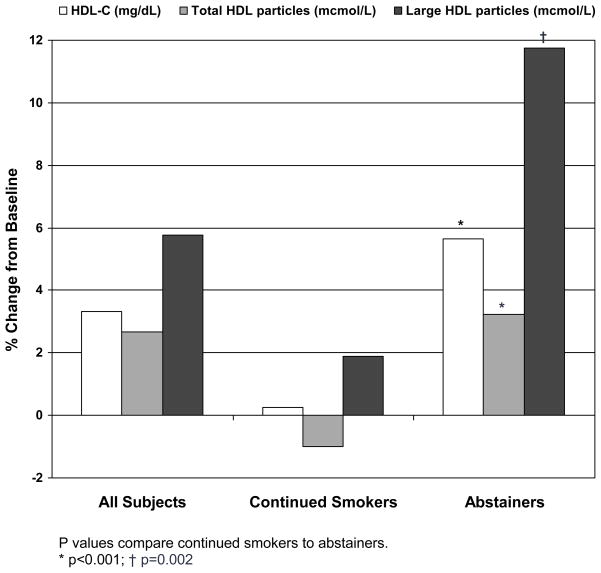
Results: the 1,504 current smokers were (mean [SD]) 45.4 (11.3) years old and smoked 21.4 (8.9) cigarettes per day at baseline. Of the 923 adult smokers who returned at 1 year, 334 (36.2%) had quit smoking. Despite gaining more weight (4.6 kg [5.7] vs 0.7 kg [5.1], P < .001], abstainers had increases in high-density lipoprotein cholesterol (HDL-C) (2.4 [8.3] vs 0.1 [8.8] mg/dL, P < .001), total HDL (1.0 [4.6] vs -0.3 micromol/L [5.0], P < .001), and large HDL (0.6 [2.2] vs 0.1 [2.1] micromol/L, P = .003) particles compared with continuing smokers. Significant changes in low-density lipoprotein (LDL) cholesterol and particles were not observed. After adjustment, abstinence from smoking (P < .001) was independently associated with increases in HDL-C and total HDL particles. These effects were stronger in women.
Conclusions: despite weight gain, smoking cessation improved HDL-C, total HDL, and large HDL particles, especially in women. Smoking cessation did not affect LDL or LDL size. Increases in HDL may mediate part of the reduced cardiovascular disease risk observed after smoking cessation.
Conflict of interest statement
AD Gepner, ME Piper, HM Johnson, JH Stein - no conflicts to disclose.
MC Fiore - Over the last three years, Dr Fiore has served as an investigator in research studies at the University of Wisconsin that were funded by Pfizer, GlaxoSmithKline and Nabi Biopharmaceuticals. In 1998, the University of Wisconsin (UW) appointed Dr. Fiore to a named Chair funded by an unrestricted gift to UW from Glaxo Wellcome.
TB Baker – Research grants from Pfizer, GlaxoSmithKline, Nabi Biopharmaceuticals, and Sanofi.
Figures
References
-
- Center for Disease Control and Prevention. Smoking-Attributable Mortality, Years of Potential Life Lost, and Productivity Losses - United States. 2002–2004 [accessed 2009 Apr 8] Morbidity and Mortality Weekly Report. 2008;57:1226–28. - PubMed
-
- American Heart Association. Heart Disease and Stroke Statistics--2009 Update. Dallas, TX: American Heart Association; 2009.
-
- Freund KM, Belanger AJ, D’Agostino RB, et al. The health risks of smoking. The Framingham Study: 34 years of follow-up. Ann Epidemiol. 1993;3:417–24. - PubMed
-
- Ambrose JA, Barua RS. The pathophysiology of cigarette smoking and cardiovascular disease: an update. J Am Coll Cardiol. 2004;43:1731–37. - PubMed
Publication types
MeSH terms
Substances
Grants and funding
LinkOut - more resources
Full Text Sources
Medical
