


Role of prostate specific antigen and immediate confirmatory biopsy in predicting progression during active surveillance for low risk prostate cancer
- PMID: 21167529
- PMCID: PMC3417207
- DOI: 10.1016/j.juro.2010.09.095
Role of prostate specific antigen and immediate confirmatory biopsy in predicting progression during active surveillance for low risk prostate cancer
Abstract
Purpose: We evaluated predictors of progression after starting active surveillance, especially the role of prostate specific antigen and immediate confirmatory prostate biopsy.
Materials and methods: A total of 238 men with prostate cancer met active surveillance eligibility criteria and were analyzed for progression with time. Cox proportional hazards regression was used to evaluate predictors of progression. Progression was evaluated using 2 definitions, including no longer meeting 1) full and 2) modified criteria, excluding prostate specific antigen greater than 10 ng/ml as a criterion.
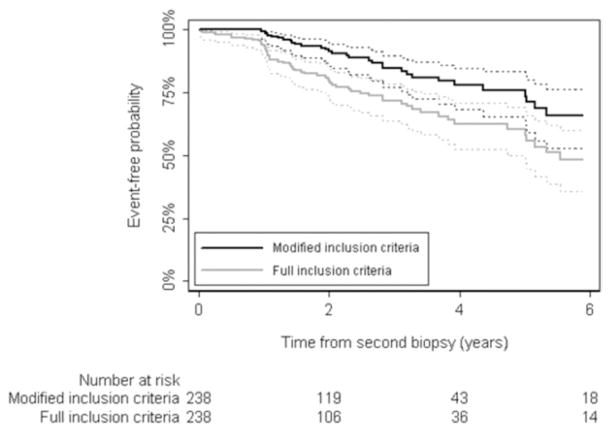
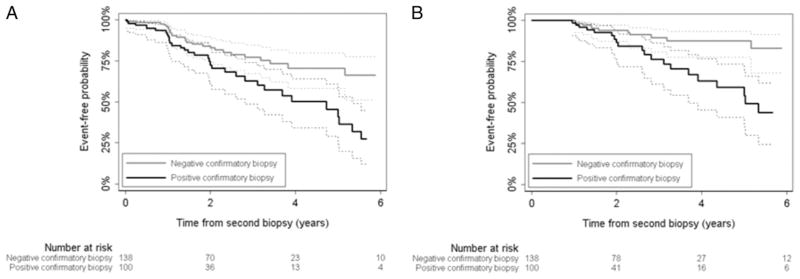
Results: Using full criteria 61 patients progressed during followup. The 2 and 5-year progression-free probability was 80% and 60%, respectively. With prostate specific antigen included in progression criteria prostate specific antigen at confirmatory biopsy (HR 1.29, 95% CI 1.14-1.46, p <0.0005) and positive confirmatory biopsy (HR 1.75, 95% CI 1.01-3.04, p = 0.047) were independent predictors of progression. Of the 61 cases 34 failed due to increased prostate specific antigen, including only 5 with subsequent progression by biopsy criteria. When prostate specific antigen was excluded from progression criteria, only 32 cases progressed, and 2 and 5-year progression-free probability was 91% and 76%, respectively. Using modified criteria as an end point positive confirmatory biopsy was the only independent predictor of progression (HR 3.16, 95% CI 1.41-7.09, p = 0.005).
Conclusions: Active surveillance is feasible in patients with low risk prostate cancer and most patients show little evidence of progression within 5 years. There is no clear justification for treating patients in whom prostate specific antigen increases above 10 ng/ml in the absence of other indications of tumor progression. Patients considering active surveillance should undergo confirmatory biopsy to better assess the risk of progression.
Copyright © 2011 American Urological Association Education and Research, Inc. Published by Elsevier Inc. All rights reserved.
Figures
Comment in
-
Prostate cancer: Active surveillance for low-risk disease: who will benefit most?Nat Rev Urol. 2011 Feb;8(2):60. doi: 10.1038/nrurol.2010.243. Nat Rev Urol. 2011. PMID: 21460810 No abstract available.
References
-
- Eastham JA. Active surveillance for prostate cancer with selective delayed definitive therapy. Clin Prostate Cancer. 2005;4:45. - PubMed
-
- Patel MI, DeConcini DT, Lopez-Corona E, et al. An analysis of men with clinically localized prostate cancer who deferred definitive therapy. J Urol. 2004;171:1520. - PubMed
Publication types
MeSH terms
Substances
Grants and funding
LinkOut - more resources
Full Text Sources
Medical
Miscellaneous
