


Short-term change in growth of uterine leiomyoma: tumor growth spurts
- PMID: 21168581
- PMCID: PMC4137966
- DOI: 10.1016/j.fertnstert.2010.05.011
Short-term change in growth of uterine leiomyoma: tumor growth spurts
Abstract
Objective: To describe the short-term changes in growth of uterine leiomyomas (fibroids).
Design: Prospective observational study.
Setting: University research center.
Patient(s): Premenopausal women with fibroids (18 blacks and 18 whites) recruited through a physician network and community outreach.
Intervention(s): Not applicable.
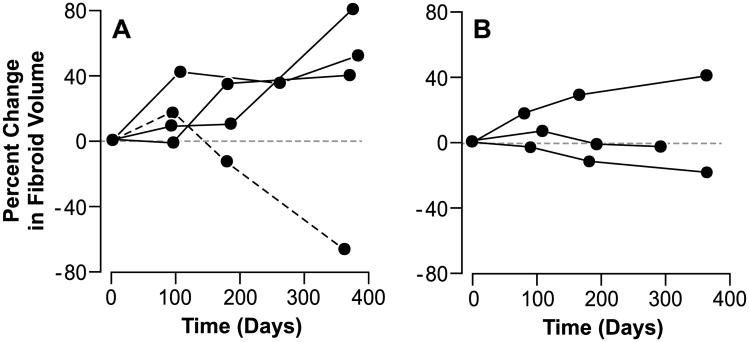
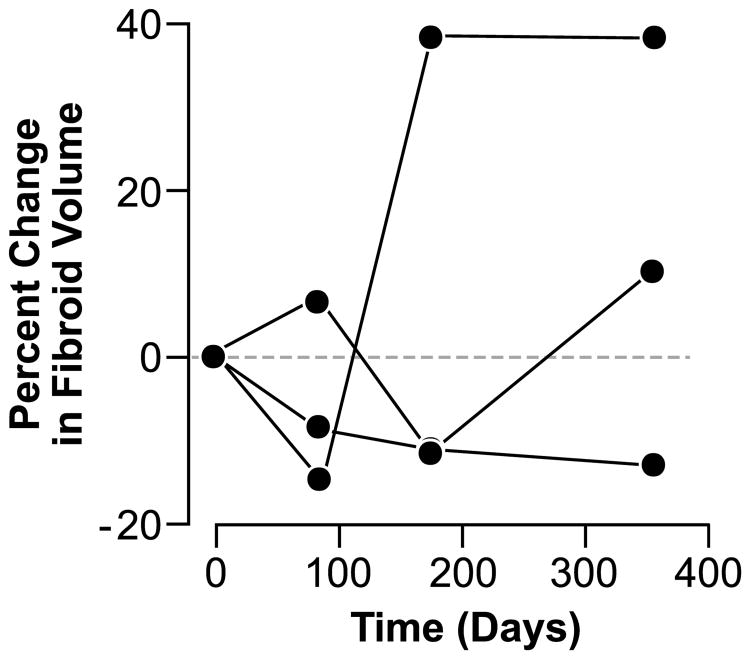
Main outcome measure(s): The volumes of 101 fibroids were measured at enrollment, 3, 6, and 12 months with magnetic resonance imaging, resulting in three interval-specific growth rates. Growth spurts were defined by interval growth rates≥30% per 3 months and substantially greater than during other intervals of observation. An overall measure of short-term change in fibroid growth was calculated as the variance of the three interval-specific growth rates.
Result(s): Growth spurts were observed in 37 of the 101 fibroids, a prevalence nearly tenfold higher than that attributable to potential measurement error. Fibroids from the same woman did not have similar short-term growth, nor were woman-specific factors (age, race/ethnicity, parity, body mass) or the fibroid position in the uterus important. However, large fibroids (>5 cm diameter) had less short-term change than smaller fibroids.
Conclusion(s): Short spurts of growth are common for fibroids, suggesting that tumor biology may change rapidly.
Published by Elsevier Inc.
Figures
References
-
- Stewart EA. Uterine fibroids. Lancet. 2001;357:293–8. - PubMed
-
- Farquhar CM, Steiner CA. Hysterectomy rates in the United States 1990-1997. Obstetrics and gynecology. 2002;99:229–34. - PubMed
-
- Flynn M, Jamison M, Datta S, Myers E. Health care resource use for uterine fibroid tumors in the United States. American journal of obstetrics and gynecology. 2006;195:955–64. - PubMed
-
- Kawaguchi K, Fujii S, Konishi I, Nanbu Y, Nonogaki H, Mori T. Mitotic activity in uterine leiomyomas during the menstrual cycle. American journal of obstetrics and gynecology. 1989;160:637–41. - PubMed
-
- Fujita M. Histological and biochemical studies of collagen in human uterine leiomyomas. [Hokkaido igaku zasshi] The Hokkaido journal of medical science. 1985;60:602–15. - PubMed
Publication types
MeSH terms
Substances
Supplementary concepts
Grants and funding
LinkOut - more resources
Full Text Sources
Medical
