


Proliferating cell nuclear antigen (PCNA): a key factor in DNA replication and cell cycle regulation
- PMID: 21169293
- PMCID: PMC3091797
- DOI: 10.1093/aob/mcq243
Proliferating cell nuclear antigen (PCNA): a key factor in DNA replication and cell cycle regulation
Abstract
Background: PCNA (proliferating cell nuclear antigen) has been found in the nuclei of yeast, plant and animal cells that undergo cell division, suggesting a function in cell cycle regulation and/or DNA replication. It subsequently became clear that PCNA also played a role in other processes involving the cell genome.
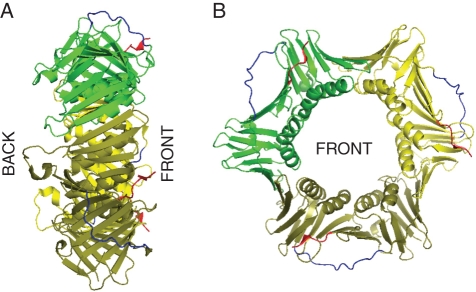
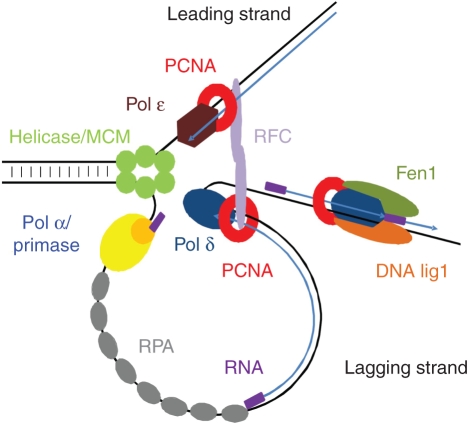
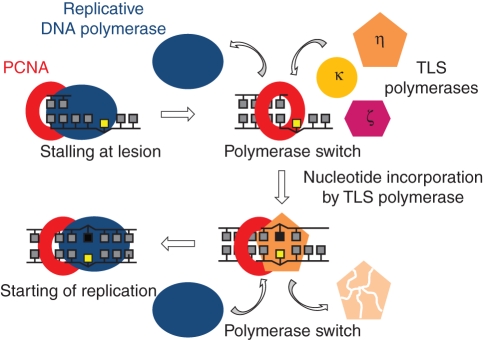
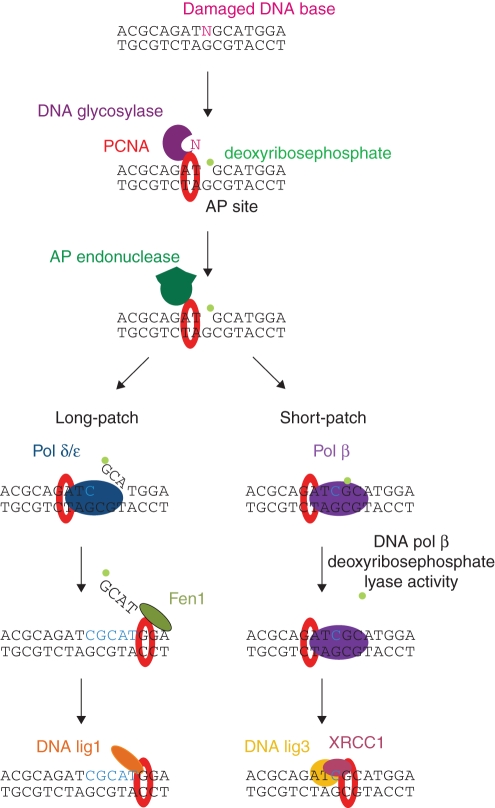
Scope: This review discusses eukaryotic PCNA, with an emphasis on plant PCNA, in terms of the protein structure and its biochemical properties as well as gene structure, organization, expression and function. PCNA exerts a tripartite function by operating as (1) a sliding clamp during DNA synthesis, (2) a polymerase switch factor and (3) a recruitment factor. Most of its functions are mediated by its interactions with various proteins involved in DNA synthesis, repair and recombination as well as in regulation of the cell cycle and chromatid cohesion. Moreover, post-translational modifications of PCNA play a key role in regulation of its functions. Finally, a phylogenetic comparison of PCNA genes suggests that the multi-functionality observed in most species is a product of evolution.
Conclusions: Most plant PCNAs exhibit features similar to those found for PCNAs of other eukaryotes. Similarities include: (1) a trimeric ring structure of the PCNA sliding clamp, (2) the involvement of PCNA in DNA replication and repair, (3) the ability to stimulate the activity of DNA polymerase δ and (4) the ability to interact with p21, a regulator of the cell cycle. However, many plant genomes seem to contain the second, probably functional, copy of the PCNA gene, in contrast to PCNA pseudogenes that are found in mammalian genomes.
Figures
References
-
- Aboussekhra A, Wood RD. Detection of nucleotide excision repair incisions in human fibroblasts by immunostaining for PCNA. Experimental Cell Research. 1995;221:326–332. - PubMed
-
- Aboussekhra A, Biggerstaff M, Shivji MK, et al. Mammalian DNA nucleotide excision repair reconstituted with purified protein components. Cell. 1995;80:859–868. - PubMed
-
- Ade J, Belzile F, Philippe H, Doutriaux MP. Four mismatch repair paralogues coexist in Arabidopsis thaliana: AtMSH2, AtMSH3, AtMSH6-1 and AtMSH6-2. Molecular and General Genetics. 1999;262:239–249. - PubMed
-
- Ade J, Haffani Y, Beizile FJ. Functional analysis of the Arabidopsis thaliana mismatch repair gene MSH2. Genome. 2001;44:651–657. - PubMed
Publication types
MeSH terms
Substances
LinkOut - more resources
Full Text Sources
Other Literature Sources
Molecular Biology Databases
Miscellaneous
